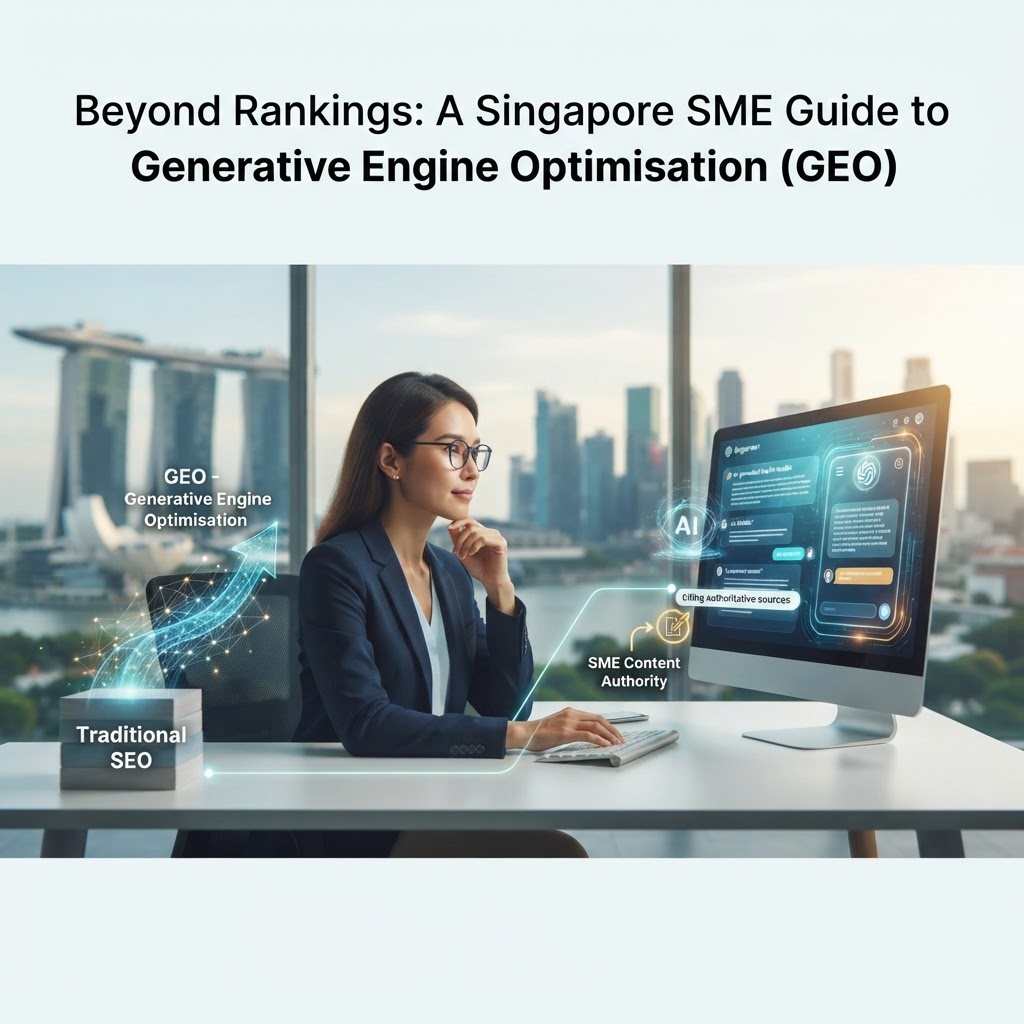
Beyond Rankings: A Singapore SME Guide to Generative Engine Optimisation (GEO)
In the rapidly shifting landscape of digital search, the traditional model of relying solely on blue links is no longer sufficient for local businesses. As AI Overviews, ChatGPT, and other conversational interfaces become the primary way potential customers discover brands, Singapore SMEs must adapt to a new paradigm known as Generative Engine Optimisation (GEO). Unlike traditional search engine optimisation, which focuses on winning a spot in a ranked list, GEO prioritises becoming the authoritative source that AI models cite. For a business owner, this transition is critical to maintaining visibility in an era where the browser is no longer the sole gateway to information. At iPro Dezign, our team helps companies navigate this technical transition, ensuring that your digital footprint remains relevant as search engines move from indexing content to synthesising it. Understanding how to structure your data for these new interfaces can mean the difference between being a forgotten link and a trusted answer for your local audience.
Table of Contents
Understanding the Shift to Generative Engine Optimisation
Generative Engine Optimisation represents a fundamental change in how information is retrieved and processed by consumers. Historically, search engines acted as directories, providing lists of websites for users to investigate. Today, Generative AI engines perform the role of a researcher, parsing data across thousands of sites to generate a concise, synthesized answer directly on the results page. For Singaporean enterprises, this means your visibility now depends on how easily AI systems can crawl, interpret, and trust your information. If your site structure is outdated or your content is not semantically clear, you risk being bypassed entirely by AI tools. Our experience indicates that successful GEO strategies require a shift in perspective; you are no longer just writing for a search algorithm, but positioning your business as a subject matter expert that AI models feel confident citing. The objective is to make your business data both machine-readable and highly authoritative, which requires a clean, structured approach to web development and data hierarchy. When an AI generates an overview about services in Singapore, such as digital marketing or eCommerce logistics, it looks for specific signals—such as verified business details, clear service definitions, and consistent NAP information (Name, Address, Phone number). These signals confirm to the AI that your entity is a legitimate, high-authority source. By focusing on entity-based SEO, where you explicitly define your business roles, service offerings, and local connections through schema markup, you increase the likelihood of your content being included in these AI-generated responses. This is not about tricks or shortcuts, but about building a robust digital foundation that speaks the language of modern machine learning models. Our team at iPro Dezign focuses on these structural requirements to ensure that your business stays at the forefront of the information synthesis process.
Building a Technical Foundation for AI Readiness
Technical excellence is the silent engine behind successful visibility in the modern search environment. Before an AI can cite your content, it must be able to crawl your website without technical hurdles. This involves ensuring your site architecture is logical and fast. Core Web Vitals—a set of metrics that measure how users experience the speed and stability of a webpage—are more important than ever. If your site takes too long to load or experiences layout shifts, search bots may struggle to index your content effectively. We often see Singapore SMEs struggling with bloated, legacy websites that were built years ago without consideration for modern mobile-first indexing or server performance. Upgrading to a modern, lightweight, and headless CMS architecture allows your content to be served with minimal friction, which is highly favoured by AI scrapers. Furthermore, security is a non-negotiable factor. Ensuring your site is fully encrypted and compliant with the PDPA (Personal Data Protection Act) signals trust to both human visitors and automated systems. A secure, well-documented website is seen as a safer source of information for generative models. We also recommend auditing your existing code to remove redundant scripts that slow down page load times. This technical refinement is exactly where SME grants, such as the PSG (Productivity Solutions Grant), can provide immense value. By utilising available grants, your business can invest in a high-performance web build that covers up to 50% of the costs, significantly improving your ability to compete in the digital space. Consider the following table which compares traditional SEO technical focus versus the broader requirements of an AI-ready GEO framework.
| Metric | Traditional SEO Focus | Modern GEO Focus |
|---|---|---|
| Speed | Good for users | Critical for AI crawling efficiency |
| Data Structure | Basic Meta tags | Rich Semantic Markup (Schema.org) |
| Accessibility | Human usability | Machine-readable entity mapping |
| Security | Baseline protection | High-trust, verifiable credentials |
By aligning these technical aspects, you create an environment where search engines perceive your business as a reliable, high-speed, and technically sound source, which is the primary requirement for being selected in an AI overview response.
Crafting Content That AI Models Trust
Content strategy in the age of GEO must move beyond keyword density to focus on entity depth and topical authority. While traditional content strategies might have prioritised using a keyword a set number of times per page, generative models look for depth, logic, and factual accuracy. They want to understand the relationship between topics. For example, if you provide accounting services in Singapore, an AI model will look for comprehensive coverage that spans tax filing, business incorporation, and local regulatory compliance. To win, your content must act as a primary source of truth. This means moving away from thin, generic blog posts and towards long-form, evidence-based guides that explain complex topics clearly. Our team at iPro Dezign often advises clients to focus on the ‘E-E-A-T’ framework: Experience, Expertise, Authoritativeness, and Trustworthiness. When you clearly outline your process, share case studies (without inventing data), and reference industry standards, you build the trust signals that AI models use to select their citations. Writing in plain, authoritative English also helps the AI parse your content more easily. Avoid industry jargon that obscures meaning. Instead, define your terms clearly. If you are discussing digital transformation, explain it in the context of Singaporean SME operations to ground the information. This strategy of deep, contextual content helps position your firm as a thought leader. It is also important to maintain consistency across your online profiles. If your website says one thing but your local directory listings say another, the AI will lose confidence in your information. Consistency, therefore, is an element of authority. Regularly updating your content ensures that the information the AI retrieves remains accurate and relevant. By treating your content as a knowledge base rather than a marketing brochure, you provide the precise, structured, and helpful data that AI systems require to generate high-quality summaries, ensuring your brand is consistently the answer suggested to your prospective clients.
Measuring Success in an AI-Driven Search World
Measuring the return on investment in a world where users may never actually visit your website is the newest challenge for digital marketing teams. Traditional metrics like organic traffic from search engines are becoming less representative of actual business impact. In an AI-focused world, we must look at ‘Brand Sentiment’ and ‘Entity Visibility.’ Are people discovering your brand name in AI summaries? Are your product offerings being correctly attributed to your firm? While the data from search consoles is still vital, you must supplement it with direct feedback. Tracking your brand’s presence in common AI queries can provide a new benchmark for success. We suggest focusing on customer enquiries as the primary indicator of performance. When a potential client mentions they found your firm through an AI search, or they arrived with a higher level of knowledge, you are seeing the results of effective GEO. For Singapore SMEs, this often results in a shorter, more efficient sales cycle. Since the AI has already provided the foundational information, your initial discovery calls can focus on specific solutions rather than explaining basic concepts. Furthermore, the cost-efficiency of this approach is significant. A well-optimised, fast-loading website that is structured for machine readability often requires less ongoing maintenance than a site that constantly needs to chase algorithmic changes. By focusing on being a foundational source, you are future-proofing your digital marketing strategy. We help our clients monitor these metrics by integrating advanced tracking that captures touchpoints from AI platforms. This data allows us to make evidence-based decisions about which content pillars to expand and which technical features require further optimisation. Investing in a strategy that prioritises being the best answer, rather than the most-clicked link, ultimately leads to higher quality leads and stronger business outcomes. Partnering with a digital agency that understands this shift is essential for SMEs looking to maintain their competitive edge in the evolving digital landscape.
The transition toward Generative Engine Optimisation is not merely a change in tactics; it is an evolution in how your business defines its digital presence. By focusing on technical speed, structured data, and authoritative content, you position your Singapore SME to thrive in an environment where AI serves as the primary gateway for your customers. Remember, the goal is to be the most helpful, accurate, and accessible source of information in your niche. As these technologies continue to mature, having a partner who understands both the technical architecture of high-performance websites and the nuances of entity-based content is vital. Whether you are looking to modernise your current site, leverage government grants for digital growth, or build a long-term strategy for AI visibility, our team at iPro Dezign is ready to support your journey. We pride ourselves on being a dependable partner for business owners who value clarity, performance, and measurable growth. Let us help you ensure your business is not just found, but trusted, by both the users and the AI models of the future. Contact our team today for a consultation regarding your site performance or to discuss your eligibility for PSG-funded digital upgrades. We are always a call away to assist with your digital transformation.
Frequently Asked Questions
- What is Generative Engine Optimisation? GEO is the process of structuring your content and website so that AI models like ChatGPT and Google AI Overviews can easily index, trust, and cite your information as an authoritative source in their responses.
- How does GEO differ from traditional SEO? While SEO aims to get you a high rank in a list of blue links, GEO focuses on making your business the information provider that AI uses to construct a direct, concise answer for the user.
- Can Singapore SMEs use PSG grants for GEO work? Yes, many digital solutions, including high-performance web development and site structure improvements, fall under the PSG grant framework, which can cover up to 50% of your project costs.
- Do I still need traditional SEO? Yes, traditional SEO remains important, but it is now part of a broader strategy where technical, semantic, and site-speed improvements are necessary to satisfy both classic search engines and modern AI interfaces.
- How can I start implementing GEO today? Begin by ensuring your technical setup is fast and secure, then focus on creating deep, authoritative content that answers common industry questions clearly, while using structured data to help search engines understand your entity.