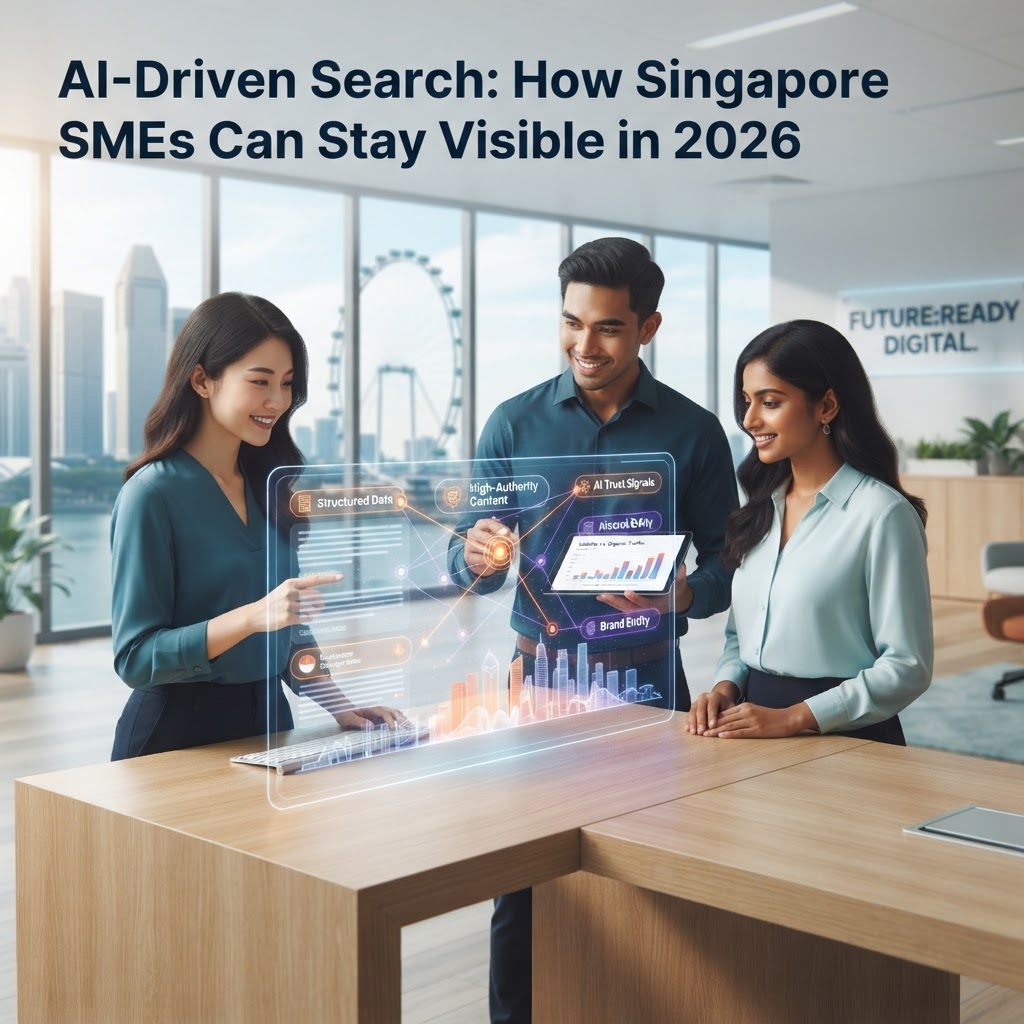
Opening: why 2026 is a turning point for ecommerce SEO in Singapore
Ecommerce competition in Singapore is maturing fast. In 2026, retailers face a mix of smarter algorithms, privacy-driven measurement changes, and buyer expectations shaped by instant, personalised shopping. For merchants and agencies, success no longer rests on generic tactics: it requires platform-level SEO, technical excellence, data-aware attribution, and creative content that converts.
This article outlines actionable priorities for ecommerce teams and digital marketing specialists operating in Singapore. It focuses on practical steps you can standardise across stores, marketplaces, and customer journeys — and highlights how a local seo singapore approach can compound growth.
The 2026 ecommerce SEO landscape in Singapore: what’s changed
Search today is more multimodal and privacy-aware. Generative AI influences content discovery, while visual and voice search are becoming mainstream for product queries. Meanwhile, Google’s continuous updates push user experience signals (Core Web Vitals) and relevance signals (E-E-A-T and entity-based understanding). Local customers expect fast, accurate, and personalised results across desktop, mobile web, and apps.
Key implications:
- Ranking advantage goes to pages that combine technical speed, structured data, and high-converting content.
- First-party data and server-side tracking are essential as third-party cookies decline.
- Marketplaces (Shopee, Lazada) demand separate optimisation strategies alongside your main storefront.
For many teams, partnering with a digital marketing agency singapore accelerates adoption of these practices while avoiding costly trial-and-error.
Technical foundations: site speed, architecture, and headless commerce
Technical SEO is the baseline for higher conversions. In 2026, buyers penalise delays: even small latency increases lower conversion rates significantly.
Actionable technical checklist:
- Prioritise Core Web Vitals: Largest Contentful Paint (LCP) under 2.5s, Cumulative Layout Shift (CLS) < 0.1, and Interaction to Next Paint (INP) improvements.
- Adopt edge/CDN strategies and server-side rendering or hybrid approaches for fast, SEO-friendly pages.
- Evaluate headless commerce for large catalogs — it enables selective rendering, faster checkout flows, and better integration with content platforms.
- Implement server-side tracking and consent-aware analytics to preserve attribution accuracy in a cookieless world.
A focused site speed optimisation program reduces friction and directly improves ranking signals and revenue per visitor.
Product content, schema, and AI: balancing automation with trust
AI-generated descriptions and briefs are now standard, but quality matters. Search engines reward unique product content that answers buyer intent and reduces returns.
Best practices:
- Use AI to generate first drafts, then enrich with human verification: sizing guidance, use cases, comparisons, and warranty/return details.
- Apply product schema (Product, Offer, Review) and granular markup for variants to improve rich result eligibility across Google and marketplaces.
- Keep canonicalisation clear for SKUs sold across multiple pages or sites to avoid duplicate content issues.
- Create intent-driven landing pages for high-value categories (e.g., “waterproof running shoes Singapore”), not just keyword-stuffed category pages.
Combining automated workflows with editorial oversight ensures scale without sacrificing the trust signals search engines look for.
Local, marketplace and omnichannel optimisation
Singapore’s ecommerce ecosystem includes both direct storefronts and vibrant marketplaces. Optimising for both increases reach and resilience.
Tactics for local advantage:
- Optimise Google Business Profile for stores, pop-ups, and warehouses — local signals still feed ecommerce visibility for “near me” and same-day delivery searches.
- Build marketplace-specific listings with tailored titles, bullets, and images; marketplace algorithms value conversion history and relevancy.
- Create cohesive inventory and shipping schemas so search engines and marketplaces surface accurate availability and delivery promises.
For local merchants, working with an experienced ecommerce SEO partner helps map product feeds, sync structured data, and tune listings for each channel.
Links, brand signals, and entity optimisation
Backlinks remain valuable, but modern link-building is more about brand and entity recognition than arbitrary metrics.
Practical steps:
- Seek placements that associate your brand with relevant topics (sustainability, tech specs, gift guides) rather than only chasing domain authority.
- Use PR and partnerships to generate brand mentions, podcast features, and influencer coverage that build topical relevance.
- Ensure consistent NAP (name, address, phone) and brand references across sites, social, and marketplaces to strengthen entity signals.
A local local SEO strategy that aligns PR and content creates durable visibility beyond algorithm tweaks.
Measurement, modelling and privacy-first attribution
With evolving privacy standards, measurement strategies must be flexible. Attribution models that relied on third-party cookies are unreliable. The future is a hybrid of first-party roofs and probabilistic modelling.
Adopt these measurement steps:
- Prioritise first-party tracking at checkout and user registration; enrich with consented CRM signals.
- Use aggregated event measurement and probabilistic matching to fill gaps while staying compliant.
- Test uplift measurement (holdout tests) to quantify SEO-driven revenue, especially when paid and organic paths overlap.
- Integrate on-site experimentation (A/B tests) to validate content layouts and structural changes that affect conversions.
An experienced digital marketing agency singapore can help implement robust attribution frameworks and interpret multi-touch signals for better budget decisions.
Operational scale: automation, taxonomy and governance
Scaling SEO across hundreds or thousands of SKUs requires process and governance.
Operational playbook:
- Define a product taxonomy that aligns SEO keywords with merchant categories and UX navigation.
- Create templated page blueprints for category, product, and collection pages with SEO fields, CTA patterns, and structured data points.
- Automate routine audits (crawl, log, Core Web Vitals) and integrate findings into the product roadmap.
- Establish a content governance model: editorial calendars, AI-use policies, and quality gates for automated descriptions.
This structured discipline reduces technical debt and keeps SEO aligned with product and marketing goals.
Hiring vs partnering: how to choose a digital marketing route
Teams often face the choice: build in-house capability or partner with a specialist. The right approach depends on scale, timeline, and internal skill mix.
Consider partnering when:
- You need rapid implementation of complex technical changes (headless, server-side tracking).
- You require specialised marketplace optimisation or regional knowledge of Singapore consumer patterns.
- You prefer outcome-based contracts that tie agency fees to measurable growth.
For long-term capability, blend both: retain an in-house SEO lead with a specialised digital marketing agency singapore for execution and tooling.
Conclusion: a concise 2026 SEO checklist for Singapore ecommerce
- Audit Core Web Vitals and prioritise fixes that improve LCP, CLS and INP.
- Standardise product schema and unique, intent-driven content across SKUs.
- Implement first-party tracking and privacy-aware attribution frameworks.
- Optimise for marketplaces and local signals alongside your main store.
- Build governance: taxonomy, templates, automation, and human quality checks.
Winning ecommerce SEO in Singapore in 2026 is about combining speed, structured data, privacy-aware measurement, and consistently useful content. These elements reduce friction for buyers and create durable organic growth. Executing them systematically — whether in-house or with a proven seo singapore partner — turns visibility into sustainable revenue and a stronger brand presence.