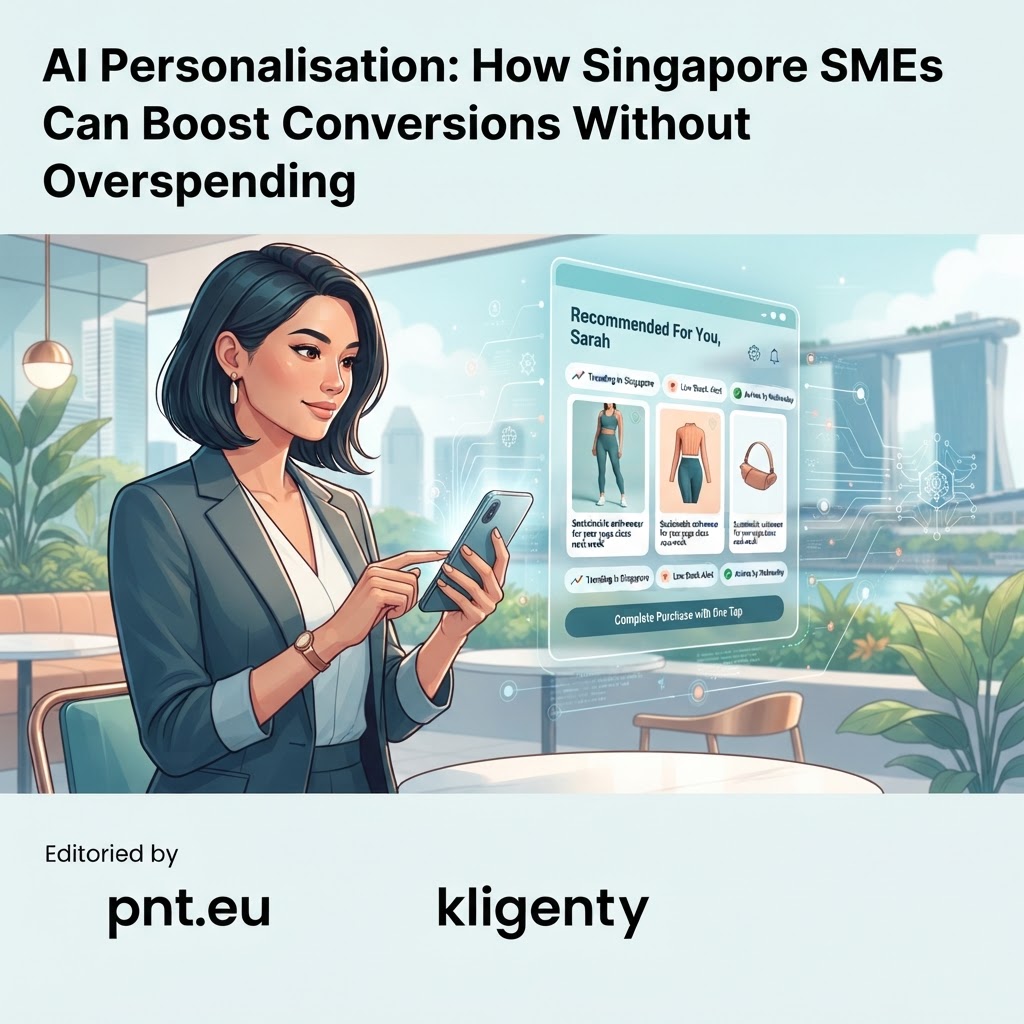
AI-Powered Personalization: Boosting Conversions for Singapore SMEs
Singapore SMEs face a growing challenge: website visitors expect more than generic content. Static pages that show the same offer to everyone no longer hold attention, and attention is the first step toward conversion. AI-powered personalization helps businesses present relevant products, content, and offers based on visitor behaviour, source, and intent — without manual effort for each user. For SMEs competing in a crowded digital market, this shift from one-size-fits-all to adaptive experiences can lift engagement, shorten the path to enquiry, and improve conversion rates meaningfully. In this guide, we explain how personalisation works, where it fits in a Singapore SME’s digital strategy, and how the Productivity Solutions Grant (PSG) can offset up to 50% of eligible project costs when you rebuild or upgrade your website with a registered vendor. Our team at iPro Dezign builds performance-first websites that integrate personalisation responsibly, keeping PDPA compliance and measurable ROI at the centre of every build.
Table of Contents
Why Static Websites No Longer Convert in Singapore’s Digital Market
Singapore’s digital landscape has matured rapidly. Consumers in the APAC region are mobile-first, time-poor, and exposed to dozens of competing tabs before lunch. A static website — one that displays identical content to every visitor regardless of how they arrived, what they searched for, or whether they’ve visited before — struggles to earn attention in this environment. Industry studies consistently show that bounce rates rise sharply when page content doesn’t match visitor intent, and slow, generic pages compound the problem.
For SMEs, the cost of a static site is quiet but real. A visitor who lands on a generic homepage after clicking a Google ad for a specific service may leave within seconds if they don’t immediately see relevance. That’s wasted ad spend, lost trust, and a missed opportunity to start a conversation. The same applies to returning customers who see no acknowledgment of their past interest — no recommended products, no reference to their previous enquiry, no continuity.
The shift toward personalised experiences isn’t a luxury reserved for large enterprises. Tools that were once expensive and complex are now accessible to SMEs through platforms like Shopify Plus, WordPress with personalisation plugins, and headless CMS architectures (a setup where the content management system is separate from the front-end display layer, allowing faster, more flexible content delivery). When built correctly, these systems use visitor data — location, referral source, browsing history, time of day — to adapt what each visitor sees in real time.
The competitive reality is straightforward. If your competitor’s website remembers what a visitor looked at last time and surfaces a relevant offer, while yours shows the same hero banner to everyone, the competitor earns the enquiry. Singapore SMEs that recognise this gap early and rebuild with personalisation in mind position themselves to convert more of the traffic they already pay to attract.
How AI-Powered Personalisation Lifts Engagement and Sales
AI-powered personalization works by analysing visitor behaviour in real time and automatically adjusting content, layout, or offers to match what each visitor is likely to respond to. Unlike manual segmentation — where a marketer creates fixed audience groups and builds separate pages for each — AI-driven systems learn continuously. They detect patterns: which products a returning visitor browsed, which services users from a particular industry tend to view, which call-to-action phrasing converts better with mobile users versus desktop users.
For an SME, this translates into practical outcomes. An accounting firm’s website might surface different service pages depending on whether a visitor arrived via a search for GST registration Singapore or corporate secretarial services. An online retailer might show returning customers a Continue where you left off section with previously viewed products, alongside a personalised recommendation based on their purchase history. A B2B software company might display case studies relevant to a visitor’s industry, inferred from their referral source or initial page interaction.
The mechanics involve several layers. First, data collection — tracking page views, clicks, time on page, and form interactions in a privacy-compliant manner. Second, analysis — the AI engine identifies behavioural patterns and predicts what content or offer will most likely convert a given visitor. Third, delivery — the website dynamically renders the personalised element, whether that’s a product block, a banner, or a tailored enquiry form. Throughout this process, the goal is not gimmickry but relevance: showing the right thing at the right moment.
| Approach | How It Works | Typical Outcome |
|---|---|---|
| Static website | Same content for all visitors | Higher bounce, lower enquiry rate |
| Manual segmentation | Fixed audience groups, separate pages | Better than static, but labour-intensive to maintain |
| AI-powered personalisation | Adaptive content based on real-time behaviour | Higher engagement, more relevant offers, improved conversion |
Typical improvements we’ve observed when personalisation is implemented well include noticeable lifts in time on site, more form submissions, and higher add-to-cart rates for eCommerce stores. These are illustrative outcomes — actual results depend on the client’s industry, traffic quality, and how thoroughly personalisation is integrated. The point is that relevance compounds: every interaction that feels tailored builds trust, and trust drives conversions.
Building a Personalisation Strategy That Complies with PDPA
Personalisation depends on data, and in Singapore, data handling falls under the Personal Data Protection Act (PDPA). SMEs sometimes hesitate to pursue personalisation because they worry about compliance. The good news is that PDPA doesn’t prevent personalisation — it requires that you handle personal data responsibly, with clear consent and purpose. A well-built personalisation strategy works within these rules from the start.
The first step is understanding what data you actually need. Effective personalisation often relies on first-party data — information visitors provide directly or generate through their interactions with your site. This includes pages viewed, products clicked, forms started, and location inferred from IP (within PDPA’s guidance on reasonable use). You don’t need invasive tracking to deliver relevant experiences. In many cases, behavioural data that isn’t personally identifiable — such as visitor viewed three service pages in the accounting category — is enough to personalise effectively.
Second, implement a clear consent mechanism. Singapore’s PDPA requires consent for collecting, using, or disclosing personal data. A well-designed cookie banner that explains what data is collected and why, with a genuine option to decline non-essential cookies, satisfies both legal requirements and visitor trust. Third, be transparent in your privacy policy about how data powers personalisation. Visitors are more comfortable with tailored experiences when they understand the trade-off and feel in control.
From a technical standpoint, our team builds personalisation layers that respect these principles. We configure analytics and personalisation tools to minimise data collection, use secure data storage, and ensure that personalisation logic runs on behaviour patterns rather than sensitive personal information. For SMEs using the PSG grant to fund a website rebuild, this compliance-first approach is especially important — vendors on the PSG list are expected to deliver solutions that meet local regulatory standards.
A practical checklist for PDPA-compliant personalisation:
- Collect only data that serves a defined personalisation purpose
- Display a clear, actionable cookie consent banner
- Document data flows in your privacy policy
- Allow visitors to request data deletion
- Use secure, encrypted storage for any personal data collected
- Review personalisation rules quarterly to ensure they remain proportionate
When built this way, personalisation becomes a trust-building tool rather than a compliance risk. Visitors who feel their data is handled respectfully are more likely to engage, enquire, and return.
Measuring ROI: Tracking Conversions from Personalised Experiences
Building a personalised website is only half the work. The other half — equally important — is measuring whether it actually improves your business outcomes. Without proper tracking, personalisation becomes guesswork, and SMEs cannot afford guesswork when they’re investing in a rebuild, potentially with PSG funding covering up to 50% of eligible costs.
Measurement starts with defining what conversion means for your business. For an eCommerce store, it might be completed purchases, add-to-cart actions, or email sign-ups. For a service business, it might be enquiry form submissions, WhatsApp clicks, or phone calls. For a B2B company, it might be demo requests or document downloads. Each of these actions should be tracked as a goal in Google Analytics 4 (GA4), the current standard for website measurement, which replaced Universal Analytics in 2023.
Once goals are set, you compare performance before and after personalisation. Key metrics to track include:
- Bounce rate: Are visitors staying longer on personalised pages?
- Pages per session: Does relevant content encourage deeper exploration?
- Goal completion rate: Are more visitors completing the actions that matter?
- Average order value: For eCommerce, does personalised product recommendation lift spend?
- Time to conversion: Does relevance shorten the journey from first visit to enquiry?
A practical reporting structure helps SMEs see the picture clearly. We typically set up dashboards that show these metrics side by side — before personalisation, during the first month of implementation, and at the 90-day mark. This timeline reflects how personalisation systems need time to learn: in the first weeks, the AI engine is gathering behavioural data and refining its predictions. Meaningful lifts often appear gradually rather than instantly, which is why a 90-day evaluation window is more honest than a one-week snapshot.
It’s also important to segment your analysis. Personalisation may lift conversions overall but perform differently across visitor types. New visitors might respond well to location-based personalisation (showing Singapore-specific offers), while returning visitors might engage more with previously viewed sections. Breaking down results by segment tells you which personalisation rules are earning their keep and which need adjustment.
For SMEs evaluating whether to invest in a rebuild, the ROI question is direct: if personalised experiences lift enquiry rates or average order value by even a modest margin, the project often pays for itself within months — especially when PSG funding reduces the upfront cost. Our team provides clear measurement frameworks as part of every build, so clients can see exactly what changed and why.
Conclusion
AI-powered personalization is no longer a future-facing concept for Singapore SMEs — it’s a practical response to a market where relevance determines conversion. Static websites lose visitors to competitors who adapt in real time, and ad spend wasted on generic landing pages is spend that could have worked harder. By rebuilding with personalisation in mind, keeping PDPA compliance central, and measuring results against clear goals, SMEs can create digital experiences that feel tailored, build trust, and convert more of the traffic they already attract. With PSG funding available to offset up to 50% of eligible costs for qualifying projects, the barrier to entry is lower than many business owners assume. If you’re weighing whether a personalised rebuild makes sense for your business, our team is always a call away — happy to assess your current site, discuss what’s feasible, and help you make a clear-headed decision. Get a quote or book a PSG consultation today.
Frequently Asked Questions
1. Is AI-powered personalisation suitable for small SMEs, or only large companies?
It suits SMEs well. Modern platforms make personalisation accessible without enterprise budgets. If your site has enough traffic to observe behavioural patterns, personalisation can improve relevance and conversions. Even smaller SMEs benefit from simple rules like location-based offers or returning-visitor prompts.
2. Does the PSG grant cover website rebuilds that include personalisation?
PSG funding can offset up to 50% of eligible costs for qualifying digital solution packages from pre-approved vendors. Website development packages that include personalisation features may qualify, subject to the specific solution and vendor listing. Our team can help you check eligibility before you commit.
3. Will personalisation affect my website’s loading speed?
If built correctly, no. Personalisation logic should run efficiently, and performance-first builds keep Core Web Vitals (Google’s metrics for loading, interactivity, and visual stability) within healthy ranges. We test speed after implementation to ensure relevance doesn’t come at the cost of performance.
4. How much traffic do I need before personalisation works?
There’s no fixed threshold, but personalisation becomes more effective as the AI engine has more behavioural data to learn from. Sites with a few thousand monthly visitors can see meaningful improvements. For very low-traffic sites, starting with simple rule-based personalisation is practical.
5. Is personalisation compatible with PDPA requirements?
Yes, when implemented with consent, transparency, and data minimisation. Personalisation can rely on behavioural data and first-party information collected with clear consent. A compliant cookie banner, a transparent privacy policy, and secure data storage keep your personalisation strategy within PDPA guidelines.