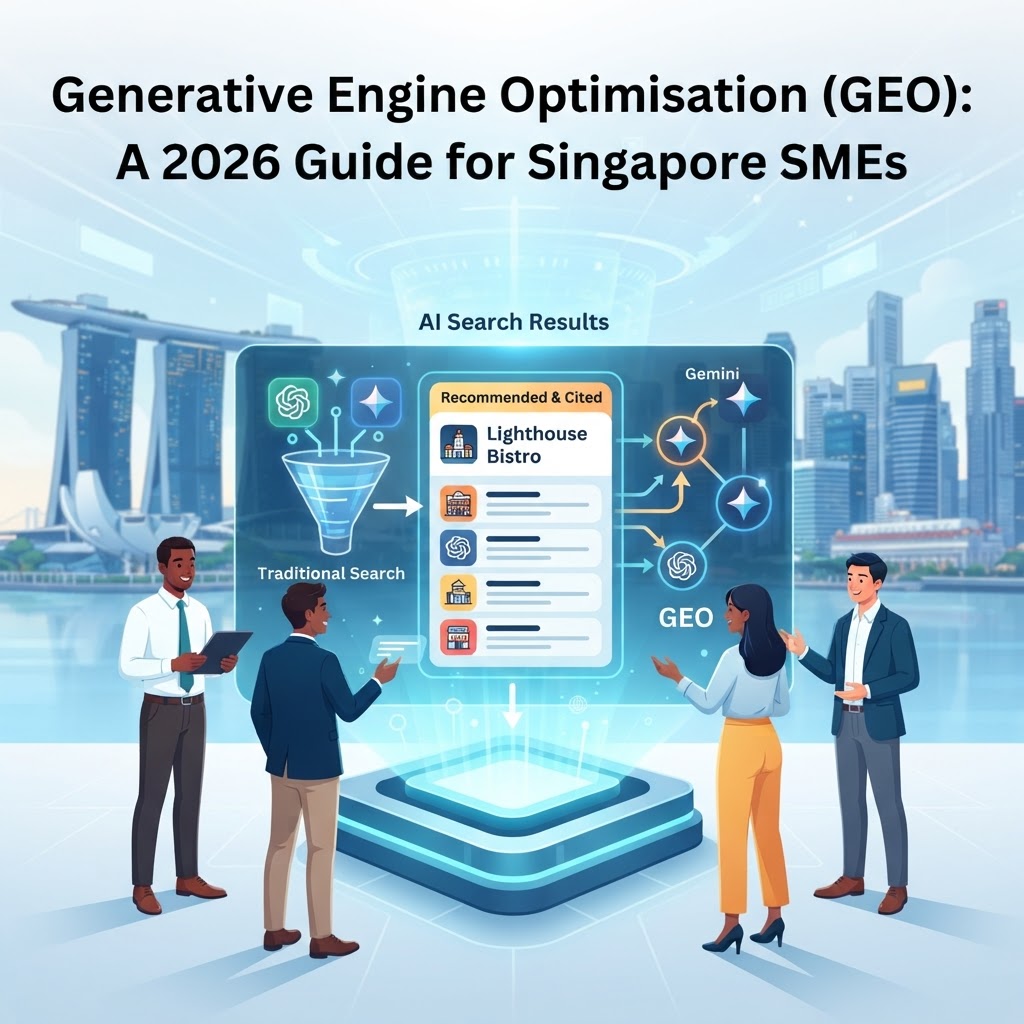
Beyond SEO: Why Singapore SMEs Need Generative Engine Optimization in 2026
For years, Singapore business owners have relied on traditional search engine optimization to bring traffic to their websites. However, the digital landscape in 2026 has shifted dramatically. As AI-powered search interfaces like Google AI Overviews and Perplexity gain traction, classic blue-link search volume is declining. Users are increasingly getting direct, synthesized answers from search engines rather than clicking through to individual websites. This evolution makes Generative Engine Optimization the new priority for Singapore SMEs aiming to maintain visibility and authority in a competitive market. At iPro Dezign, our team helps local businesses navigate this transition by focusing on the technical and structural requirements needed to be cited as a credible source by AI engines. Relying on outdated tactics is no longer enough; you need a proactive strategy to remain the go-to authority in your niche. If you are a local SME looking to future-proof your digital presence, understanding how to appear in AI-generated answers is now the most critical task in your marketing roadmap. Let us explore how your brand can adapt to remain relevant and visible.
Table of Contents
Why Traditional SEO is Changing
The transition away from traditional search is not just a trend; it is a fundamental shift in how people access information. In the past, Google functioned primarily as a directory, connecting users to a list of potential websites. Today, Generative AI models act as a research assistant, reading and synthesizing content to provide a direct answer before a user even decides to scroll. For a Singapore business owner, this means the traffic you once relied on from high-ranking positions in standard search results may become less frequent. When users obtain the information they need from an AI snippet, they are less inclined to click through to your domain unless your content is structured in a way that the AI finds authoritative and useful. This is particularly relevant in the Singapore market, where mobile-first habits and rapid adoption of productivity tools are high. When your digital strategy does not account for this shift, your website essentially becomes invisible to the growing number of users adopting AI-based search tools. Our team observes that while search volume for long-tail queries might remain, the nature of the engagement is changing toward information-gathering rather than shopping-intent clicks. Therefore, simply having a website that ranks for a keyword is no longer the ultimate goal; you must now ensure that your content provides the high-quality, verifiable data that AI models rely on to build their answers. This requires a shift in mindset: moving from targeting search bots to targeting the informational requirements of large language models. This shift requires audit-based content, improved technical performance, and a clear understanding of how these engines value expertise. Adapting to this reality ensures your SME remains a primary source for customers seeking reliable local solutions in an automated, AI-driven internet environment.
What is Generative Engine Optimization
Generative Engine Optimization involves tailoring your website content and structure to be selected as a source by large language models. Unlike traditional optimization, which focuses on keyword density and backlink volume to please an algorithm, this approach prioritizes logical clarity, entity mapping, and trust markers. An AI engine looks for authoritative consensus and structured data to verify facts. If your business is an SME in Singapore, you must ensure your technical foundations, such as schema markup and fast page loads, provide a clean signal for these engines to process your information accurately. For instance, when an AI summarizes a “best digital agency in Singapore” query, it draws from sources it deems reliable, current, and relevant. To be that source, you need to prove your expertise through deep, well-structured content that answers specific user queries rather than generic marketing fluff. This methodology often involves mapping out entity relationships—connecting your brand, your services, your location, and your customer successes in a way that machines can interpret effortlessly. This is a technical process that involves refining how your site is built and presented. We suggest that SMEs move toward a headless content management system or at least a highly optimized performance-first setup to minimize server-side latency. The goal is to provide a rich stream of data that helps the AI model understand who you are, what you offer, and why you are the most trustworthy option in your local context. By focusing on precision and verifiable data, you become the definitive source the AI cites in its overview, effectively placing your brand at the forefront of the user’s intent. This is the new standard of online visibility, and it is crucial for long-term growth.
The following table outlines the key differences between traditional SEO and Generative Engine Optimization strategies for your SME.
| Metric | Traditional SEO | Generative Engine Optimization |
|---|---|---|
| Primary Goal | Keyword Rankings | AI Citation/Source Authority |
| Content Focus | Keyword Frequency | Topical Authority/Truthfulness |
| Data Structure | Standard Meta Data | Rich Schema & Entity Linking |
| Success Indicator | Click-Through Rate | AI Mention & Brand Recall |
| Technical Focus | Backlinks | Data Cleanliness & Speed |
Preparing Your Website for AI
Getting your website ready for an AI-first future begins with a technical audit. If your site suffers from slow load times or bloated code, it will be deprioritized by AI models that value efficient data retrieval. Core Web Vitals, a set of metrics used by Google to measure user experience, are even more important now. An AI system parsing your site needs a seamless experience to index your content effectively. If your server struggles to render pages, you are effectively closing the door to being included in AI overviews. Beyond speed, you must focus on structured data markup. This is a form of code that adds context to your content—telling the engine, for example, that a specific section of text is a price, an address, or a customer review. By implementing robust schema, you help the AI clearly understand your Singapore business details. Furthermore, consider the language and tone of your content. AI models favor authoritative, objective information. Avoid overly promotional language that reads like a sales brochure; instead, provide helpful insights, guides, and clear answers to common problems faced by your clients. This builds topical authority, which is a major signal for search engines. Our agency frequently assists SMEs in Singapore in updating their technical stacks to meet these requirements. With support from the PSG grant, many companies find this a cost-effective way to upgrade their digital infrastructure while improving overall site performance. Remember, AI is not trying to rank you; it is trying to solve a problem for the user. If your content is the most useful solution, the AI will naturally cite you as the authority, thereby sending highly qualified traffic to your site. This is a fundamental change that turns your website from a passive business card into an active, intelligent, and highly reachable information hub.
The Future of SME Digital Growth
Looking ahead to late 2026 and beyond, the competitive advantage for Singapore SMEs lies in the fusion of technology and human expertise. AI can summarize information, but it cannot replace the trust and relationship-building that occurs in a local business interaction. By positioning your SME as a cited expert, you leverage AI to do the heavy lifting of lead qualification. When an AI cites your content as the answer to a prospect’s query, that prospect arrives on your site with a higher level of confidence in your capabilities. This is exactly where our expertise at iPro Dezign comes in. We do not just build websites; we create digital ecosystems designed for the modern search environment. From performance-first web builds that meet strict technical standards to strategic content planning that addresses the nuances of your industry, we handle the technical heavy lifting so you can focus on running your business. We also provide full support for PSG grant applications, allowing Singapore SMEs to access up to 50% funding for their digital transformation projects. This makes it easier to invest in the necessary upgrades—such as high-speed hosting, clean code architecture, and structured data implementation—without overextending your budget. The future of digital growth is about being recognized, and in an AI-dominated world, that recognition is earned through technical excellence and superior content quality. We invite you to have a conversation with our team to discuss your current setup and identify opportunities for optimization. Whether you are a small startup or an established firm, the steps you take today to align with AI search will determine your market position in the coming years. Let us build a resilient digital foundation together that ensures your SME is seen, trusted, and chosen as the primary solution for your customers.
Conclusion
As we navigate the transition into 2026, the rise of AI-driven search is changing how customers interact with Singapore businesses. Generative Engine Optimization is no longer an optional strategy; it is a necessity for SMEs that wish to remain competitive. By shifting your focus from traditional keyword chasing to building topical authority, implementing robust structured data, and ensuring technical performance, you can position your brand as a primary source for AI engines. At iPro Dezign, our team is committed to helping you navigate this shift with professional expertise and results-driven solutions. With the added benefit of government grants like PSG, there has never been a better time to invest in your digital infrastructure. Reach out today for a consultation to learn how we can help your SME thrive in the evolving digital landscape.
FAQ
1. What is the difference between SEO and Generative Engine Optimization? Traditional SEO focuses on ranking in blue links, while GEO focuses on being cited as a trusted source in AI-generated answers.
2. Does AI search kill website traffic? It changes traffic patterns by prioritizing direct answers, but appearing as a cited source can drive higher-quality, more intent-driven traffic to your site.
3. Can I use PSG grants for digital optimization? Yes, many digital marketing and web improvement services are eligible for PSG funding in Singapore, helping SMEs cover significant project costs.
4. How do I make my site more ‘AI-friendly’? Focus on high-speed technical performance, clear structured data, and providing deep, factual answers to industry-specific questions.
5. Should I stop traditional SEO tactics entirely? No, you should integrate GEO with your current strategy to ensure a balanced approach that covers both classic search and emerging AI interfaces.