Why SEO Singapore in 2026 is different
Search in 2026 is no longer just a rankings game — it’s a multi-modal, AI-driven marketplace where visibility extends beyond classic blue links. For companies in Singapore, this means combining time-tested local SEO fundamentals with newer capabilities: AI search optimization, generative engine readiness, and performance-first web experiences. A modern approach to SEO Singapore must bridge traditional organic strategies and the emerging requirements of generative and conversational engines.
Key trends shaping SEO Singapore this year
- AI-first answers and SERP ownership: Search engines increasingly use large language models to deliver direct answers. That shifts share-of-voice away from third-party pages unless your content is structured to feed those models.
- Hyper-local intent: Singapore’s dense urban market rewards hyper-local signals — local schema, NAP consistency, localized content for HDB towns and commercial districts, and Google Business Profile optimization.
- Page experience and Core Web Vitals remain critical: Fast, secure, and accessible sites convert better and are favored for placement in rich results and voice answers.
- Structured data and knowledge graph signals: Schema markup improves the chance of being cited by AI and appearing in featured snippets.
- Privacy and first-party data: With cookies fading, businesses must lean into first-party analytics, consented personalization, and server-side tracking.
These factors combine to make SEO Singapore in 2026 an integrated discipline that requires content, technical, product, and analytics alignment.
Core tactics every digital marketing agency Singapore should master
A professional digital marketing agency Singapore needs to deliver both strategic vision and granular execution across these areas:
- Local visibility: Optimize Google Business Profiles, local citations, and localized landing pages. Build content targeted to specific neighbourhoods and user intents.
- Content engineered for AI: Create concise, factual blocks that answer common queries and are easy to extract. Use clear headings, lists, and data tables.
- Technical excellence: Reduce time-to-first-byte, implement critical CSS, and use server-side rendering where necessary for dynamic JavaScript sites.
- Structured data: Implement schema for FAQs, products, events, and local business details to support extraction by generative engines.
- Conversion optimization: SEO must feed a conversion funnel — from discovery to micro-conversions to revenue.
For practical design and SEO interplay, consider resources that combine web design with SEO tactics like these web design tips to boost SEO Singapore in 2026: https://iprodezign.com/web-design-singapore-tips-to-boost-seo-singapore-2026/.
Preparing content for generative engines and AI search
Generative engines evaluate content differently than traditional crawlers. They prioritize clarity, authority, and machine-readability. To make content usable by AI-driven results:
- Use structured blocks for facts: short paragraphs, bullet lists, Q&A sections, and explicit definitions.
- Add timestamps and version control to rapidly-changing pages so models surface current data.
- Publish clear sources and citations so extractor models can validate claims.
- Optimize semantic relevance rather than keyword density: cover topics in depth and build topical authority.
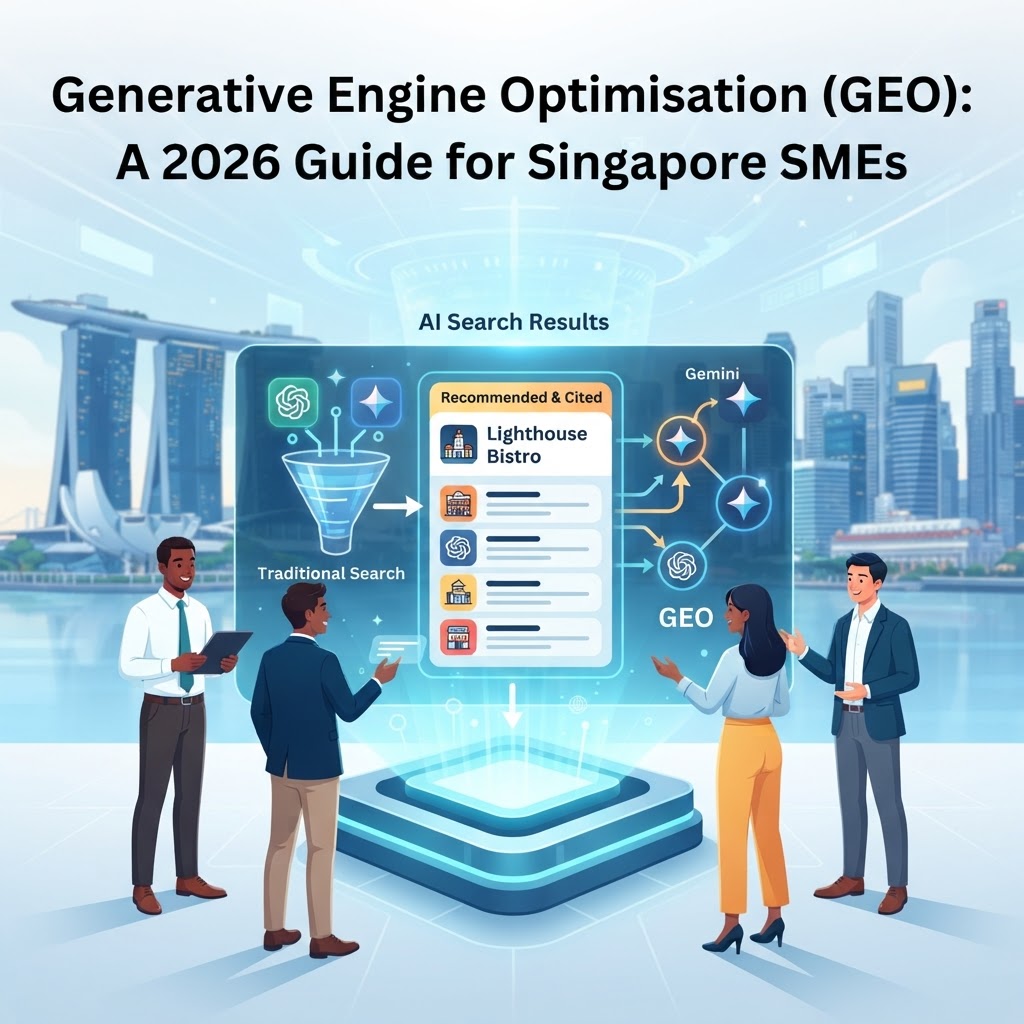
Specialist guidance on adapting for generative systems can help your team execute these changes effectively. A focused guide on generative engine optimization explores tactics specifically for Singapore SMEs: https://iprodezign.com/generative-engine-optimization-singapore-sme-guide-6/ and this complementary resource highlights additional implementation techniques: https://iprodezign.com/generative-engine-optimization-singapore-sme-guide-5/.
Technical SEO priorities for a competitive edge
Technical health underpins every SEO win. Key priorities for 2026:
- Performance: Aim for LCP under 2.5s and a low TTFB. Use image optimization (AVIF/WebP), responsive loading techniques, and selective preloading.
- Accessibility and mobile UX: Ensure all interactive elements are reachable, labelled, and operable on small screens.
- Crawl efficiency: Reduce duplicate content, manage pagination with rel=prev/next where needed, and provide clear sitemaps.
- Structured data hygiene: Maintain consistent schema, avoid mislabelled markup, and test with schema validation tools.
- Indexing for AI: Provide explicit machine-readable summaries for key pages where appropriate.
Integrating web design with technical SEO increases wins — teams that marry design and SEO are better positioned to capture both search and on-site conversions. For practical examples and recommendations, see this guide on web design and SEO: https://iprodezign.com/web-design-singapore-tips-to-boost-seo-singapore-2026/.
Measuring success: metrics that matter in 2026
Classic KPIs still matter, but new signals deserve attention:
- Discovery metrics: organic impressions, visibility in SERP features, and presence in AI answer cards.
- Engagement metrics: dwell time on information-dense pages, scroll depth, and micro-conversion rates.
- Conversion metrics: contact form submissions, e-commerce revenue, assisted conversion paths.
- Share of voice in AI: tracking mentions or citations by search-answer interfaces (where possible) and referral traffic from those widgets.
- Business outcomes: customer acquisition cost, lifetime value, and retention from organic channels.
Dashboards should combine search console data, server logs, product analytics, and first-party CRM signals to provide a full view of SEO performance.
How to choose a digital marketing agency Singapore that delivers
Selecting an agency is about measurable capability, not marketing promises. Look for these traits:
- Case studies with clear results: Agencies should show impact on traffic, conversions, and revenue for Singapore clients.
- Cross-discipline teams: SEO, content, web development, UX and data teams must collaborate daily.
- AI and generative experience: Ask how they prepare content for AI extraction and what tools they use to measure presence in answer features.
- Local market understanding: Singapore’s compact market needs hyper-local strategies that reflect neighbourhood search behaviours.
- Transparent roadmaps and reporting: Regular, outcome-focused reporting with accessible dashboards.
A reputable agency that demonstrates these capabilities is profiled here: https://iprodezign.com/leading-digital-marketing-agency-singapore-web-design-2026/ — use it as a benchmark when evaluating partners.
What modern agency capabilities will accelerate results
A future-ready digital marketing agency Singapore will combine these capabilities:
- AI search optimization: Skills in query intent mapping for conversational assistants, embedding-based retrieval strategies, and prompt-aware content engineering. Learn practical steps in AI search optimization here: https://iprodezign.com/ai-search-optimization-singapore-sme-guide-3/.
- Generative content engineering: Ability to craft seed content that’s accurate, concise, and citation-ready for generative answers (see generative engine optimisation guides linked above).
- Full-stack performance engineering: Frontend and backend teams working to shave milliseconds off every page interaction.
- Data strategy and privacy: Systems to capture and use first-party data ethically and effectively.
- Continuous experimentation: Rapid A/B testing of content forms, metadata, and structured snippets to discover what AI engines prefer.
These capabilities turn search visibility into tangible business outcomes — not just more sessions, but higher-quality leads and closed revenue.
Implementation roadmap for SMEs and in-house teams
A practical phased plan keeps projects manageable and measurable:
- Audit and quick wins (0–30 days): Technical healthcheck, local profile optimisations, and prioritized content patches.
- Foundation (30–90 days): Structured data across primary pages, performance improvements, and topical content hubs.
- AI readiness (90–180 days): Rewriting priority pages into machine-friendly blocks, adding citations, and monitoring answer placements.
- Growth and scaling (6–12 months): Topical cluster expansion, link-building with local authority sites, and conversion rate optimization.
This timeline balances immediate traffic recovery with longer-term authority-building.
Final takeaways
SEO Singapore in 2026 is a hybrid discipline: the basics still drive value, but modern success depends on aligning content and technical systems for AI and generative engines. Businesses and agencies that invest in structured content, performance, and local relevance will capture both traditional search users and the growing volume of AI-driven queries. Use proven frameworks, track the right metrics, and choose a digital marketing partner with demonstrated AI search and web design experience to turn visibility into measurable growth.
Start aligning your SEO Singapore plan with AI-first strategies and partner with a digital marketing agency Singapore that can deliver measurable results.