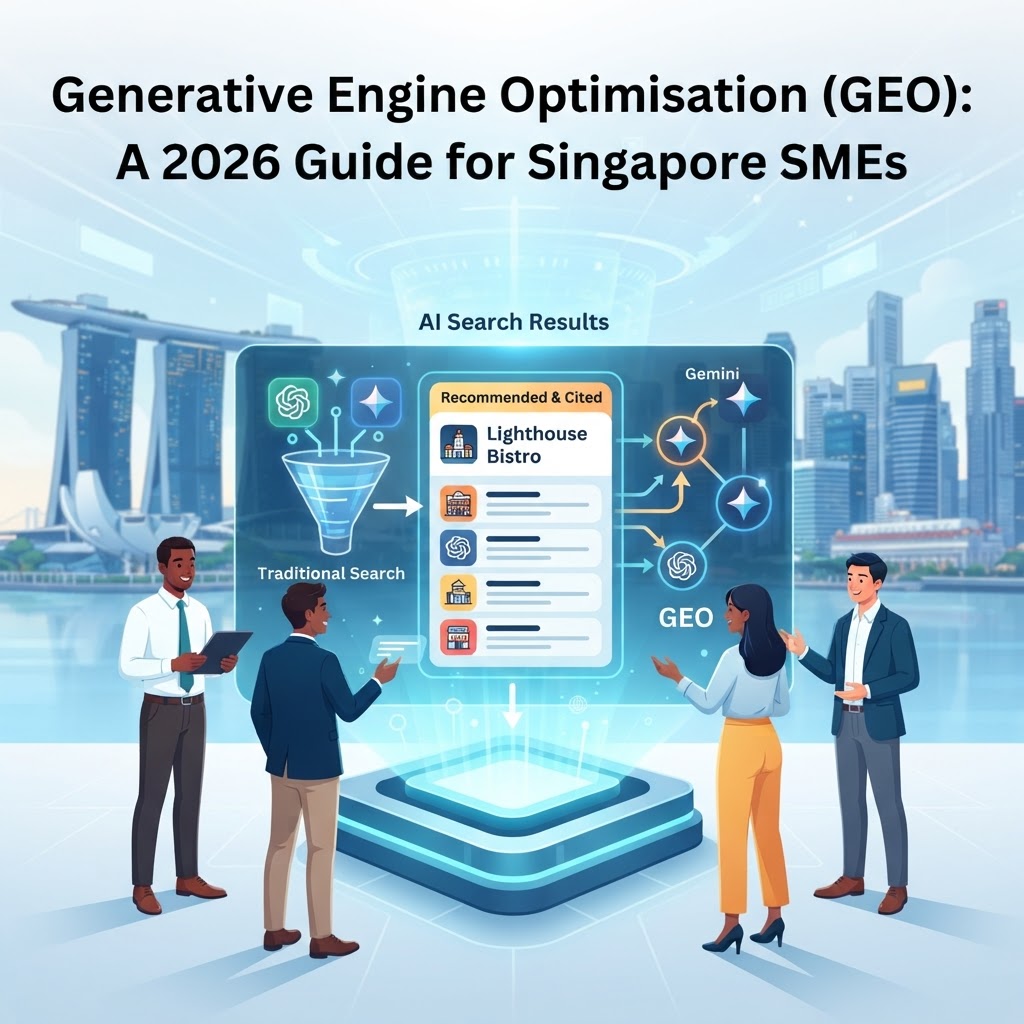
Generative Engine Optimisation (GEO): A 2026 Guide for Singapore SMEs
As we navigate the digital landscape in 2026, the way Singaporean consumers discover local businesses has shifted dramatically. While traditional search engines remain relevant, an increasing number of decision-makers are turning to AI-powered platforms like ChatGPT, Gemini, and Perplexity to source information, compare products, and make final purchasing decisions. This transition necessitates a new approach known as Generative Engine Optimisation (GEO). For local small and medium enterprises (SMEs), failing to adapt to this change means missing out on the primary way future clients seek expertise and services. At iPro Dezign, we specialise in bridging this gap. By focusing on how AI models interpret your brand’s authority, we help you secure citations and recommendations within AI responses. This guide breaks down what GEO entails for your business, why it differs from conventional search tactics, and how you can position your brand to thrive in this AI-first environment. Whether you are looking to modernise your web presence or maximise your digital marketing ROI, understanding these principles is the first step toward sustained growth in an increasingly competitive Singaporean market.
Table of Contents
What is Generative Engine Optimisation?
Generative Engine Optimisation, or GEO, represents a fundamental shift in how digital content is structured and presented for modern AI interfaces. Unlike traditional Search Engine Optimisation (SEO), which focuses on achieving high rankings on a results page, GEO prioritises being cited as a factual, relevant source within an AI-generated answer. When a user asks an AI tool for a recommendation, the tool synthesises data from multiple sources to provide a summary. If your website provides accurate, structured, and high-quality information, the AI is significantly more likely to include your brand as a reference. This requires a transition from keyword-focused content toward topical authority and entity-based information architecture. For Singapore SMEs, this means your digital foundation—your website—must act as an unambiguous data source. It involves using schema markup, which is code that helps search engines understand the context of your content, to clearly define your services, location, and expertise. When an AI crawler visits your site, it should find clear, concise, and structured data that it can easily cross-reference. At iPro Dezign, our team views GEO as the logical evolution of web design, ensuring that every site we build is not only user-friendly but also machine-readable. We focus on clear language, authoritative tone, and precise factual presentation, all of which are essential for building trust with both human readers and artificial intelligence algorithms. By focusing on being the definitive answer to specific industry questions, you create a durable moat against competitors. This approach relies on providing deep, nuanced information that exceeds the standard promotional copy typically found on business websites. By consistently addressing the ‘who, what, when, where, and why’ of your services, you signal to AI engines that your SME is the reliable expert in your particular Singaporean market niche.
Why AI-Driven Search Changes the SME Landscape
In the past, the journey from search to sale usually involved clicking a link, browsing a site, and evaluating a landing page. In the era of AI, that journey is changing. Many users now get their questions answered without ever visiting a traditional website, as the AI synthesises a comprehensive answer directly in the chat interface. For Singapore businesses, this change alters the funnel completely. If your brand is not mentioned in the AI response, you may be missing out on potential customers who consider the AI’s summary to be the final word. This shift is particularly impactful for service-based industries such as professional consulting, digital agencies, and eCommerce. Research indicates that consumers trust information delivered in a direct, conversational format, making the AI’s recommendation highly influential. Furthermore, mobile-first APAC users, who are accustomed to seamless, fast-loading digital experiences, are increasingly favouring AI tools for their convenience. If your website is slow, contains outdated information, or lacks clear contact details, you are effectively invisible to these platforms. We often see clients whose technical infrastructure—such as poorly configured Core Web Vitals, which are metrics that measure loading speed, interactivity, and visual stability—hinders their ability to be indexed correctly. When these factors are neglected, the AI perceives the site as low-quality or non-authoritative. By contrast, an SME that proactively adapts to GEO creates a competitive advantage that is difficult to replicate. This is not about ‘gaming’ the system; it is about providing better, more accessible information that AI models prefer to use. Our team understands that Singapore SMEs often have limited resources, which is why we focus on high-impact, low-maintenance technical fixes that improve both human conversion rates and AI visibility. Aligning your digital strategy with this reality ensures that your brand remains the primary solution for prospective customers in Singapore, regardless of how they search for you.
| Feature | Traditional SEO | Generative Engine Optimisation (GEO) |
|---|---|---|
| Primary Goal | High ranking in search results | Citations within AI summaries |
| Target Audience | Human traffic | Human users and AI models |
| Content Style | Keyword-driven copy | Topical, authoritative information |
| Measurement | Click-through rate (CTR) | Brand mentions and quality traffic |
Core Strategies to Optimise for AI Responses
To succeed in the current market, your website must be built for both clarity and technical precision. The first step involves refining your content strategy to focus on deep topical authority. This means publishing content that answers complex industry questions thoroughly, rather than just chasing search volume. If you run a Singaporean logistics firm, your content shouldn’t just mention ‘shipping services’—it should explain the nuances of local supply chains, customs regulations, and last-mile delivery challenges in detail. AI models look for this depth to verify expertise. Secondly, the technical build of your site is critical. A headless CMS—a backend-only content management system that allows for faster delivery of content to any device—can provide the performance speed and structural flexibility required for AI crawlers to scan your data efficiently. We also recommend auditing your site for PDPA compliance and ensuring your site architecture is intuitive. Third, you must leverage structured data. By implementing schemas, you give the AI a roadmap to your business, clearly identifying your operating hours, service areas in Singapore, and customer satisfaction ratings. This reduces the ‘guessing work’ for the AI and increases the likelihood of your brand being recommended. Finally, consider the role of social proof and external mentions. AI models look at the ‘network’ surrounding your brand. If reputable industry portals or local business directories mention your services, your authoritative score increases. At iPro Dezign, we assist our clients in managing these technical aspects, from performance-focused web builds to metadata optimisation. We understand that managing a business is time-consuming, so we provide one-stop, end-to-end support, ensuring that your digital footprint is not just a brochure, but a highly effective, automated lead generation tool that speaks the language of modern AI search engines.
Partnering for Long-Term Digital Success
Strategic growth for a Singapore SME requires a partner who understands the intersection of technical design and evolving search behaviours. Choosing the right digital partner is about more than just finding someone to build a website; it is about finding a long-term growth partner who prioritises your ROI and operational efficiency. Many SMEs find themselves overwhelmed by the rapid pace of change, from the introduction of AI in search to the complexities of the PSG grant process. At iPro Dezign, we simplify this complexity. Our team works with you to evaluate your current digital maturity and identifies the most effective steps to prepare for GEO. We focus on long-term sustainability, creating web solutions that are secure, mobile-responsive, and inherently built for performance. By taking advantage of government funding like the PSG grant—which can cover up to 50% of the cost for eligible digital solutions—you can invest in professional-grade web architecture that future-proofs your business against the next wave of technological shifts. Our consultative approach means we explain the ‘why’ behind every recommendation, ensuring you are empowered to make informed decisions for your company. We avoid gimmicks and high-pressure sales, focusing instead on honest, measurable outcomes that move your business forward. Whether you need a refreshed website that adheres to the latest standards or a comprehensive content strategy that establishes your brand as an industry leader, our team provides the technical excellence and regional expertise to help you succeed. We are always a call away, ready to assist with updates, strategy adjustments, or simply to provide guidance as your SME scales. Investing in your digital presence today is an investment in your brand’s relevance for the decade ahead, and we are committed to being the partner that helps you achieve those ambitious business goals.
Conclusion
Adapting to the rise of AI-driven search is no longer optional for SMEs aiming to stay ahead in the Singaporean market. By embracing Generative Engine Optimisation (GEO), your business can shift its focus from chasing transient clicks to becoming a trusted, cited expert in your field. This transition requires a combination of high-quality, authoritative content and a robust, performance-led website structure. While the technical landscape continues to evolve, the core principles of reliability, speed, and helpfulness remain constant. At iPro Dezign, we are dedicated to helping our clients navigate this shift with professional, one-stop solutions and a commitment to measurable growth. If you are ready to prepare your business for the next phase of digital evolution, we invite you to book a consultation today to explore your PSG grant eligibility and start a conversation about your future success.
Frequently Asked Questions
1. What is the main difference between traditional SEO and GEO? Traditional SEO targets ranking on search result pages, whereas GEO focuses on being the primary factual source for AI-generated answers.
2. Is my SME too small to benefit from GEO? No, GEO is vital for SMEs because it allows you to dominate specific, high-intent niches and gain recognition as an expert in your local area.
3. Can I use PSG grants for website updates for GEO? Yes, many digital solutions, including those for web development and content management, may be eligible for PSG funding to support your digital transformation.
4. How long does it take to see results from GEO? Similar to traditional search strategies, GEO is a long-term investment. While technical fixes provide immediate performance gains, building authority takes consistent effort over time.
5. Why should I choose iPro Dezign as a partner? We offer a professional, consultative approach focused on measurable ROI, technical excellence, and genuine partnership, helping SMEs navigate complex digital changes with ease.