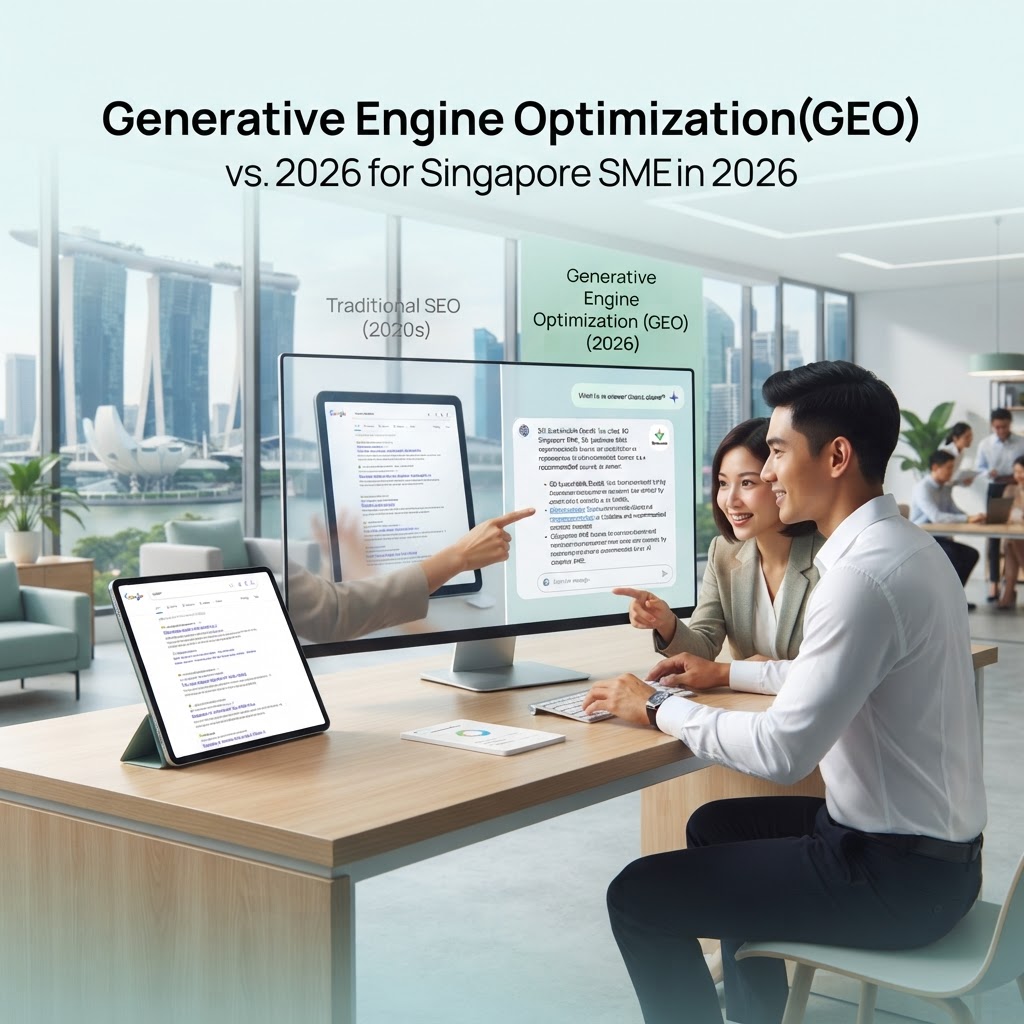
Beyond Traditional SEO: A 2026 Guide to Generative Engine Optimization for Singapore SMEs
As we navigate the digital landscape of 2026, the way your Singaporean customers find your business is undergoing a fundamental transformation. For years, digital marketing success was measured by your ability to climb the organic rankings on search engines through keywords and backlinks. However, the rise of AI-powered search experiences has introduced a new paradigm: Generative Engine Optimization. If your website is not structured to be understood, synthesized, and cited by AI models, your business risks becoming invisible in this new era. At iPro Dezign, we work closely with local SMEs to navigate these shifts, ensuring your digital presence remains robust, compliant, and visible. Understanding Generative Engine Optimization is no longer an optional strategy; it is a critical necessity for any business looking to maintain its market share in an AI-first economy. In this guide, we will explore why traditional tactics are evolving and how you can adapt your online architecture to thrive in a world where AI models increasingly curate the information your prospective clients consume daily.
Table of Contents
Why Generative Engine Optimization Matters for Singapore SMEs
In the Singaporean business context, the transition from traditional search to generative AI is swift. Decision-makers often look for quick, summarized answers that help them compare service providers or evaluate product features without clicking through ten different links. When an AI generates a response, it pulls data from various sources to build a credible, cohesive answer. Generative Engine Optimization focuses on positioning your company as an authoritative source that the AI can confidently cite. This differs from legacy SEO, which prioritized volume and keyword frequency. Today, quality, technical transparency, and structured data carry far more weight. If your SME operates in a competitive market like B2B services, e-commerce, or hospitality, your ability to be referenced by AI tools directly correlates to your brand’s trust and visibility. AI engines essentially act as a digital concierge, selecting businesses that provide the most accurate, contextually relevant, and easily parsable information. If your website is outdated, slow, or poorly organized, the AI will likely bypass your content in favor of competitors who have invested in a modern digital architecture. We help local businesses audit their current standing, moving away from outdated keyword stuffing toward a strategy that prioritizes high-value, factual, and well-organized content that these emerging engines are designed to digest. By treating your website as a knowledge base rather than just a marketing brochure, you position yourself as a leader in your sector. Our approach focuses on long-term sustainability, ensuring your business stays relevant even as algorithms continue to evolve. This involves deep analysis of how your brand appears across various AI-powered discovery platforms, ensuring that the summaries they generate are accurate and highlight your unique value proposition clearly. Ultimately, this strategy builds a durable digital foundation that serves both human visitors and the increasingly sophisticated bots that assist them in making purchasing decisions.
Optimizing Your Content Strategy for AI Citations
Content is the fuel for AI models. To be cited, your information must be accessible, accurate, and structured in a way that allows the AI to extract value. Simply writing blog posts is no longer sufficient; you need to provide clear, succinct answers to the questions your potential customers are asking. For example, if you are a local renovation firm, instead of generic articles about design, you should provide detailed guides on the costs of home improvements, the legal requirements in Singapore, and the timelines for specific HDB or condo projects. When you provide authoritative, granular data, you make it easy for AI models to incorporate your insights into their responses. We recommend adopting a structured content model where your FAQs, product pages, and service descriptions are clearly defined using schema markup—a form of code that provides search engines with explicit information about your site’s content. This ensures that the AI does not have to guess what your page is about; it receives a structured roadmap. Furthermore, the tone of your content should be professional and informative, mirroring the consultative approach that Singaporean clients appreciate. Avoid the fluff that many low-quality websites rely on; instead, focus on objective facts, clear data points, and helpful comparisons. Our team assists clients in mapping their content to the specific pain points and inquiries of their target audience. By addressing these issues directly, you increase the likelihood that the AI will feature your brand as a recommended solution. This is not about tricks or shortcuts; it is about demonstrating expertise and reliability through high-quality, readable, and technically sound information. When a potential lead asks an AI about the best digital solutions for their business, your brand should be the one cited because you provided the most helpful, clear, and comprehensive answer. This strategy ensures that your authority grows in tandem with the intelligence of the systems being used to discover you, creating a virtuous cycle of traffic and brand trust.
| Metric | Traditional SEO Focus | GEO Focus |
|---|---|---|
| Primary Goal | Page Rank/Click | Citation/Authority |
| Content Style | Keyword Heavy | Fact-Driven/Structured |
| Measurement | Keyword Position | AI Visibility/Brand Recall |
| Technical Need | Site Speed | Performance + Data Markup |
Technical Foundations: The Role of Performance and Structure
While content provides the substance, the technical health of your website determines if the AI can even read your site effectively. We emphasize the importance of Core Web Vitals—a set of standardized metrics that measure user experience, such as how quickly your page loads, how stable it is as it renders, and how responsive it is to user input. If a search engine bot, AI, or human visitor finds your site slow or unstable, they will leave. In the competitive Singapore landscape, a three-second delay can lead to a significant drop in engagement. A headless CMS—a backend-only content management system that allows you to deliver content across multiple platforms via an API—can be an excellent choice for businesses looking to optimize for 2026. It allows for a more flexible, faster, and more secure architecture that modern AI models can scan without encountering the bottlenecks often found in legacy, plugin-heavy websites. Security is equally vital; ensuring your site follows PDPA compliance and uses encrypted connections (HTTPS) is a foundational expectation. We also prioritize mobile-first performance, as the majority of your potential leads in Singapore are likely accessing your site via mobile devices. When your technical foundation is solid, you reduce the friction between your information and the AI model’s ability to process it. This involves optimizing your server-side rendering, minimizing code bloat, and ensuring that your images are compressed and served in efficient formats. These technical efforts pay dividends by not only satisfying the requirements for AI citation but also by significantly improving your conversion rates for human visitors. A fast, secure, and clean website is a professional signal to the world. It shows that you value your customers’ time and that you are committed to delivering a superior experience. We partner with businesses to rebuild, migrate, or optimize their digital platforms with these performance-first principles in mind, ensuring that your investment today supports your growth tomorrow.
Future-Proofing Your Digital Presence with PSG
In Singapore, the government provides significant support for digital transformation through the Productivity Solutions Grant (PSG). This initiative is designed to help local SMEs adopt digital technologies, covering up to 50% of the cost of approved solutions. Investing in an AI-ready website, upgraded security, or a more efficient CMS is a classic example of a project that can be supported by these grants. By leveraging PSG, your business can build a high-performance digital presence while minimizing the financial barrier. This makes the transition to Generative Engine Optimization much more attainable. Our role as your digital partner is to help you identify which components of your project qualify for these grants and to guide you through the process, ensuring you receive the support you deserve. We focus on creating sustainable digital assets—whether it is a new e-commerce storefront, an optimized service landing page, or a complete site overhaul—that are built for long-term ROI. We are honest about the effort involved; there is no magic button that generates leads without a consistent, strategic approach. However, with the right foundation and support, your SME can punch above its weight class. We bring years of expertise in web design and performance optimization, helping you translate the complex requirements of the digital economy into actionable steps. When we build or optimize your site, we look beyond the immediate launch. We consider how your site will perform in a market where AI models are the primary interface for discovery. This is about building a future-proof identity that remains competitive, relevant, and trusted. Whether you are a startup looking to make your mark or a mature business aiming to stay relevant, we are here to walk you through the process, answer your questions, and ensure your digital strategy aligns with your business goals. Let’s start a conversation about your digital future and see how we can help you stay ahead of the curve while maximizing your local funding opportunities.
The shift toward Generative Engine Optimization is not a trend that will fade; it is the natural evolution of how information is processed and delivered. By prioritizing structured, authoritative, and fast-loading content, you are not just chasing algorithms—you are creating a better experience for your customers. At iPro Dezign, we pride ourselves on being a reliable partner to Singaporean SMEs, helping you cut through the noise and build a digital home that is ready for the future. From leveraging the PSG grant to ensuring your technical infrastructure is world-class, we focus on measurable, professional results. Reach out to our team today to discuss your digital transformation needs. Let us help you ensure that when the next potential client asks an AI for the best solution in your niche, your brand is the first one it recommends.
Frequently Asked Questions
1. What is Generative Engine Optimization? GEO is the process of optimizing your website content and structure so that AI-powered search engines can easily understand, synthesize, and cite your brand as an authority in their generated responses.
2. How does GEO differ from traditional SEO? Traditional SEO focuses on keywords and backlinks to rank on a results page. GEO focuses on high-value, structured information that helps AI models provide accurate, cited answers to user queries.
3. Can I still use traditional SEO strategies? Yes, traditional SEO foundations, like having high-quality content and a fast website, are still necessary. GEO builds upon these foundations by adding a focus on data clarity and structure.
4. How does the PSG grant help my digital efforts? The Productivity Solutions Grant allows Singaporean SMEs to receive funding for up to 50% of the cost of eligible digital solutions, making it more affordable to build an AI-ready, high-performance website.
5. Why is a professional digital agency necessary for this transition? Navigating the technical requirements for AI readiness—such as schema markup and performance optimization—requires specialized expertise to ensure your site is built correctly, securely, and in line with local business standards.