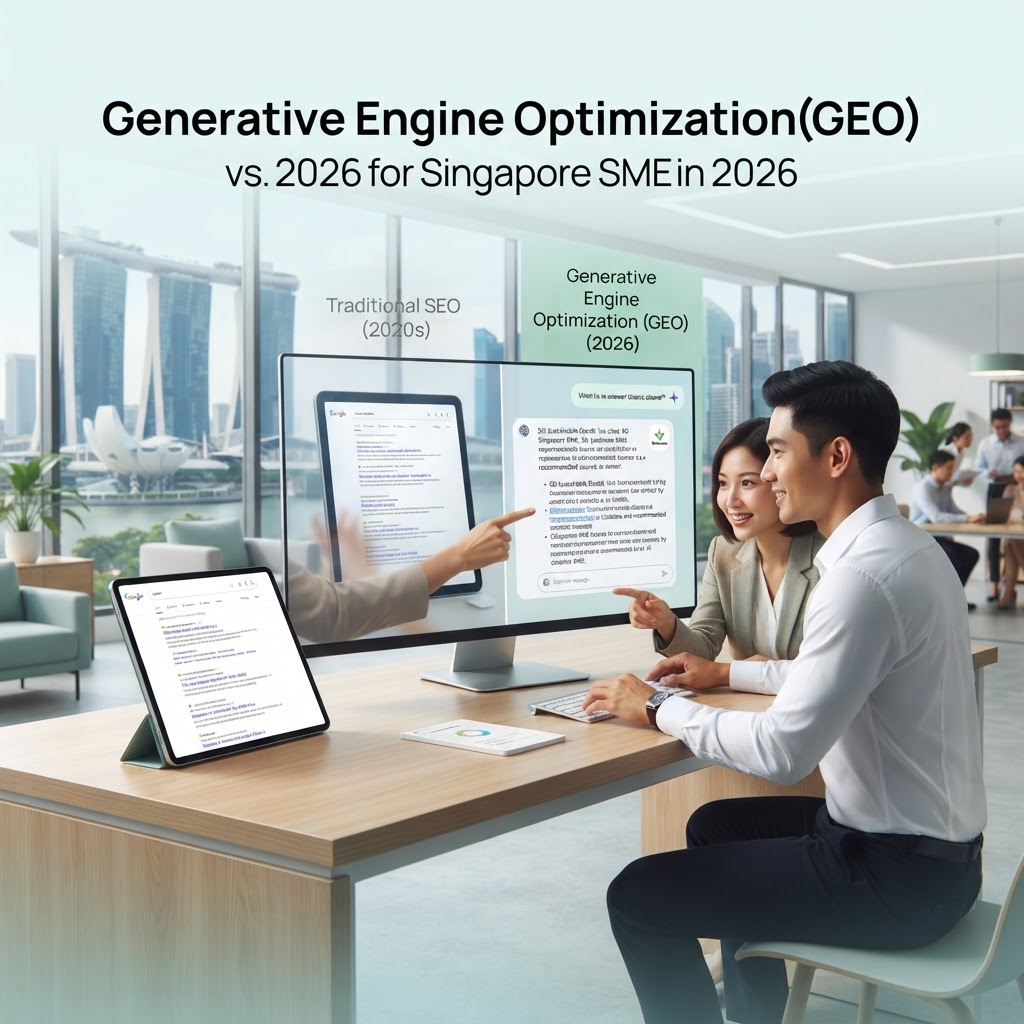
The AI inflection point for Singapore businesses
Singapore’s digital economy is accelerating. With high internet penetration, advanced digital payment adoption, and a government push for AI innovation, companies face a market that rewards speed, personalization, and measurable ROI. For SMEs and larger organisations alike, partnering with a digital marketing agency Singapore that’s AI-ready is no longer optional — it’s a competitive necessity.
This article explains what AI readiness looks like in practice for marketing and web design, outlines the core services to expect from a modern agency, and offers a practical roadmap you can apply in 2026 and beyond.
Why AI readiness matters for a digital marketing agency Singapore
AI amplifies human skill: it increases creative throughput, automates repetitive tasks, and improves targeting. In Singapore’s market, where customer journeys are short and expectations high, an agency that uses AI effectively will:
- Reduce time-to-market for campaigns through automation and generative tools.
- Improve conversion rates with data-driven personalization and adaptive landing pages.
- Deliver better attribution and reporting so budgets are spent where they matter.
Agencies must combine AI models with disciplined measurement and local market intelligence. That mix ensures campaigns are not just novel, but also relevant and compliant with local regulations and customer preferences.
Core services of an AI-ready digital marketing agency Singapore
A future-ready agency blends traditional capabilities with AI-first workflows. Key services include:
- AI-enhanced strategy and planning: scenario-based forecasting, audience clustering, and creative ideation.
- Search and content optimization: automated content frameworks, semantic SEO, and prompt-based content generation.
- Paid media with dynamic creative optimization: real-time creative splits and automated bid strategies tuned for Singapore’s consumer segments.
- Conversion rate optimization (CRO): AI-driven A/B testing, predictive heatmaps, and adaptive UX changes.
- Analytics and governance: model explainability, data quality checks, and ethical use frameworks.
For a technical primer on how generative approaches change search and content workflows, see the generative engine optimization guide that outlines practical steps for SMEs.
Web design Singapore: built for conversion and AI
Web design in 2026 is less about fixed pages and more about adaptive experiences. A strong web design singapore approach covers:
- Performance-first UX: fast load times and progressive delivery for mobile-first users.
- Modular design systems: components that can be personalized on the fly by AI-driven content engines.
- Accessibility and inclusivity: designs that comply with local and international accessibility standards.
- SEO-by-design: technical foundations that enable AI indexing and structured data tagging.
Design and development must be tightly integrated with marketing. For current design patterns and what digital agencies are prioritizing next year, review the 2026 Singapore web design trends every digital agency needs.
How to integrate AI into marketing and web design workflows
Integration should be pragmatic and staged. A typical phased approach looks like:
- Audit and foundation: review data sources, analytics setup, CMS capabilities, and privacy compliance.
- Low-risk pilots: personalize email flows, automate content summaries, or deploy dynamic CTA testing.
- Scale successful pilots: extend personalization to landing pages and paid media creative.
- Continuous optimization: use MLOps-style governance for models affecting UX and messaging.
Choose tools that let your team retain control: human-in-the-loop systems reduce risk and maintain brand voice. For tactical guidance on transforming operations and capability-building for SMEs, the digital transformation for SMEs resource provides a practical framework.
The interplay between SEO and AI-led web design
SEO remains foundational. But today’s best practices require SEO and web design to work together: technical SEO enables AI models to surface the right content, while AI can accelerate keyword research and content creation. Key priorities include:
- Structured data and schema: make content discoverable and rich in SERPs.
- Page experience signals: Core Web Vitals matter for mobile-first Singapore audiences.
- Content relevance and authority: use AI to scale relevance without sacrificing editorial quality.
A focused conversion roadmap combining SEO and design principles will improve visibility and ensure traffic turns into measurable business value — more on this in the SEO and web design conversion roadmap.
Measuring ROI and the metrics that matter
Traditional vanity metrics are no longer sufficient. Track business-aligned KPIs:
- Revenue per visitor and margin-adjusted lifetime value.
- Incremental conversions attributable to AI-driven personalization.
- Time-to-conversion and funnel friction points reduced by adaptive design.
- Cost per acquisition (CPA) improvements from automated media optimization.
Use experimentation platforms to quantify lift. When AI-driven changes are clearly tied to improved KPIs, scaling decisions become evidence-based rather than speculative.
Choosing the right digital marketing agency Singapore
When evaluating agencies, look beyond buzzwords. Prioritize partners that demonstrate:
- A documented AI governance policy and transparent model usage.
- Proven case studies combining web design and data-driven marketing.
- Cross-discipline teams: product designers, data scientists, copy strategists, and campaign managers working together.
- Clear onboarding and knowledge transfer plans so your internal team can maintain momentum.
You should also ask for specifics: which tools do they use for generative content? How do they validate model outputs? What are the fallback controls for brand safety?
For agencies already publishing frameworks and playbooks, a generative engine optimization primer can reveal how they approach prompt design and search alignment in practice.
Practical 90-day roadmap for implementation
A rapid, pragmatic plan to get AI benefits without heavy upfront spend:
- Days 1–14: Data and tooling audit — map customer journeys, tag goals, and identify low-hanging experiments.
- Days 15–45: Launch two pilots — (1) an AI-personalized landing page for your highest-converting channel, (2) automated ad creative variations.
- Days 46–75: Validate results and standardize successful templates into your CMS and design system.
- Days 76–90: Automate reporting and build a quarterly optimization calendar based on experiment outcomes.
This cadence prioritizes speed and learning. Keep documentation and runbooks so experiments are repeatable and auditable.
Case examples and quick wins
- Local retailer: implemented AI-driven product recommendations and saved an average of 18% on ad spend while improving cross-sell revenue.
- B2B services firm: used AI to generate highly relevant landing page variations, increasing demo request conversions by 34% within two months.
- Fintech startup: optimized onboarding UX with predictive forms that reduced abandonment during KYC by 22%.
These wins come from combining a nimble web design singapore approach with targeted AI-driven marketing, not from one-off tools alone.
Risks, ethics and regulatory considerations
Singapore has robust expectations around data protection and responsible AI. Agencies must ensure:
- Personal data usage aligns with PDPA and organisational consent policies.
- Generated content is audited for accuracy and bias, especially in regulated sectors.
- Model provenance and fallback mechanisms are documented to avoid misinformation.
A trusted partner will bake these controls into delivery, not bolt them on as an afterthought.
Final checklist before engagement
- Confirm measurable KPIs tied to revenue or leads.
- Require a staged pilot approach with clear success criteria.
- Verify the agency’s capability in both web design and data science.
- Ask for references that show outcomes, not just activity.
For teams looking to align people, process, and technology, a practical, agency-authored guide on digital transformation for SMEs shows how to sequence investments and build internal capability.
Closing: future-proofing your digital presence in 2026
By combining thoughtful web design singapore with AI-ready marketing practices, businesses in Singapore can achieve faster growth, more efficient advertising, and customer experiences that adapt in real time. Prioritize partners who demonstrate technical rigor, clear governance, and cross-functional delivery. When design, SEO, and AI are integrated, your digital presence becomes a scalable revenue engine rather than a static brochure — a shift that will define winners in 2026.
Further reading and practical frameworks are available in dedicated guides covering generative optimization, design trends, digital transformation, and SEO-conversion roadmaps to help teams make informed, measurable decisions.