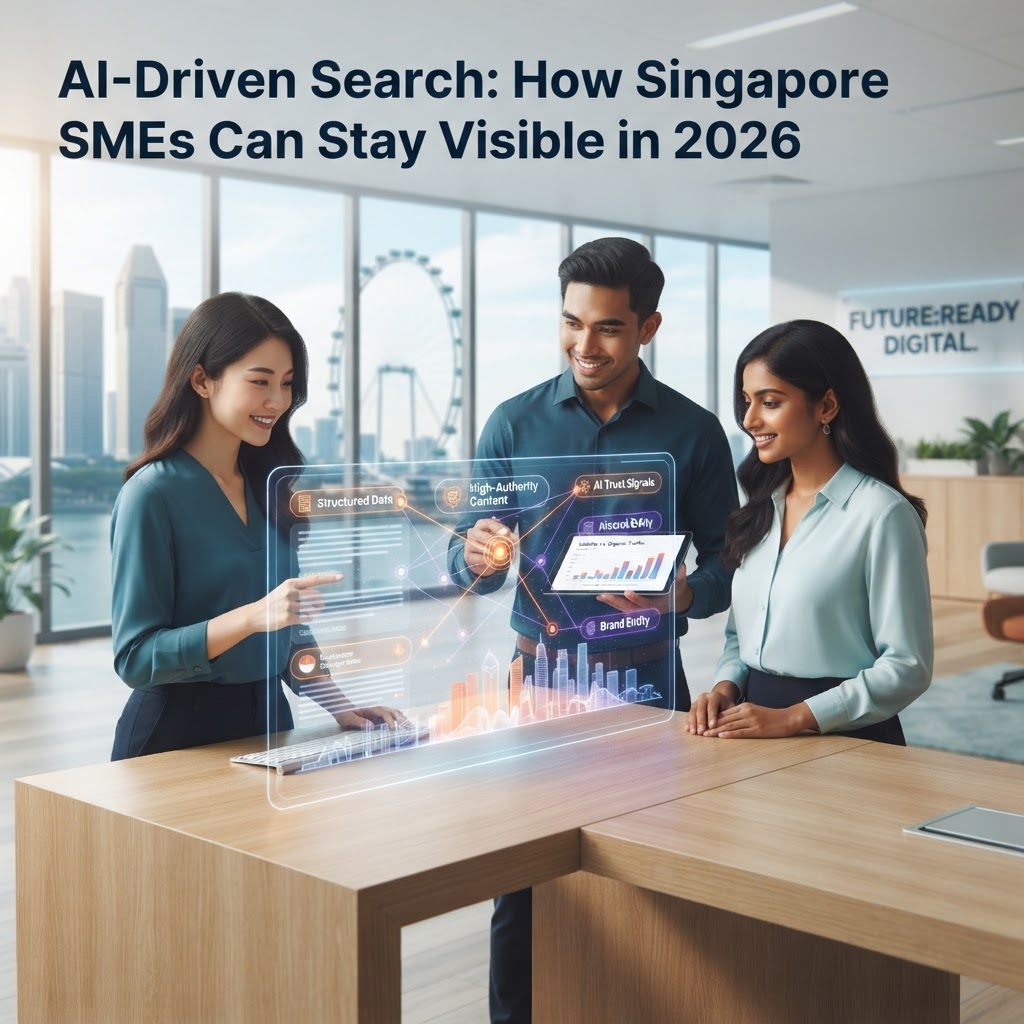
The AI advantage for Singapore businesses
In 2026, the intersection of artificial intelligence and digital marketing is no longer experimental—it’s standard practice for competitive brands in Singapore. Businesses looking to scale need a digital marketing agency Singapore that blends creative strategy, rigorous data analysis, and next-generation automation. Paired with modern web design Singapore, these capabilities produce better user experiences, higher conversion rates, and measurable ROI.
What a modern AI-driven digital marketing agency offers
An AI digital marketing agency is more than a vendor; it becomes an extension of your growth team. Core service pillars include:
- Data-driven audience segmentation: AI models analyze first- and zero-party data to identify high-value micro-segments and personalize messaging at scale.
- Predictive analytics and forecasting: Machine learning forecasts demand, lifetime value (LTV), and churn—helping allocate budgets more efficiently.
- Automated creative optimization: Generative AI accelerates ad creative iterations while performance models highlight the best-performing variants.
- Smart bidding and programmatic media: AI-driven bidding strategies secure efficient CPMs and better ROAS across platforms.
- Integrated SEO and content automation: Natural language models and entity-based SEO optimize topical relevance and site architecture.
These capabilities often come bundled with technical web skills. The best agencies will pair these services with cutting-edge web design Singapore to ensure marketing and product experience are tightly aligned.
Why web design still matters in an AI-first age
AI can target, personalize, and automate—but the moment a user lands on your site, design determines conversion. Modern web design Singapore focuses on:
- Intent-driven UX: Designs built from search and behavioral intent maps that guide visitors toward conversion.
- Performance optimization: Fast load times, progressive hydration, and image/asset optimization that preserve ad quality scores and reduce bounce.
- Accessibility and inclusive design: Meeting WCAG standards broadens reach and reduces legal and reputational risk.
- Conversion-focused templates: Landing pages optimized by AI-driven A/B testing for headline, layout, and CTAs.
A cohesive approach—where your digital marketing agency Singapore and UX team collaborate—keeps messaging consistent and maximizes each channel’s effectiveness.
Core KPIs to demand from your agency
Selecting an agency is easier when you know which metrics matter. Beyond vanity metrics, prioritize these KPIs:
- Conversions and cost-per-acquisition (CPA) by channel
- Customer lifetime value (LTV) and margin-adjusted ROI
- Organic traffic growth and keyword visibility (for web design and content synergy)
- Page speed, Core Web Vitals, and bounce rate (web experience metrics)
- Marketing-influenced revenue and attribution accuracy
An AI-led partner will present these metrics using visual dashboards and explain attribution changes as models evolve. Request to see how they link creative tests and site changes to bottom-line outcomes.
Integrating AI responsibly
AI tools unlock efficiency but must be governed. Responsible agencies in Singapore follow best practices:
- Transparency: Clear documentation of models used for personalization and content generation.
- Data privacy and compliance: Strict adherence to PDPA and robust handling of consent and data minimization.
- Human-in-the-loop workflows: Final review processes to ensure output aligns with brand voice and legal requirements.
- Bias auditing: Regular checks so targeting and models don’t unintentionally exclude or misrepresent audiences.
Ask your digital marketing agency Singapore how they validate model outputs and maintain audit trails for decision-making.
How to evaluate portfolios and case studies
When evaluating agencies, look for proof of applied AI and web craftsmanship:
- Case studies showing measurable lift from personalization, predictive models, or automation.
- Examples of performance gains tied to a site redesign—improved conversion rates after a web design Singapore overhaul.
- Clear attribution of which tactics drove results (SEO improvements, paid media optimization, on-site UX changes).
- Cross-industry experience balanced with deep knowledge of your sector.
A strong portfolio explains methodology: data sources, model training cadence, testing procedures, and the web engineering decisions that supported campaign performance.
Building a winning brief for 2026
To get accurate proposals, prepare a brief that covers:
- Business goals: Revenue targets, user acquisition objectives, and target LTV.
- Current stack and data availability: CRM, analytics, consent mechanisms, and tag managers.
- Brand and creative constraints: Voice, imagery rules, and industry regulations.
- Technical requirements: Hosting, CMS preferences, headless architecture, or required integrations.
A mature digital marketing agency Singapore will translate this brief into a roadmap covering marketing automation, AI-enabled personalization, and a phased web design Singapore plan for improved conversion paths.
Pricing models and what to expect
Agencies now price engagements much more flexibly to reflect technology investments:
- Retainer + performance: Base retainer for strategy and tools, plus performance incentives based on KPIs.
- Project-based for site redesigns: Fixed scope for UX and engineering with milestone-based payments.
- Hybrid: Core services via subscription with additional spending on media and experimentation.
Ensure contracts include clear SLAs around data ownership, model portability, and exit handover so your data and insights remain yours.
Measuring ROI: attribution and incrementality
In a multi-touch environment, ROI measurement requires robust testing frameworks:
- Holdout and geo-experiments: Test campaigns’ true lift by withholding exposure in controlled populations.
- Incrementality testing for paid channels: Confirm that ad spend is truly additive and not just redistributing conversions.
- Unified measurement: Combine server-side events, clean rooming techniques, and deterministic matches to improve attribution.
A forward-looking agency will propose a mix of experimental design and pragmatic attribution models to validate spend and scale winners.
Trends to watch in 2026 and beyond
- Conversational search and multimodal queries: Websites must support rich content formats and fast indexing for voice and visual search.
- Real-time personalization at the edge: Delivering tailored experiences with minimal latency using edge compute will be a competitive advantage.
- Privacy-first measurement: Expect wider adoption of aggregated event measurement and privacy-preserving analytics.
- AI-assisted creative workflows: Human creatives will orchestrate and refine AI outputs rather than replace them completely.
Agencies that combine deep technical web skills with AI-driven marketing strategies will lead the market. Look for teams that bridge analytics, engineering, and creative disciplines.
Final checklist when hiring an agency
Before signing, confirm:
- They have demonstrable AI use-cases and transparent methodologies.
- Their web design approach aligns with conversion goals and performance benchmarks.
- Ownership and portability of data, models, and creative assets are contractually clear.
- Reporting cadence and OKRs are defined upfront.
- They show a roadmap for continuous optimization and scaling.
Engaging the right partner—one that understands both AI marketing and practical web design Singapore execution—turns technology into sustained business growth. A pragmatic, measurement-first approach will ensure your investments in AI and design deliver real revenue and long-term advantage.