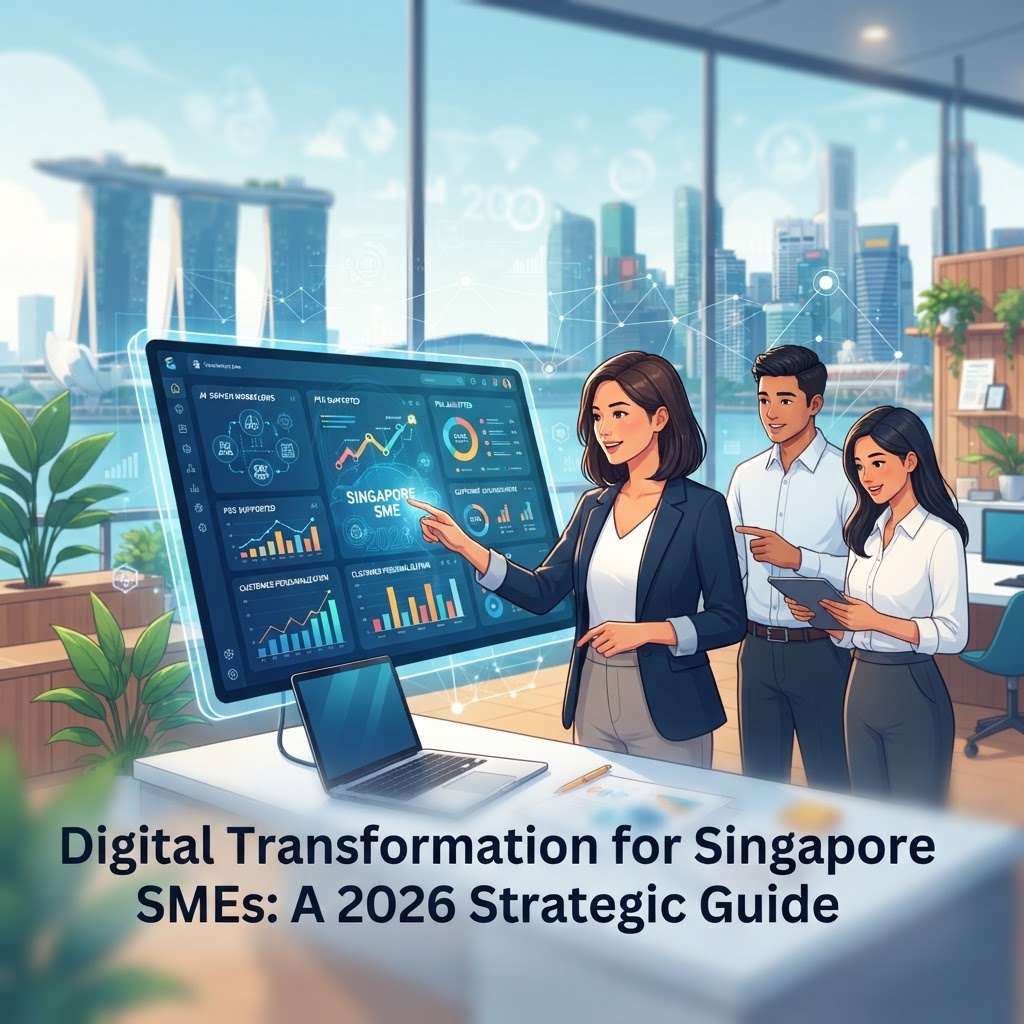
Digital Transformation for Singapore SMEs: A 2026 Strategic Guide
As we navigate 2026, the Singaporean business landscape is shifting rapidly. For local enterprises, digital transformation for SMEs Singapore is no longer a luxury reserved for large corporations; it is a fundamental requirement for survival and growth. As consumer expectations rise, the demand for seamless, AI-driven digital experiences has become the new benchmark. Owners today face a dual challenge: upgrading aging infrastructure while maintaining the operational agility that defines our local business culture. Whether you are managing a boutique retail shop or an industrial supplier, the transition to digital workflows—incorporating intelligent automation and personalized web experiences—can significantly improve your bottom line. At iPro Dezign, we observe that businesses adopting these modern standards early often see higher engagement and streamlined internal processes. Fortunately, support mechanisms like the Productivity Solutions Grant (PSG) offer substantial assistance, allowing SMEs to claim up to 50% of qualifying costs for technology adoption. This guide explores how you can leverage these tools to remain competitive, secure, and ready for the future, ensuring your digital footprint works as hard as your team does every day.
Table of Contents
Building a Future-Ready Digital Infrastructure
Establishing a robust digital foundation is the first step toward long-term scalability. For many Singaporean SMEs, the challenge lies in moving away from legacy systems that are difficult to manage and prone to security vulnerabilities. A modern infrastructure must be cloud-native, enabling your team to access critical business data securely from any location. When we talk about digital infrastructure, we are referring to the underlying web architecture that powers your online presence. For e-commerce businesses, this often involves moving to a headless content management system (CMS)—a setup where the back-end content repository is decoupled from the front-end presentation layer. This decoupling allows for greater design flexibility, faster page load speeds, and improved security, as the attack surface is significantly reduced. Data sovereignty remains a top priority in our region, and ensuring your systems are fully compliant with the Personal Data Protection Act (PDPA) is not just a legal obligation but a cornerstone of client trust. Our team emphasizes that a well-structured site architecture supports search engine visibility by ensuring that Google bots can crawl and index your content efficiently. Furthermore, mobile-first design is non-negotiable in Singapore, where a vast majority of traffic originates from smartphones. If your site is not optimized for mobile interactions, you are effectively turning away potential leads. Integrating a secure, reliable hosting environment that provides consistent uptime is essential. We recommend choosing solutions that offer automated daily backups and threat monitoring to protect your assets. By investing in these foundational elements, you move from merely having a website to owning a digital asset that drives measurable value, allowing your staff to focus on strategy rather than troubleshooting technical outages or security concerns.
The Role of AI-Driven Workflows in 2026
In 2026, artificial intelligence has moved beyond the hype phase and into the realm of daily operational necessity. For SMEs, AI-driven workflows provide a practical way to manage increased customer volume without a proportional increase in headcount. Many business owners ask how they can realistically apply these technologies. The answer lies in automating routine tasks. For instance, customer support can be enhanced using sophisticated, AI-powered chatbots that handle common enquiries regarding shipping, product availability, or service pricing, escalating only the complex queries to your human staff. This significantly reduces response times and keeps your service team focused on high-value interactions. Beyond support, AI is transforming how we handle content strategy and marketing. Predictive analytics tools can now parse your web traffic data to identify user intent, suggesting personalized content paths that lead to higher conversion rates. When we implement these workflows, we prioritize tools that integrate seamlessly with your existing CRM and inventory management systems. This creates a cohesive ecosystem where data flows freely between departments. For instance, an automated system can trigger a personalized email sequence based on a user’s interaction with a specific category on your website, effectively nurturing leads without manual intervention. Another critical area is the use of AI in streamlining supply chain communication. By using automated alerts for stock replenishment, your business can avoid the risks of overstocking or missing sales due to inventory gaps. It is important to note that AI is not a replacement for human judgment; rather, it is a tool that enhances the capability of your existing workforce. Our consultative approach involves auditing your current workflows to identify repetitive tasks that are prime candidates for automation. By adopting these methods, your SME gains the precision and efficiency typically associated with large corporations, while maintaining the personal touch that characterizes the Singaporean business spirit.
Prioritizing User Experience and Performance
User experience (UX) is the bridge between a visitor and a loyal customer. In an environment as fast-paced as Singapore, your digital platform must be fast, intuitive, and visually aligned with your brand values. Core Web Vitals—a set of metrics that measure real-world user experience for loading performance, interactivity, and visual stability—are the gold standard for gauging how your site feels to a human visitor. If your page takes longer than three seconds to load, the bounce rate spikes, and your potential revenue walks out the door. We consistently see that improving LCP (Largest Contentful Paint) and FID (First Input Delay) results in direct, positive impacts on enquiry rates. A performance-first build involves minimizing heavy scripts, optimizing high-resolution imagery for mobile devices, and using efficient caching mechanisms to ensure that every click yields a near-instant response. Beyond speed, personalization is the differentiator. In 2026, users expect your site to remember their preferences and offer suggestions relevant to their previous browsing history. This creates a tailored experience that makes the customer feel valued rather than just another anonymous visitor. We often recommend a clean, minimalist design language that highlights your primary call-to-actions clearly, preventing the visual clutter that leads to decision paralysis. Remember, every design element should serve a purpose. Whether it is a clear contact form, a direct link to a quote request, or a simplified checkout process, the goal is to reduce the cognitive load for your visitor. When we assist clients with these improvements, we look at the data to see where users are dropping off and adjust the layout accordingly. The following table provides a comparison of how traditional versus performance-optimized sites impact business outcomes:
| Feature | Traditional Build | Performance-Optimized Build |
|---|---|---|
| Page Load Time | 5-8 Seconds | Under 2.5 Seconds |
| Conversion Rate | Baseline | Increased by 20-40% |
| Mobile User Experience | Often Glitchy | Seamless / Fluid |
| SEO Potential | Limited | High Visibility |
By focusing on these metrics, you build a site that acts as a 24/7 sales representative, consistently delivering results regardless of the time of day or the device being used by your customer.
Maximizing Government Grants and PSG Support
Navigating the costs of digital transformation can be daunting, but Singaporean SMEs have a distinct advantage in the form of government support. The Productivity Solutions Grant (PSG) remains a powerful catalyst for local businesses looking to adopt pre-scoped digital solutions. Whether you are seeking a complete website rebuild, a new e-commerce storefront, or advanced SEO tools, the PSG can often cover up to 50% of the qualifying costs. This financial support reduces the barrier to entry, allowing SMEs to invest in higher-quality, professional-grade tools that they might have otherwise avoided due to budget constraints. However, applying for grants requires careful planning and eligibility verification. It is essential to work with a pre-approved digital partner who understands the intricacies of the application process. At iPro Dezign, we pride ourselves on helping clients navigate these requirements with transparency. We explain the scope of work clearly, map it against the grant guidelines, and ensure that your project meets the standards required for funding. Beyond the financial benefits, the process of documenting your digital strategy for a grant application often forces a necessary internal audit. It clarifies your goals, identifies the specific problems you aim to solve, and sets a roadmap for success. When you partner with us, we treat your grant application as a collaborative effort. We prioritize reliability and responsiveness, ensuring that you are never left guessing about the status of your project or your funding. We do not just build a site; we act as a growth partner, helping you justify the investment through measurable ROI. Investing in digital transformation now, while government subsidies are available, is a prudent financial decision that can pay dividends for years to come. By choosing a partner who values integrity and technical excellence, you ensure that your business is not just spending money, but investing in a robust, future-proof digital infrastructure that serves your customers and your team efficiently, all while keeping your operational costs manageable.
Digital transformation is a journey that requires careful planning, the right partners, and a clear vision. In 2026, Singaporean SMEs that proactively adopt AI, optimize for performance, and leverage available grants will find themselves in a significantly stronger market position. At iPro Dezign, our team is committed to providing the technical expertise and strategic guidance needed to navigate this evolution. We believe in building long-term relationships based on trust, transparency, and a shared commitment to your growth. If you are ready to modernize your web presence, improve your operational efficiency, or simply want to explore how the PSG can support your upcoming projects, we are always here to help. Reach out to our team today for an honest conversation about your business goals and discover how we can help you turn your digital vision into a reality.
Frequently Asked Questions
1. How does the PSG grant help with digital transformation? The Productivity Solutions Grant (PSG) provides funding for up to 50% of the costs of pre-approved digital solutions, making it significantly more affordable for SMEs to upgrade their web and operational systems.
2. What is the most important factor for SEO in 2026? While quality content remains vital, technical performance metrics known as Core Web Vitals are crucial. A fast, mobile-responsive, and secure site is essential for maintaining visibility and user trust.
3. Why should an SME consider a headless CMS? A headless CMS offers greater security, superior loading speeds, and the flexibility to push content across multiple platforms simultaneously, which is excellent for growing businesses.
4. How do I start the PSG application process? The first step is identifying your business needs and finding a pre-approved vendor. We can help guide you through the initial requirements and eligibility check for your specific project.
5. Is AI suitable for small businesses? Absolutely. AI is highly effective for automating routine customer service, inventory management, and marketing tasks, allowing small teams to achieve more without increasing overhead costs.