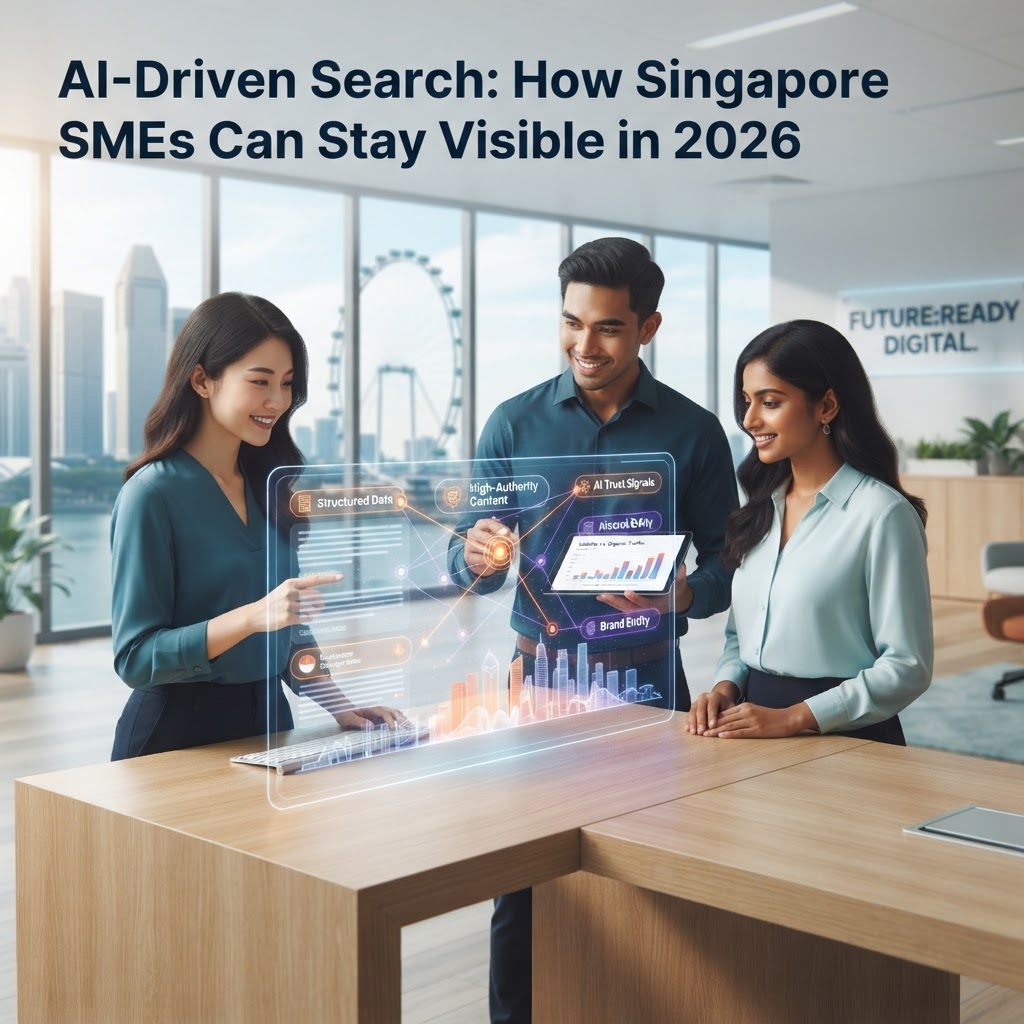
Is Traditional SEO Dead? Why Singapore SMEs Must Pivot to Generative Engine Optimization (GEO) in 2026
The digital landscape in Singapore is undergoing a profound transformation that many local business owners have yet to fully appreciate. For years, the pursuit of top rankings on traditional search engines like Google has been the primary focus of digital marketing budgets. However, as consumers shift toward AI-powered interfaces such as ChatGPT, Gemini, and AI Overviews, the rules of the game have fundamentally changed. We are no longer just fighting for a blue link; we are now competing for inclusion within AI-generated responses. This shift introduces the critical concept of Generative Engine Optimization (GEO). If your business relies solely on traditional search strategies, you risk becoming invisible to the modern Singaporean consumer who now prioritizes AI-driven insights over endless lists of websites. Understanding GEO is not just a technical requirement for 2026; it is a business imperative. As an agency committed to helping SMEs thrive, our team believes that pivoting your strategy now will ensure your brand remains relevant, authoritative, and accessible in an increasingly automated search ecosystem. This article explores why this transition is necessary and how you can prepare your business for the future of search visibility.
Table of Contents
- The Shift from Search Engines to Generative Engines
- Understanding the Core Mechanics of GEO
- Adapting Your Content Strategy for AI Visibility
- The Role of Technical Performance in AI Citations
- Frequently Asked Questions
The Shift from Search Engines to Generative Engines
The transition from traditional search to generative AI interfaces represents the most significant change in consumer behavior since the invention of the smartphone. In Singapore, tech-savvy users are increasingly adopting AI-powered search tools to streamline their research, from finding professional services to evaluating product features. These interfaces do not simply return a list of links; they synthesize vast amounts of data to provide direct answers, summaries, and comparative recommendations. Consequently, the traditional model of optimizing for specific keywords is losing its effectiveness. When a user asks an AI tool for a recommendation for the best digital agency in Singapore, they are not necessarily browsing the search results page. They are listening to the AI synthesis. This necessitates a strategic shift toward Generative Engine Optimization, where the primary objective is to become the trusted source that AI models cite. Unlike traditional search, which favors quantity and link density, generative engines prioritize semantic authority, factual accuracy, and high-quality, structured information that can be easily parsed. Businesses that continue to rely on older tactics, such as keyword stuffing or low-value guest posting, will find themselves ignored by these sophisticated models. To remain competitive, Singaporean SMEs must move beyond the basic SEO checklist and start thinking about how their brand identity, service expertise, and technical infrastructure contribute to the AI knowledge base. Our team has observed that companies which invest in building verifiable expertise and providing clear, data-backed insights are consistently gaining more traction in these new environments. By focusing on quality, you ensure that your business provides the evidence base that AI models need to deliver accurate recommendations to potential customers who are ready to make a purchasing decision.
Understanding the Core Mechanics of GEO
Generative Engine Optimization is fundamentally different from traditional search engine optimization because it is designed to satisfy the needs of machine learning models rather than human users alone. While traditional SEO often involved targeting high-volume keywords to manipulate rankings, GEO requires an emphasis on providing comprehensive, structured, and trustworthy data. AI engines such as ChatGPT or Google’s Gemini utilize large language models that are trained on massive datasets to identify the most authoritative information for a given query. Therefore, your digital presence must become a source of truth. This involves deep investment in content that explains your specific industry expertise, offers unique local insights, and maintains a consistent, professional tone that machines can process as reliable information. One critical component of this strategy is the optimization of your website’s schema markup and metadata. Schema markup is a type of code that helps search engines understand the context and intent behind your content, such as identifying a business address, pricing, or review ratings. When this data is structured correctly, it becomes significantly easier for AI models to verify your credentials and feature your business in their responses. Furthermore, GEO emphasizes the quality of the citations your brand receives across the web. While traditional link building sought to gather as many backlinks as possible, GEO values high-quality mentions in authoritative, industry-specific publications. Think of it as building your brand’s reputation with both human audiences and the AI models that represent them. The table below outlines the primary differences between the old approach and the new strategy that every Singaporean SME should be considering as we head into 2026.
| Feature | Traditional SEO | Generative Engine Optimization (GEO) |
|---|---|---|
| Primary Goal | Link Clicks / Rankings | AI Citation / Trust Verification |
| Content Focus | Keyword Density | Semantic Authority & Accuracy |
| Technical Priority | Mobile-Friendly/Speed | Structured Data (Schema) & Logic |
| User Goal | Traffic Growth | Direct Influence on AI Answers |
By implementing these adjustments, you align your digital presence with the way modern consumers interact with the internet, ensuring that your company remains a go-to recommendation in the age of intelligent automation.
Adapting Your Content Strategy for AI Visibility
Content creation must evolve to meet the requirements of generative search. In the past, writing for the web often meant producing long-form content designed to capture as many search queries as possible. Today, the focus must shift to creating content that directly answers complex, intent-driven questions. This is because AI engines are designed to solve user problems quickly. If your content provides clear, concise, and highly relevant solutions, the AI is more likely to use your business as its primary source. For Singaporean SMEs, this means prioritizing thought leadership pieces, detailed case studies, and comprehensive service breakdowns that demonstrate expertise rather than just listing services. When you write, avoid fluff and generic industry statements. Instead, share specific insights that show your team’s deep understanding of the local market, such as how PSG grants apply to your specific solutions or how you manage PDPA compliance in your digital builds. Another vital aspect of this approach is to anticipate the questions your customers are asking. What are the common pain points that lead a client to seek your service? Instead of writing articles that focus on broad keywords, create content that addresses specific scenarios and challenges. By providing the exact answer an AI model is looking for, you increase the likelihood of being cited as the authoritative source. This strategy not only benefits your AI visibility but also builds immense trust with potential clients who land on your page. Our team often advises clients to focus on the ‘why’ and ‘how’ of their business processes. When you share professional, evidence-led content, you are feeding the AI the high-quality, reliable information it needs to confidently present your brand to users who are currently in the research phase of their buying journey. The more transparent and helpful your content, the better your chances of achieving visibility.
The Role of Technical Performance in AI Citations
Technical excellence remains the backbone of any successful digital strategy, even as we shift toward generative search. The principles of speed, mobile responsiveness, and security are still paramount, but their importance is now amplified by the needs of AI crawlers. An AI model must be able to crawl, parse, and understand your website content with minimal friction. If your site is bloated, slow, or poorly structured, you are essentially making it difficult for the AI to ingest your knowledge. Performance metrics, such as Core Web Vitals—which measure user experience factors like page loading speed and visual stability—continue to be crucial indicators of a healthy website. Our agency prioritizes these performance-first builds because they ensure that the foundation of your digital property is solid. A faster site does not just please search engines; it lifts conversions and provides a better experience for the human user once they arrive at your site. For SMEs, this is a strategic advantage. When you use PSG grants to rebuild your site, you are not just updating your look; you are investing in an infrastructure that is built for 2026 and beyond. A headless CMS or a streamlined, lightweight framework can significantly reduce load times, ensuring that your site remains lightning-fast for both users and the AI agents that visit it. Security is another non-negotiable factor. Because AI models are designed to recommend safe and reliable sources, a secure, HTTPS-encrypted site with a clear privacy policy is essential. Furthermore, ensure your site is easy to navigate, with clean, logical hierarchies that help the AI understand your core offerings. By keeping your technical house in order, you are signaling to both the search engines and the generative models that your business is a high-quality, trustworthy partner. Investing in these technical standards today will position your SME to capture significant market share in the years ahead, regardless of how the search landscape continues to evolve in the Singapore market.
Conclusion
The pivot to Generative Engine Optimization is not a trend to ignore; it is the natural progression of how information is processed and shared in the digital age. For Singaporean SMEs, the challenge lies in shifting from a legacy mindset of link building and keyword density to a focus on brand authority, structured data, and technical excellence. While the path ahead requires investment and strategic planning, the opportunity to be the trusted voice in an AI-powered world is immense. Our team is ready to guide you through this transition, from upgrading your site’s technical architecture to crafting content that resonates with both human experts and machine learning models. Whether you are looking to leverage PSG funding to modernize your presence or simply want an audit of your current digital strategy, we are just a call away. Let us help you secure your position as a market leader in 2026.
Frequently Asked Questions
1. Is traditional SEO completely dead? It is not dead, but it is evolving. Traditional strategies are becoming less effective on their own, and businesses must now integrate GEO to maintain visibility in AI search interfaces.
2. How does GEO affect my local Singapore business? GEO helps your business appear in AI-generated answers, which is where many local customers now start their research. It ensures you are seen as an authority by the tools they use most.
3. Can I use PSG grants for an AI-ready website rebuild? Yes, many digital projects, including those focused on performance and site architecture, may be eligible for PSG funding. Our team can help you check your current eligibility.
4. How quickly will I see results after switching to GEO? Like all digital strategies, this depends on your starting point and industry, but shifting to authoritative content and clean technical builds provides a sustainable long-term advantage.
5. What is the first step in starting my GEO strategy? The first step is to conduct a technical audit to ensure your site is readable by AI, followed by a content review to ensure your site acts as an expert source of information.