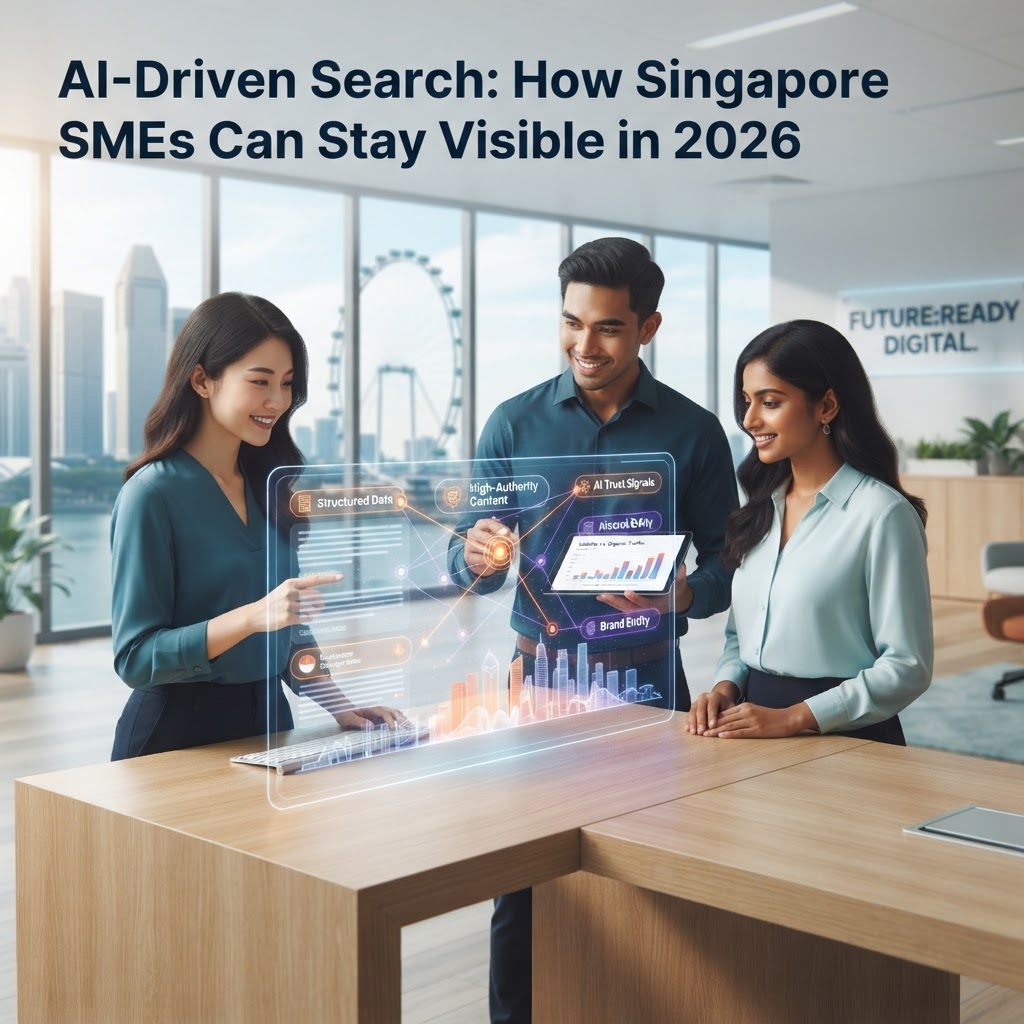
The new convergence: design and discoverability in 2026
In 2026, the gap between visual design and search visibility has narrowed into a single discipline. Businesses in Singapore are no longer treating seo singapore and web design singapore as separate projects: a site that looks great but performs poorly in search is an expensive showroom with no visitors. Conversely, a search-optimized site with poor UX loses the conversions modern marketers need. This article walks through the trends, the technical checklist, and a pragmatic playbook to align design and SEO for measurable business outcomes.
Why integration matters now
Search engines have matured beyond simple keyword matching. Google and other engines evaluate experience signals — loading performance, layout stability, accessibility, and semantic structure — as proxies for quality. Meanwhile, consumers expect fast, polished experiences on mobile and expect personalised content. For Singapore businesses competing in crowded local niches, integrated efforts yield three concrete benefits:
- Higher organic rankings driven by improved Core Web Vitals and on-page relevance.
- Better conversion rates as UX reduces friction and boosts trust.
- Lower long-term cost: fewer redesigns and less technical debt when SEO and design are aligned from the start.
Key 2026 trends shaping SEO and web design
- AI-assisted content and layout decisions
AI tools are now integrated into content strategy and design systems. From generating content outlines that match search intent to optimizing visual hierarchy for conversion, AI speeds iteration. But human oversight remains essential to maintain brand voice and ensure factual accuracy.
- Core Web Vitals as functional design criteria
Performance metrics like interaction latency, Largest Contentful Paint and Cumulative Layout Shift are design constraints. Designers and developers use component libraries that are pre-optimized for performance, and content teams write with these limits in mind.
- Mobile-first equals conversion-first
Singapore’s mobile penetration remains very high. Mobile design that treats touch, screen real estate and network variability as first-class citizens directly affects organic performance and conversions.
- Structured data beyond FAQ
Schema is now applied strategically to enhance rich results for services, local business info, events and product inventory. Rich snippets reduce friction by surfacing essential info directly in search results.
- Privacy-aware personalization
Designs must balance personalization with consent. First-party signals and privacy-compliant telemetry are replacing third-party cookie reliance for search optimization and user experience tuning.
Practical UX + SEO checklist for Singapore sites
- Technical foundation
- Fast hosting close to Singapore, plus CDN and intelligent caching.
- Mobile-first responsive CSS, avoiding heavy frameworks that bloat payloads.
-
Semantic HTML with clear headings, ARIA where necessary, and accessible navigation.
-
Performance and behaviour
- Aim for LCP < 2.5s, CLS < 0.1, and FID/INP below recommended thresholds.
-
Defer non-critical scripts, use resource hints, and opt for inline critical CSS.
-
Content and structure
- Map content to search intent: transactional, informational, navigational.
- Use structured data for local business, service offerings and reviews.
-
Maintain a logical URL and breadcrumb structure for crawlability.
-
Visual and conversion elements
- Design prominent CTAs in sticky or above-the-fold positions without harming CLS.
-
Use progressive disclosure (accordions, tabs) for long content without hiding it from crawlers.
-
Local and multilingual considerations
- Implement hreflang where relevant and keep local listings (Google Business Profile) synchronized.
- Prioritize page load and content for Singaporean audiences: currency, addresses, local trust signals.
A 6-step playbook to align seo singapore and web design singapore
- Discovery and intent-mapping
Start with keyword research that focuses on intent, not just volume. Identify clusters where design can be leveraged to move users from discovery to conversion. For a ready playbook, consult the SEO Singapore and web design Singapore playbook 2026 for a tactical roadmap.
- Content-first wireframes
Produce wireframes that prioritize content hierarchy and conversion pathways. Use content outlines derived from search intent and include schema placeholders so developers can plan markup from the beginning.
- Component-driven design system
Build a design system where components are pre-optimized for performance and accessibility. This reduces rework when SEO or UX tests require changes. If you want examples of agencies applying these practices at scale, see how an AI-powered SEO Singapore approach combines automation with UX principles.
- Technical implementation and audit
Run pre-launch audits: Lighthouse, Search Console checks, structured data testing, and accessibility scans. Integrate basic telemetry for real-user metrics so you can measure actual performance after launch.
- Launch: measured rollout
Use feature flags and phased rollouts to protect rankings. Monitor search impressions, crawling patterns, and URL-level performance. Make rapid fixes for redirects, canonical issues and content that loses visibility.
- Iterate with data
Treat the site as a product: A/B test layouts, headline treatments and CTAs while monitoring SERP performance. Continuous improvement beats a one-time redesign.
Design patterns that help SEO (and conversions)
- Content hubs and topic clusters: Group related pages under a hub page to signal topical authority and improve internal linking.
- Hybrid landing pages: Combine long-form informative content with clear purchase signals and local trust markers.
- Interactive elements that don’t hurt performance: Use lightweight client-side rendering where necessary and server-side rendering for SEO-critical paths.
- Clear visual hierarchy for featured snippets: Use concise paragraphs, bullet lists and tables where search engines commonly extract answers.
Measuring success: KPIs that matter
- Organic traffic and qualified leads: Track not just sessions but downstream conversions attributed to organic channels.
- Core Web Vitals and real-user metrics: Field data from users in Singapore should guide design trade-offs.
- Keyword visibility for intent-focused phrases: Monitor rankings for transactional and local queries, not just head terms.
- Bounce rate vs engagement: Contextualise bounce with scroll depth and session quality metrics to avoid misleading conclusions.
Common pitfalls and how to avoid them
- Over-optimizing for desktop visuals: Desktop-only design can create hefty payloads and poor mobile experiences. Default to mobile-first.
- Ignoring semantics in design handoffs: Designers must embed content intent and heading structure in prototypes. Avoid handoff documents that omit content hierarchy.
- Treating SEO as an add-on: Late-stage SEO fixes are more expensive and rarely reach their full potential. Make SEO part of the MVP.
Case study snapshot (composite example)
A local Singapore service provider redesigned its site with a component library and content hubs mapped to search intent. They implemented structured data for services and local business schema, and optimized images and fonts for mobile. Within 12 weeks they saw a 35% uplift in organic lead form submissions and improved LCP from 4.8s to 1.9s. The work combined design changes with targeted content optimisation and local schema—showing how strategic collaboration pays off.
For practical agency help and examples of localized design and SEO integration, explore a web design Singapore digital marketing agency that publishes case studies and templates.
Implementation resources and tooling
- Audit: Lighthouse, PageSpeed Insights, Search Console, Screaming Frog.
- Performance: WebPageTest, Real User Monitoring (RUM) solutions.
- Accessibility: axe, WAVE.
- Content: keyword clustering tools, AI assistants for rapid drafting (with human review).
If budget is a constraint, prioritise the low-hanging fruit: compress images, eliminate render-blocking scripts, and ensure clear H1/H2 structure. For agencies and teams evaluating vendors, compare portfolios for both design aesthetics and provable SEO outcomes — many firms now list combined services; see references to a best digital marketing agency Singapore SEO for examples of integrated service packages.
Budgeting and timelines
A typical integrated project for an SME in Singapore might span 8–16 weeks depending on scope: discovery (2 weeks), wireframes and content (2–4 weeks), build (4–6 weeks), launch and optimisation (2–4 weeks). Costs vary widely: templated solutions are lower cost, while bespoke systems and complex integrations are higher. For more budget-friendly launches, consider modular approaches or an affordable web design Singapore offering that balances cost with SEO-friendly practices.
Final takeaway
In 2026, the smartest digital strategies treat search and design as the same craft: building experiences that people love and search engines can understand. By planning content, structure, performance and accessibility together, Singapore businesses can create web platforms that deliver sustainable organic growth and higher conversion yields. The future is not just discoverable—it’s design-driven and measurable.