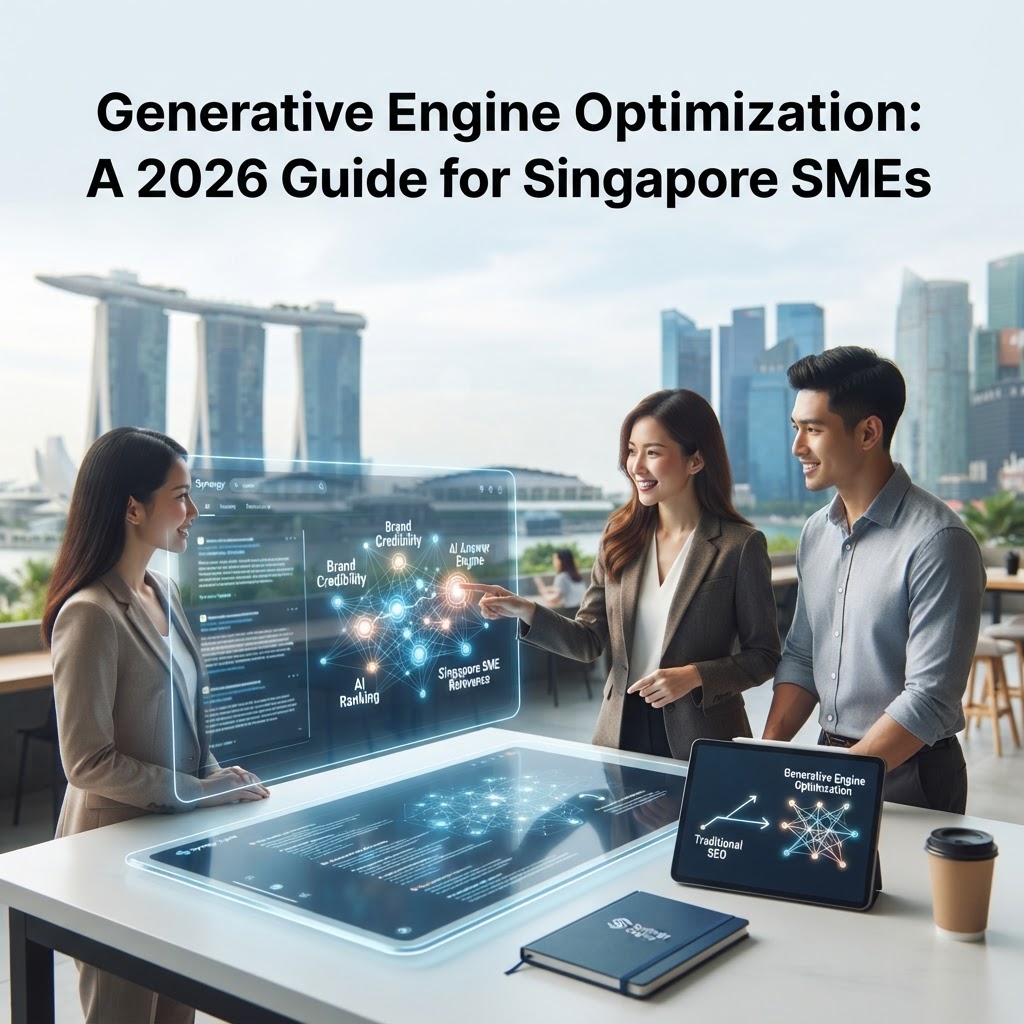
Why 2026 is a tipping point for SEO Singapore
Search in 2026 is shaped by more than traditional ranking signals. Generative AI, stronger privacy controls, and intent-first search engines have combined to change how customers discover brands. For a digital marketing agency Singapore teams must pivot from one-off tactics to systems that blend technical excellence with creative, measurable content. The agencies that win will be those that treat SEO as an integrated product discipline, not an afterthought.
Core trendlines every digital marketing agency Singapore should track
- AI-native search and LLM integration: Search results are increasingly influenced by large language models that summarize, synthesize and rank content using semantic understanding rather than simple keyword matches.
- Privacy-first targeting and cookieless measurement: First-party data strategies, server-side tagging, and modeled conversions are now essential.
- Experience and E-E-A-T signals: Google’s emphasis on Experience and Expertise continues to deepen — real-world performance, demonstrable expertise, and user trust matter.
- Video and multimodal content: Short-form video, interactive media and audio features are indexable and highly visible in SERPs and discovery feeds.
- Local and hyperlocal relevance: Local search (including Maps and conversational assistants) remains a critical channel for Singapore businesses.
Technical foundations: speed, structure, and crawl efficiency
SEO in 2026 still relies on technical fundamentals — but the bar is higher.
- Core Web Vitals and real user metrics: Prioritise real-user field data over synthetic lab tests. Improve LCP, FID/INP, and CLS by optimising server response, reducing render-blocking resources, and deferring non-critical JS.
- Semantically structured HTML and schema: Use schema markup for products, FAQs, events, recipes and organizational data. Structured data helps LLMs surface your content as direct answers.
- Crawl budget and index strategy: For larger sites, implement URL parameter handling, canonicalisation, and intelligent sitemaps. Adopt on-demand indexing for critical updates to accelerate discovery.
- Accessibility and mobile parity: Ensure feature parity across devices. Mobile-first indexing is non-negotiable in a mobile-first market like Singapore.
Content strategy for 2026: intent-first and modular
Content is no longer purely long-form or short-form — it’s modular and intent-led.
- Map content to intent clusters: Create pillar pages for core services and cluster content that answers every stage of the funnel: awareness, consideration, decision.
- Modular content blocks: Build content as reusable blocks (summaries, stats, use-cases) that can be assembled for landing pages, knowledge hubs, and AI prompts.
- Conversational and multimodal assets: Produce transcripts for videos, captions for audio, and rich metadata so search engines can repurpose your assets.
- E-E-A-T evidence: Publish case studies, author bios with verifiable credentials, and client testimonials. Demonstrate outcomes with measurable KPIs.
Local SEO: dominate Singapore neighborhoods and micro-markets
Local search is granular. A single national keyword can hide dozens of high-value micro-intents across Singapore districts.
- Google Business Profile optimisation: Keep GBP accurate, use Posts and Q&A, and collect verified reviews. Local updates and hours matter for maps and assistant results.
- Local content hubs: Create pages and landing experiences tailored to neighborhoods (e.g., Orchard, Jurong) and service availability.
- Local schema and NAP consistency: Ensure Name, Address, Phone are consistent across directories and your site.
For agencies wanting to combine local presence with AI-enabled design, check out strategies from a leading Singapore digital marketing agency with AI web design.
AI tools and automation: augment, don’t replace
AI is an accelerator when used as part of a disciplined workflow.
- AI for discovery and insights: Use LLMs to generate topic clusters and content briefs, but always validate with search data and human expertise.
- AI-assisted content production: Automate drafts, variant testing, and meta generation — then have SMEs refine voice, accuracy and citations.
- RAG and knowledge bases: Use retrieval-augmented generation to ensure responses are grounded in your proprietary data rather than hallucinated content.
- Automate repetitive tasks: Use automation for reporting, log file analysis, and bulk status checks to free up strategists for high-level work.
If you’re focusing on AI-led optimisation, explore frameworks in AI SEO Singapore for digital marketing agencies.
Content distribution beyond classic organic: discovery and syndication
Organic search remains core, but distribution has expanded.
- Federated discovery (social + search): Optimize content to be discoverable in social discovery feeds and search simultaneously.
- Owned channels first: Prioritise email and first-party audiences to reduce dependency on third-party platforms.
- Strategic syndication: Repurpose core assets into microcontent for feeds and backlinkable long-form assets for authority.
Measuring impact: KPIs that matter in a privacy-first world
Move from last-click vanity metrics to business outcomes.
- Outcome-based KPIs: Lead quality, revenue per channel, repeat purchase rate and time-to-conversion.
- Modeled conversions and incrementality tests: Use experimentation and uplift analysis to understand true value when deterministic attribution is limited.
- Real user behaviour: Focus on session quality metrics, scroll depth, video completions and micro-conversion paths.
UX, CRO and SEO: a unified conversion funnel
SEO traffic is only valuable when conversions occur. Align UX and CRO with SEO targets.
- Landing experiences tailored to intent: Differentiate pages for informational vs transactional queries.
- Lightweight interactive elements: Progressive disclosure and quick-check tools improve engagement without hurting performance.
- Experiment with personalised journeys: Use first-party signals to tailor content blocks for returning visitors.
For practical build guidance on combining SEO and modern web design, review the Practical SEO Singapore web design guide.
Team and process: how digital marketing agencies Singapore should organise
The right team structure matters more than headcount.
- Cross-functional pods: Combine SEO specialists, content strategists, UX designers and data analysts in outcome-driven pods.
- Continuous learning and playbooks: Maintain living playbooks for AI use, schema patterns, and local optimisation.
- Client education: Help clients understand why systems (not campaigns) create compounding organic growth.
If you’re positioning your agency as a true partner, look to case studies and positioning tips from the best digital marketing agency Singapore web design.
Tactical 2026 checklist for SEO Singapore success
- Audit real-user Core Web Vitals and prioritise fixes that move metrics for the majority of users.
- Implement full schema coverage for product, service, FAQ and local business data.
- Create an intent map and build modular content blocks for each intent cluster.
- Set up RAG-based content validation to reduce hallucinations in AI-assisted assets.
- Harden measurement: server-side tagging, consent-aware data collection and modeled conversions.
- Build a local content calendar and optimise GBP weekly for high-engagement categories.
- Run bi-weekly experiments to test title features, AI-generated snippets, and visual content variations.
For concrete growth hacks that blend design and SEO, read the SEO Singapore web design growth hacks.
Final note: strategy over shortcuts
The most sustainable results in SEO Singapore come from disciplined systems: technical hygiene, intent-driven content, local relevance and responsible use of AI. Agencies that combine measurable experimentation with a focus on user experience will deliver scalable, long-term ROI for clients in 2026 and beyond.