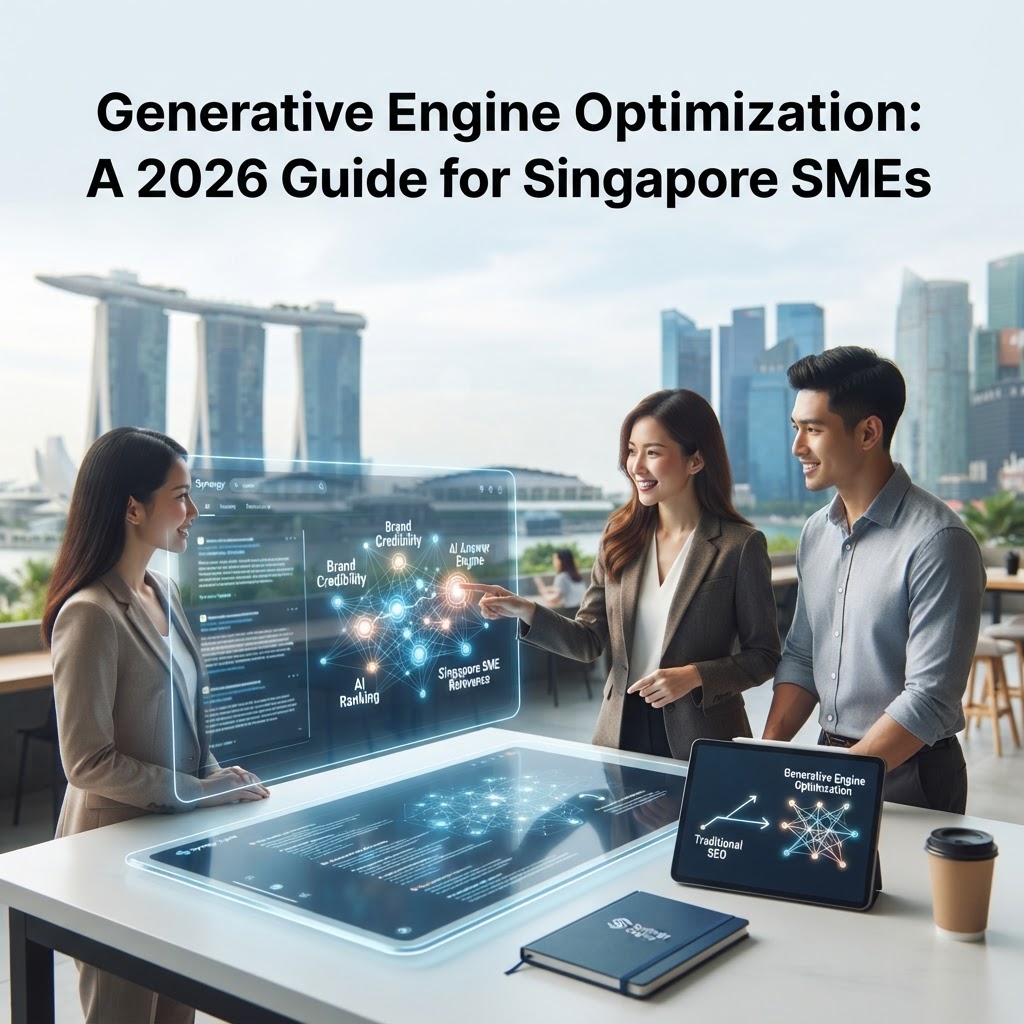
Answer Engine Optimisation: Why Your Singapore Business Needs to Prepare for AI Search
In the digital landscape of 2026, the traditional search experience is undergoing a profound transformation. For years, SMEs in Singapore have focused their efforts on securing blue links on search engine results pages. However, with the rise of AI-driven tools like Google AI Overviews, the rules of the game have shifted permanently. Today, successful visibility requires a strategy known as Answer Engine Optimisation (AEO). This approach moves beyond simple keyword stuffing or chasing algorithm updates; it focuses on structuring your digital presence so that AI models can clearly understand, index, and present your business as the definitive answer to a user’s query. As mobile-first users in Singapore increasingly rely on AI to provide instant, synthesised responses to their problems, businesses that fail to adapt risk becoming invisible. Whether you are a retail store, a B2B service provider, or an e-commerce brand, understanding AEO is now the difference between being featured as a trusted authority or being filtered out of the AI conversation entirely. This guide explains how to future-proof your website and capture this new wave of search traffic effectively.
Table of Contents
Understanding Answer Engine Optimisation
Answer Engine Optimisation (AEO) is the process of formatting and optimising your web content to be ingested by artificial intelligence systems. Unlike traditional SEO, which aims to get a website to rank on the first page of Google, AEO prioritises being the primary source of information within an AI response or a conversational search result. In Singapore, where busy professionals and tech-savvy consumers look for quick, accurate solutions, the transition to conversational search is accelerating. When a user asks an AI about the best logistics firm in Singapore or the latest compliance requirements for the PDPA, the system does not just provide a list of links; it synthesises a direct answer based on the high-quality, structured data it crawls. Our team finds that many local SMEs are still operating under the assumption that keyword density is the primary driver of success. This is a misconception. AI models look for semantic relevance, authoritativeness, and clarity. By focusing on AEO, you position your brand to answer specific questions directly. This involves identifying the common questions your target audience asks and providing concise, evidence-based answers on your site. When your content acts as a direct answer, the likelihood of an AI tool selecting your business to show as a featured citation increases significantly. It is not about tricking the machine; it is about providing the clear, structured context that AI models need to feel confident in recommending your business to their users. As we look at the trajectory of digital marketing in 2026, the businesses that thrive are those that pivot from being ‘links’ to being ‘authoritative answers’ in the eyes of the AI algorithms.
Structuring Content for AI Readability
To succeed in the age of AI search, how you structure your information is just as important as the information itself. Search engines now utilise advanced natural language processing to parse the structure of your pages. If your content is buried in long, rambling paragraphs without clear headings or distinct data points, AI models struggle to extract meaningful snippets. We recommend adopting a ‘structured content’ approach, which includes the use of schema markup—a form of code that tells search engines exactly what a piece of content represents. For example, if you are a Singapore-based business, using local business schema ensures that AI tools recognise your physical address, opening hours, and service areas instantly. Beyond schema, your content should follow a logical hierarchy using H2 and H3 tags. This makes it easier for AI to digest the content into segments, identifying specific sections that answer user queries. Tables are also highly effective tools for AI readability. By presenting comparative data, pricing models, or feature lists in a table, you provide the AI with a neat, easy-to-read package of data that it is far more likely to feature in its response. Here is a simple comparison of traditional SEO versus AEO focus:
| Metric | Traditional SEO | Answer Engine Optimisation |
|---|---|---|
| Core Objective | Traffic to website | Direct answer in AI summary |
| Content Style | Broad, long-form content | Concise, direct, entity-focused |
| Success Indicator | Keyword rankings | Citation frequency in AI results |
| Target User | Searcher clicking links | AI user seeking immediate facts |
We believe that when a website is built with this level of precision, the AI system perceives it as a reliable, high-integrity source, leading to better visibility for the brand across multiple search interfaces and digital assistants.
Technical Foundations and Core Web Vitals
An effective AEO strategy relies heavily on a robust technical foundation. If your website is slow, cumbersome, or inaccessible on mobile devices, even the best content will fail to gain traction with AI systems. This is where Core Web Vitals come into play. These are a set of metrics defined by Google to measure user experience, including loading speed, interactivity, and visual stability. An AI bot, much like a human, prefers a site that loads quickly and is easy to navigate. If your page takes too long to load, the AI might discard your site as a potential source of information. In the context of Singapore’s digital market, where mobile browsing is the standard, having a site that is fully optimised for mobile is a non-negotiable requirement. Furthermore, modern web architecture such as a headless CMS allows for faster, more secure, and more flexible content delivery, which is vital for AI crawlers. We often see SMEs losing potential leads because their websites are built on outdated platforms that lack the technical performance required for today’s search environments. A performance-first build not only pleases search engines but also significantly improves the conversion rate for human visitors who reach your site. Beyond speed, technical SEO includes ensuring that your site is secure (using HTTPS) and follows local PDPA compliance, as AI engines assess trust signals as part of their ranking criteria. When our team helps a client rebuild their site, we ensure these technical standards are baked into the core of the project, not added as an afterthought. This provides a measurable ROI as the site becomes more resilient against shifts in search technology and more effective at retaining visitors once they arrive.
Partnering with a Digital Agency
Navigating the transition to AI-focused search can feel overwhelming for a busy business owner, but you do not need to do it alone. Partnering with a professional digital agency allows you to focus on your core business while experts handle the complexities of your digital footprint. In Singapore, many SMEs can leverage the Productivity Solutions Grant (PSG) to support their digital transformation projects, including website builds and SEO integration. This makes professional-grade digital upgrades significantly more affordable, with funding covering up to 50% of qualifying costs. A good agency acts as a strategic partner rather than just a service provider. We pride ourselves on offering a one-stop solution that encompasses design, development, and AI-ready content strategy. Our approach is consultative and transparent, focusing on what works for your specific market rather than generic tactics. We understand that your time is valuable, which is why we prioritise clear communication, regular reporting, and a collaborative process that keeps you informed at every stage. Whether you are looking to upgrade your e-commerce store or overhaul your corporate presence, our team is committed to delivering solutions that are built for the long term. We do not just build a website; we build a digital asset that is designed to grow with your business and withstand the evolving demands of search engines. By choosing a partner who understands the nuances of the Singaporean market, regulatory requirements, and the technical demands of AI search, you ensure that your investment is protected and your digital strategy remains competitive. If you are ready to learn how your business can benefit from a tailored AEO strategy and explore your eligibility for PSG support, we invite you to book a consultation with our experts today.
Conclusion
Preparing your Singapore business for the era of Answer Engine Optimisation is no longer a luxury; it is a necessity for long-term growth. As AI continues to reshape the way your potential customers discover and interact with brands, the businesses that provide clear, structured, and fast-loading answers will dominate the conversation. By investing in a performance-first website and embracing the shift toward AI-readable content, you are positioning your brand for success in an increasingly complex digital world. Our team is here to help you navigate this transition, ensuring your digital presence is as professional and effective as your business itself. Do not let your competitors be the ones providing the answers your customers are searching for. Contact our team today to discuss your digital goals and explore how we can help you thrive in the new search landscape.
Frequently Asked Questions
- What is Answer Engine Optimisation? It is the practice of optimising content so that AI models can easily find, understand, and use your information to answer user queries directly.
- How does AEO differ from traditional SEO? While SEO aims for high search rankings and traffic, AEO focuses on being cited as the direct answer within AI-generated responses.
- Can SMEs in Singapore get funding for this? Yes, businesses may be eligible for the Productivity Solutions Grant (PSG) to help offset the costs of professional website development and digital upgrades.
- Are Core Web Vitals still important? Yes, they are critical for AI systems to assess whether your site provides a good user experience, which is a major factor in being selected as a source.
- How do I start my AEO strategy? Start by identifying the most important questions your customers ask and ensuring your website provides clear, concise, and structured answers to these queries.