Introduction
The SEO landscape in 2026 is dramatically reshaped by AI, shifting search behavior, and stricter privacy norms. For any digital marketing agency Singapore aiming to scale, the question is no longer whether to invest in search — it’s how to reorganise teams, tools, and processes to capture sustained organic growth. This article outlines practical strategies, metrics and tactics specifically for agencies and in-house SEO teams in Singapore that want measurable results this year.
The Singapore SEO Context in 2026
Singapore’s search market reflects both global trends and local particularities: high mobile adoption, multilingual search sessions, and a dense competitive environment across finance, property, F&B and tech sectors. As global engines favour relevance, experience and direct answers, local businesses rely on agencies to bridge the gap between technical excellence and culturally resonant content. Agencies positioned as strategic partners — not just vendors — will win long-term contracts.
Key shifts to watch:
- AI-driven search results prioritise concise, authoritative answers and structured data.
- User experience and site performance (Core Web Vitals) remain ranking signals.
- Local and multilingual optimisation gains importance for Singapore’s mixed-language audience.
- Conversion focus and revenue attribution become essential for proving agency ROI.
Prioritise E-E-A-T with Local Authority
Experience, Expertise, Authoritativeness and Trustworthiness (E-E-A-T) underpin ranking performance in mature verticals. For a digital marketing agency Singapore, that means:
- Building author pages and contributor bios that highlight verifiable local expertise.
- Using Singapore-relevant data, case studies and customer stories to demonstrate authority.
- Securing citations and links from reputable local press, industry bodies and partners.
Practical tip: create a content hub of Singapore-focused resources (guides, calculators, research) that can act as a link magnet and proof point for client campaigns.
Technical SEO: Speed, Schema and Crawl Efficiency
Technical foundations remain non-negotiable. In 2026, search engines process signals faster and expect cleaner site architecture.
- Core Web Vitals: Prioritise Largest Contentful Paint (LCP) and Interaction to Next Paint (INP) improvements — mobile-first optimisations are critical for Singapore’s on-the-go users.
- Site architecture: flatten deep hierarchies and improve internal linking so authority flows to high-value pages (service pages, local landing pages).
- Structured data: implement schema for products, localBusiness, FAQs, and how-tos to increase visibility in answer boxes and rich results.
- Crawl budget: reduce duplicate pages, canonicalise parameterised URLs and serve compressed assets to conserve crawl budget.
For agencies that blend web design and SEO, a collaborative build process yields faster time-to-rank and fewer redesign reversions. See how integrated approaches improve conversions and search synergy in our analysis of web redesign impacts.
Content Strategy: Intent-First and Multilingual
Move away from keyword lists to an intent-first content model. Identify principal search intents (informational, transactional, navigational, local) and map content accordingly. For Singapore markets, ensure content is culturally and linguistically appropriate.
- Pillar pages + topic clusters: anchor long-tail topical relevance with authority pages that aggregate resources and internal links.
- Localised landing pages: create pages for specific neighbourhoods or service areas (e.g., Orchard, Jurong) rather than generic country pages.
- Multilingual layering: produce primary content in Singapore English and adapt key pages into Mandarin, Malay or Tamil when the target audience demands it.
To scale content production, pair human expertise with AI-assisted drafts and rigorous editorial controls. For guidance on implementing AI in search-focused content creation, consult an applied AI search optimisation guide tailored to SMEs.
AI & Generative Search: Tactical Adoption
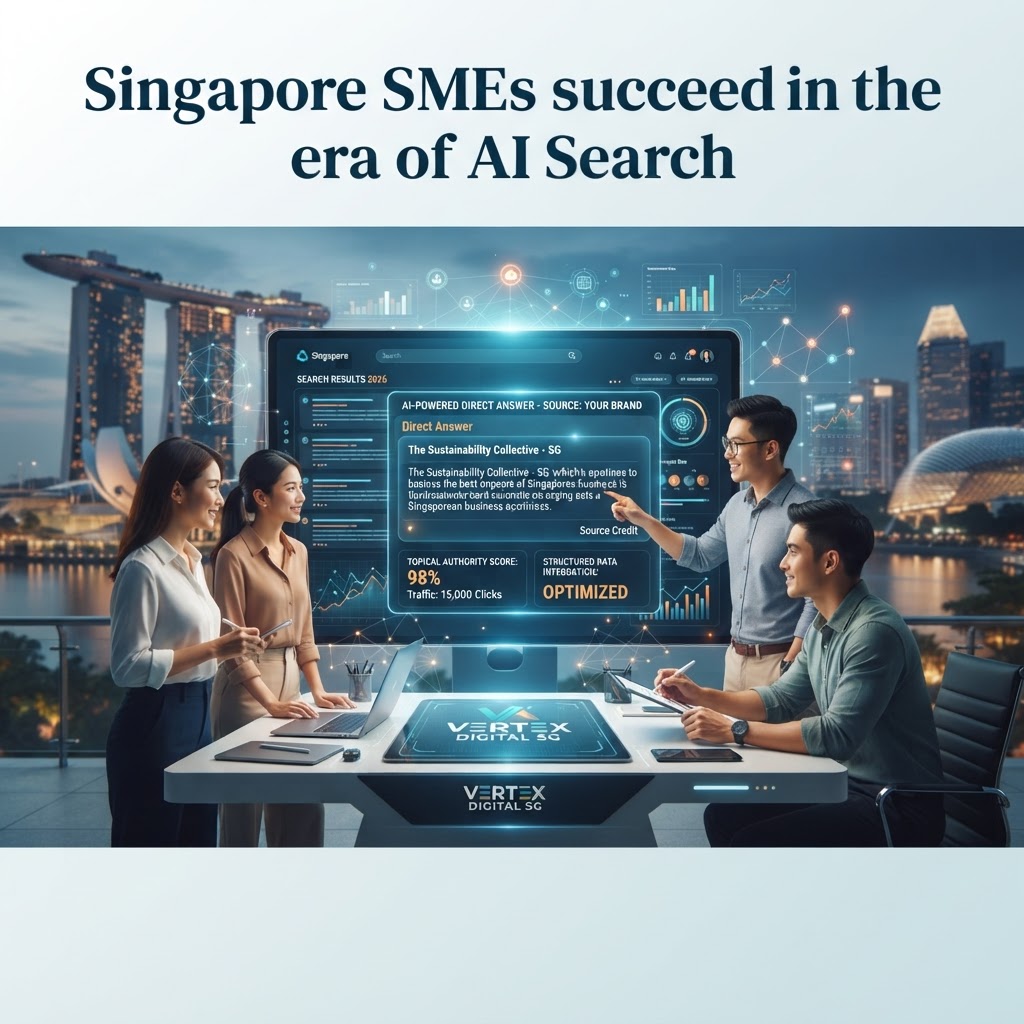
AI-generated snippets and generative answers are changing click behavior. Agencies must optimise for both organic clicks and zero-click visibility by:
- Optimising for answer engines: structure content so that it directly answers common queries, using short, scannable paragraphs and clear facts.
- Owning featured answers: create concise, factual summaries at the top of long-form pages to increase the chance of being used in snippets.
- Experimenting with generative content responsibly: use AI to draft outlines and data pulls, but always edit for accuracy, local context and voice.
If your agency is exploring generative engine optimisation, a focused resource explains the mechanics and practical steps to benefit from this new format.
Local SEO & GMB-Equivalent Presence
Local signals matter in Singapore’s compact market. Prioritise these steps:
- Google Business Profile optimisation: consistent categories, services, up-to-date hours and high-quality images.
- Local citations: uniform NAP (Name, Address, Phone) across directories and industry listings.
- Reviews and reputation: encourage verified reviews and respond promptly with location-specific information.
- Local landing pages with schema: embed local schema and event markup where relevant.
Agencies that can prove improved foot traffic and local conversions stand out when bidding for enterprise work.
Conversion-led SEO and Web Design Integration
Search-driven leads are only valuable if they convert. Align SEO with CRO (conversion rate optimisation) and web design to capture higher quality traffic:
- Page-level experimentation: test CTAs, form lengths and microcopy, measuring impact on organic landing pages.
- Mobile-first funnels: reduce friction on mobile checkout and enquiry flows.
- Design for signals: use clear author and contact cues to improve trust signals on SEO landing pages.
A practical case study on combining web design and SEO shows measurable uplift in conversions when both disciplines collaborate from concept to launch.
Measurement: Attribution and Revenue Focus
Agencies must move beyond rankings and sessions. Track metrics that matter to clients:
- Assisted conversions and multi-touch attribution for organic search.
- Organic revenue per channel and per landing page.
- SERP feature share and answer click-through rates.
- Speed and experience metrics tied to conversion outcomes.
Use server-side analytics, GA4 with properly implemented events, and data-layer best practices to create reliable dashboards that demonstrate impact.
Team Skills and Org Design for 2026
Successful agencies refactor teams around outcomes, not outputs. Consider these structures:
- Cross-functional squads: SEO + content + developer + CRO in each client pod.
- An AI ops or content engineering role: to maintain prompt libraries, data integrity and quality control for AI-written drafts.
- Local search specialists: bilingual SEOs who understand Singapore nuances and regulatory considerations.
Training and knowledge-sharing are essential; invest in upskilling on generative search, schema, and multilingual optimisation.
Practical 90-Day Playbook for Agencies
Month 1 — Audit & Prioritise
– Technical crawl and Core Web Vitals report.
– Content intent map for top clients and 10 quick-win page updates.
– Local profile & citation scan.
Month 2 — Implement & Test
– Launch schema and FAQ expansions on priority pages.
– Run mobile funnel CRO tests on two organic landing pages.
– Start a multilingual pilot for a high-value service.
Month 3 — Scale & Measure
– Document revenue attribution and share findings with clients.
– Scale successful content patterns into topic clusters.
– Automate reporting and establish SLA for ongoing optimisation.
Pairing these actions with investment in tools and a disciplined QA process produces consistent gains.
Tools and Integrations to Consider
- Core vitals & RUM: Lighthouse, PageSpeed Insights, or real-user monitoring.
- Crawl & technical SEO: Screaming Frog, Sitebulb.
- Content research & AI assist: enterprise-grade LLM platforms with prompt governance.
- Local citation management and review monitoring.
- Data & attribution: GA4, server-side tagging and business intelligence dashboards.
For agencies adopting AI search tactics, review specialist guidance on integrating AI with search workflows in local SME contexts.
Conclusion
For a digital marketing agency Singapore, SEO in 2026 demands a hybrid approach: rigorous technical foundations, localised content crafted for intent, and strategic use of AI to scale without sacrificing quality. Agencies that can align web design, content, and measurable conversion outcomes will secure the most valuable, long-term client relationships.
Adopt the outlined playbook, invest in cross-disciplinary skill sets, and prioritise revenue-focused measurement to convert search visibility into demonstrable business growth.
AI search optimisation guide | Boost conversions & web design | Answer engine optimisation resource | Generative engine optimisation overview | AI SEO meets web design case study