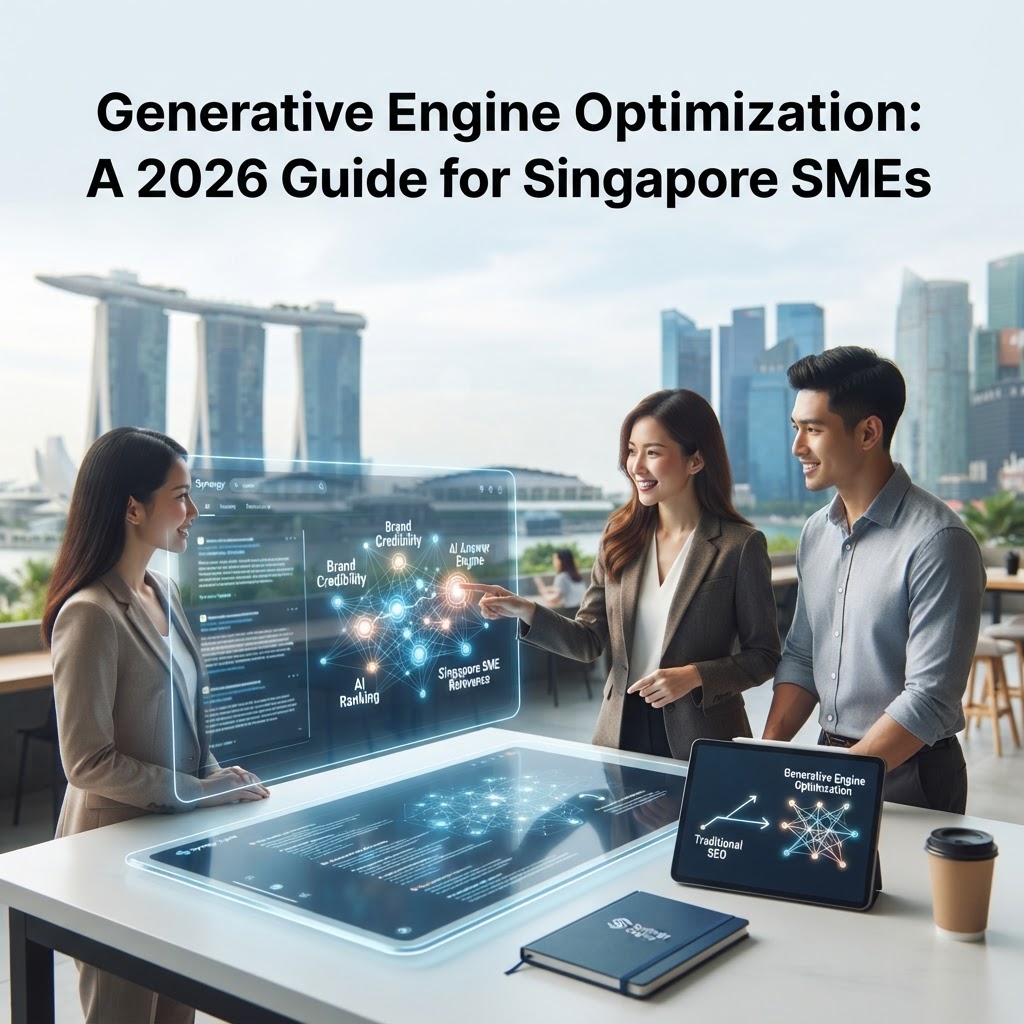
Singapore’s search landscape in 2026 demands a different playbook. Local AI SEO isn’t about replacing human strategists — it’s about blending advanced AI capabilities with local-first fundamentals so agencies can drive measurable traffic and conversions for Singapore businesses.
Why local AI matters for SEO Singapore in 2026
Search engines and conversational interfaces have evolved. Generative models, multimodal ranking, and richer SERP features reward content that answers local intent precisely and quickly. For businesses in Singapore, where mobile-first behavior, multilingual queries (English, Mandarin, Malay, Tamil) and proximity signals matter, local AI SEO provides tools to:
- Surface local business answers in conversational search and zero-click SERPs
- Personalize landing content dynamically for micro-audiences (e.g., precinct-level promos)
- Automate high-signal tasks (schema, summaries, review snippets) while keeping editorial oversight
Digital marketing agency Singapore teams that master this blend capture a bigger share of intent-driven traffic and improve conversion efficiency.
Core components of a Local AI SEO program
A practical framework for agencies includes four pillars:
- Technical foundations — reliable crawling, structured data, and fast pages
- Local entity & citation hygiene — consistent NAP, Google Business Profile optimization, local schema
- Content & intent intelligence — AI-assisted briefs, local topic clusters, multilingual content
- Measurement & privacy-safe modeling — conversion attribution, offline signals, server-side analytics
Each pillar has AI accelerants: RAG (retrieval-augmented generation) for fast local answers, LLM-assisted content briefs, and automated schema generation for pages and FAQs.
Technical foundations agencies must get right
Search performance still starts with fundamentals. For SEO Singapore projects in 2026, prioritize:
- Core Web Vitals and LCP improvements on mobile networks common in Singapore
- Edge and server-side rendering for dynamic local pages to ensure crawlability
- Structured data for LocalBusiness, Service, Review, and FAQ to increase SERP real estate
- Canonicalization and hreflang where multilingual pages target different languages
Automated tooling can generate initial schema and audit reports, but human QA is essential to avoid inaccurate business data being surfaced in knowledge panels.
Content strategy: local entities, semantics and helpfulness
AI can write, but it must be guided by intent and local insight. Create content around entities — places, neighborhoods (e.g., Orchard, Jurong), and real-world experiences. Good practices:
- Build micro-clusters: a pillar page about a service plus location-specific subpages optimized for precinct-level search intent
- Use local data signals — opening hours, service areas, local events — to make content unique and useful
- Include multilingual snippets and transliterations where appropriate to capture non-English queries
- Employ LLMs for outline generation, then have writers add local nuance, customer stories, and images
Link the content production workflow to tools that pull verified local facts so AI-generated text doesn’t hallucinate details.
Optimize profiles, reviews and on-the-ground signals
Local pack and Maps visibility hinge on consistent profiles and quality reviews. Agencies should:
- Keep Google Business Profile data accurate and complete; automate scheduled updates for hours and special events
- Use review-generation programs tied to purchases, with follow-ups and templates that comply with platform guidelines
- Monitor citations across directories and clean inconsistencies programmatically
Validate any automation with manual checks to prevent mismatches that harm local trust signals.
Automation and workflows for a modern digital marketing agency Singapore
Automation should reduce repetitive work and free teams to focus on strategy. Core automation areas:
- Keyword and SERP intent clustering using AI to identify local opportunities
- Automated content briefs that include local intent, required schema, and internal-linking targets
- Template-driven local landing pages created at scale with dynamic blocks for neighborhood-specific facts
- Programmatic review monitoring and response suggestions for frontline teams
For agencies evaluating partners or tooling, a practical resource on how to evaluate a digital marketing agency in Singapore can clarify what to expect from vendors and platforms.
Learn how to evaluate a digital marketing agency in Singapore
Integrating AI with web design and UX
SEO and web design must be inseparable. AI-driven personalization only performs when UX supports it: progressive disclosure of local offers, clear CTAs, and accessible content. Examine designs for:
- Component-level personalization (hero, promos, contact options) driven by search intent
- Accessibility and mobile ergonomics for quick local actions like calls and directions
- Fast image delivery and optimized local images that reflect neighborhoods
For teams building modern sites, frameworks that combine AI-led content with solid design principles are becoming the standard; see examples of AI web design approaches for Singapore agencies.
AI web design for digital marketing agency Singapore
Personalization and ecommerce for local businesses
Ecommerce businesses benefit from AI personalization that respects privacy. Use server-side signals and first-party data to:
- Surface store-availability or click-and-collect options for nearby shoppers
- Recommend local bestsellers based on neighborhood preferences
- Trigger localized promotions tied to events or seasons in Singapore
When applying personalization, combine generative copy for dynamic product descriptions with verified local inventory data to avoid mismatches.
AI personalization for ecommerce in Singapore
Generative engines and ranking: optimization beyond keywords
Search ranking increasingly values contextual and factual accuracy. Generative engines pull from multiple sources; ensure your content is easy to retrieve:
- Implement knowledge layers (structured data, internal search indexes) so generative models pull the right facts
- Use canonical, authoritative content for common local queries to become the primary cited source
- Create short, factual snippets that can be used as answer boxes and voice responses
Read more on generative engine optimization tactics tailored for SMEs to make sure your client’s content is discoverable by modern engines.
Generative engine optimization for Singapore SMEs
Measurement, privacy and resilient analytics
Third-party cookies are out; privacy-aware attribution and modeling are in. For local AI SEO measurement:
- Implement server-side events and first-party event models for conversions and lead tracking
- Match offline signals (walk-ins, calls) with online touchpoints using hashed identifiers where permitted
- Use experimentation to validate AI-driven personalization lifts across neighborhoods
GA4 provides event-driven tracking but combine it with CRM integrations and call-tracking to close the loop on local performance.
90-day tactical plan for agencies
Week 1–2: Audit
- Crawl and Map Cluster: crawl the site, map local pages, collect GCP and citation data
- Performance baseline: CWV, mobile performance, and top local keywords
Week 3–6: Foundation uplift
- Fix urgent technical issues, deploy critical schema, and optimize ranking-critical pages for mobile
- Create canonical local landing page templates and set up server-side rendering where needed
Week 7–10: Content & automation
- Generate AI-assisted content briefs, produce neighborhood micro-pages, and deploy structured FAQs
- Automate review monitoring and schedule business profile updates
Week 11–12: Measure and iterate
- Run low-cost experiments on personalization and localized CTAs
- Measure conversions with first-party models and refine targeting
Throughout, keep human editors in the loop to validate AI outputs and ensure local nuance.
Common pitfalls and how to avoid them
- Over-reliance on raw AI output: Always add local facts and human editing to avoid hallucinations
- Ignoring profile hygiene: Small inconsistencies in NAP break local authority
- Scaling without QA: Programmatic pages can create thin, duplicate content if not templated correctly
- Neglecting offline signals: For many Singapore businesses, phone calls and walk-ins still drive revenue
A well-governed automation pipeline with sampling and manual reviews mitigates these risks.
Conclusion
Local AI SEO for Singapore in 2026 is a pragmatic mix of automation, local-first content, technical excellence, and privacy-aware measurement. Digital marketing agencies that pair AI capabilities with local insight will win higher intent traffic and stronger conversions. Start by shoring up technical foundations, standardizing local data, and deploying controlled AI workflows — then scale what demonstrably improves outcomes.
For guidance on aligning SEO and design to local strategies in Singapore, explore integrated approaches that unite search, UX, and AI-driven content.
SEO Singapore meets web design — integrated approaches
Adopting these steps positions agencies to deliver consistent, measurable local growth for Singapore clients throughout 2026 and beyond.