Generative Engine Optimization: A 2026 Guide for Singapore SMEs to Stay Visible
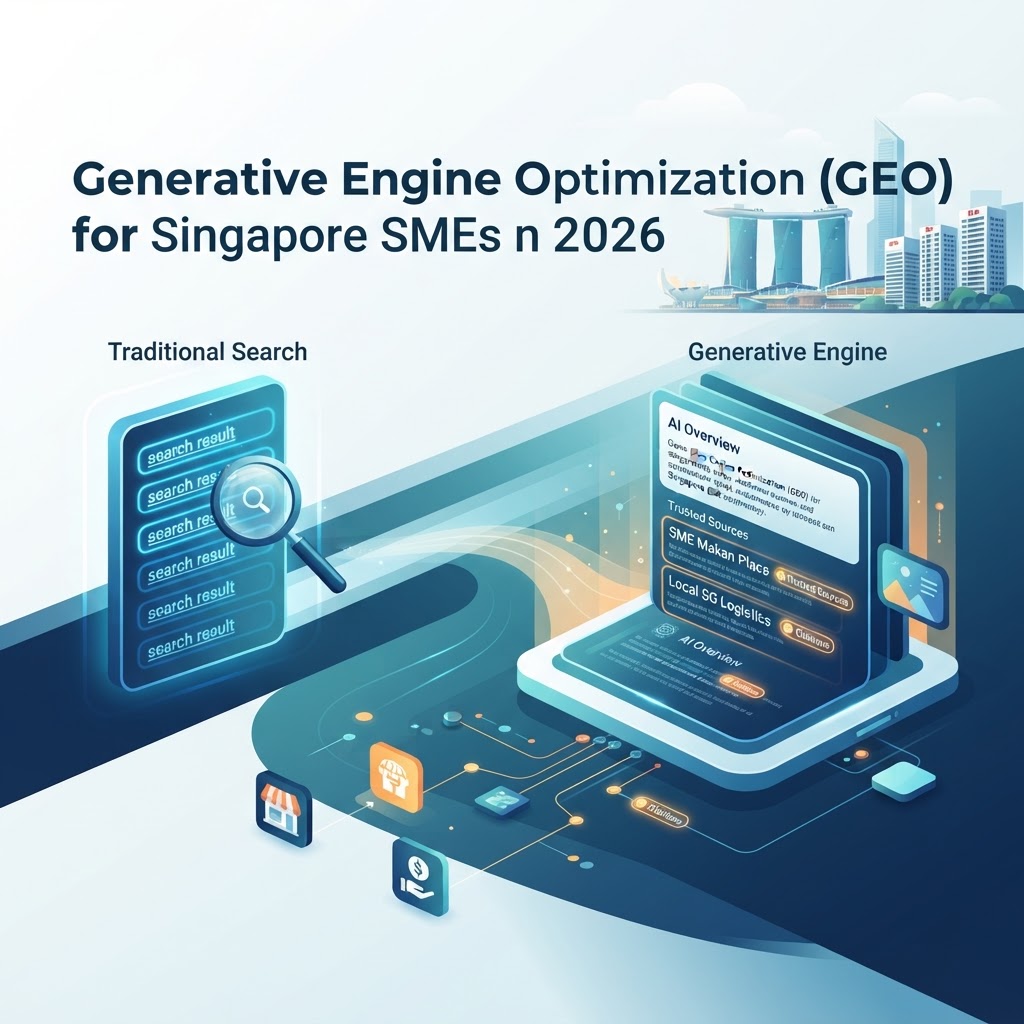
The digital landscape in Singapore is undergoing a profound transformation. As AI Overviews and generative search models redefine how users find information, the old playbook of keyword stuffing and backlink farming is becoming obsolete. For Singaporean business owners, this shift represents a critical juncture. To remain discoverable in an era dominated by large language models, your digital strategy must pivot toward Generative Engine Optimization (GEO). While traditional SEO focuses on getting your link clicked, GEO focuses on ensuring your brand is cited as the authoritative answer within the AI-generated responses that now occupy the top of search result pages. At iPro Dezign, our team recognises that for local SMEs, visibility is the lifeblood of growth. Whether you operate in retail, professional services, or manufacturing, understanding how to position your content for AI discovery is no longer optional. This guide outlines how you can adapt your digital presence, leverage Singapore government grants like the Productivity Solutions Grant (PSG) for necessary website upgrades, and maintain a competitive edge in a landscape where the interface between brand and consumer is increasingly mediated by machine intelligence.
Table of Contents
Understanding the Shift to Generative Engine Optimization
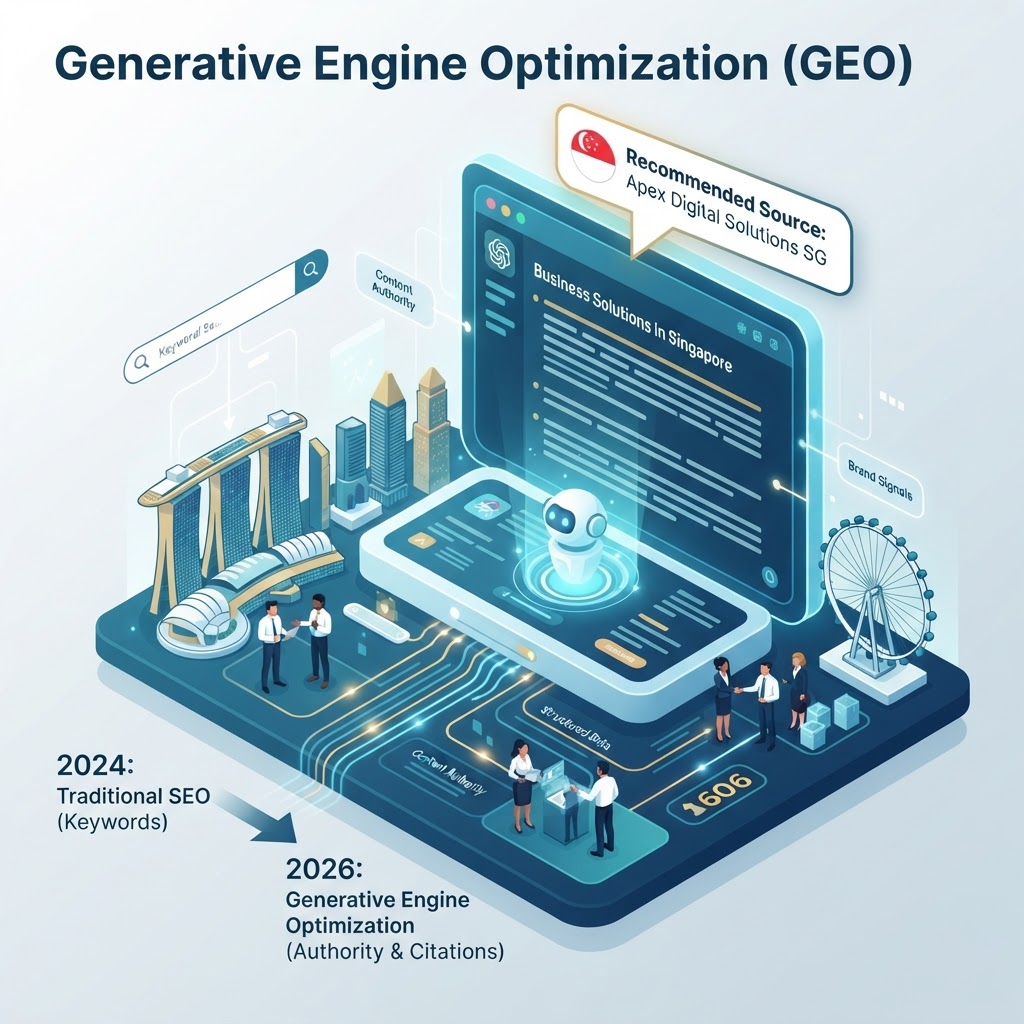
Generative Engine Optimization (GEO) is the practice of optimizing content to be indexed and cited by generative search engines like Google’s AI Overviews, Perplexity, or ChatGPT. Unlike traditional SEO, which prioritizes ranking in a list of blue links, GEO prioritizes becoming the source of truth for the model. When a user asks a complex question, the AI synthesizes information from multiple sources to provide a concise, natural-language summary. If your business provides that synthesis—clear, evidence-based, and highly relevant—the AI will attribute the information to you. For an SME in Singapore, this is a significant opportunity to capture high-intent traffic without needing a massive domain authority score. The shift requires moving away from thin, keyword-heavy landing pages toward depth-first content that answers specific, multi-layered queries. Our digital agency has observed that AI models favour content structured around entities and concepts rather than individual keyword strings. By mapping out the semantic relationships between your services, local Singapore market needs, and customer pain points, we create a knowledge graph that search models can easily ingest. This does not mean you abandon traditional SEO entirely; rather, you evolve it. You must ensure your site is technically capable of being crawled effectively while simultaneously feeding the AI the structured data it craves to understand your expertise. Because the interface is moving toward conversational dialogue, your brand voice must evolve to be more descriptive and helpful. Rather than just targeting a term like ‘office renovation Singapore,’ you should focus on answering the intent: ‘How can I renovate my office while complying with BCA regulations and staying within a budget?’ By providing the precise answer that the AI wants to cite, you become an indispensable component of the generative search experience.
Building Trust and Authority in the AI Era
Establishing authority in the AI age is fundamentally about demonstrating Expertise, Experience, Authoritativeness, and Trustworthiness (E-E-A-T) in a way that machine learning algorithms can verify. AI models are trained to avoid hallucinating facts, which means they are biased toward sources that consistently provide accurate, well-documented information. For Singapore SMEs, this means your content strategy must shift from surface-level blog posts to data-rich, industry-specific insights. When you write about your services, cite local regulations, industry benchmarks, and professional standards relevant to the Singapore market. If you are a digital agency or a consultancy, include case studies that showcase real outcomes with transparent methodologies. The key is to provide structured evidence that an AI can ‘read’ and trust. Use specific formatting such as tables to summarize complex information, as these are often pulled directly into AI snippets. We recommend focusing on long-form content that acts as an educational hub for your niche. By creating evergreen resources—such as comprehensive guides on PDPA compliance, PSG grant applications, or sustainable energy adoption for Singapore businesses—you create a recurring touchpoint that AI systems will frequently reference. It is essential to ensure that your website architecture facilitates this. Information should be layered logically, with internal linking strategies that reinforce the thematic authority of your site. Our team often helps clients perform a content audit to prune low-value pages that may dilute their overall authority score in the eyes of an AI evaluator. Remember, if your site is cluttered with outdated or thin content, the algorithm may treat your entire domain as less reliable. By focusing on quality over quantity and consistently updating your content to reflect the latest industry developments, you maintain your status as a reliable source in the eyes of search engines. This commitment to transparency and accuracy builds the long-term trust that search systems prioritize when selecting which brand to cite in their generated answers.
Technical Infrastructure for AI Search
Behind every great content strategy lies a robust technical foundation. AI search models rely heavily on the speed, security, and structured data of your website to evaluate its quality. Core Web Vitals—Google’s set of metrics for measuring user experience, including Largest Contentful Paint (LCP) for loading performance—are more relevant than ever. If your site is slow, unresponsive, or difficult to navigate, it signals to both traditional crawlers and AI models that your content may be inferior. For many Singapore SMEs, this is where a professional website rebuild or optimization becomes necessary. Modernizing your site to use lightweight code, efficient image compression, and a fast Content Delivery Network (CDN) ensures your server responds near-instantly, even for global users. Furthermore, technical SEO has evolved into technical GEO. This involves implementing Schema markup, which is code that helps search engines understand the context of your page. By using specific Schema types for products, organizations, FAQs, and local businesses, you are essentially providing the AI with a roadmap to your data. A well-structured site allows the AI to extract your business hours, service prices, and location details directly, placing them into a rich snippet that occupies more screen space. This is critical for mobile users in Singapore, who expect instant results on the go. Below is a comparison of how traditional technical SEO requirements differ from the needs of modern Generative Engine Optimization.
| Metric | Traditional SEO Focus | GEO Focus |
|---|---|---|
| Site Speed | Page load time under 3 seconds | Sub-second rendering and structured data availability |
| Data Format | Text-heavy landing pages | Entity-based content and Schema markup |
| Navigation | User flow for conversion | Semantic hierarchy for AI crawling |
| Content Type | Keyword-targeted articles | Comprehensive, authoritative resource guides |
We often assist SMEs in leveraging the PSG grant to fund these technical improvements. By upgrading to a performant, mobile-responsive, and secure infrastructure, you not only improve your conversion rates but also make it significantly easier for AI search models to interpret and recommend your business. Our team emphasizes building with a focus on longevity, ensuring that your CMS is flexible enough to adapt to future algorithmic changes without needing a complete overhaul every two years.
Developing a Localized GEO Strategy for Singapore SMEs
Applying GEO in the Singapore market requires a localized approach that respects our specific business environment. Singapore is a unique, high-trust, and highly connected market, which influences how users interact with AI. When building your strategy, emphasize your local presence and compliance. Mention your local office location, your registration with ACRA, and your adherence to the PDPA (Personal Data Protection Act). AI models are increasingly sensitive to ‘local intent.’ When a user searches for a service, the model will look for providers that explicitly demonstrate local context. By incorporating regional keywords, local case studies, and testimonials from Singaporean clients, you signal to the AI that your business is the most relevant option for users in this territory. Furthermore, consider the multilingual and multicultural nature of Singapore. If your business serves multiple segments, your content should reflect this breadth, perhaps through localized landing pages that address specific cultural or industrial nuances. A robust GEO strategy should also be integrated with your overall digital marketing mix. Your social media presence, Google Business Profile, and review platforms all serve as data points that AI models crawl to build a composite view of your brand. If your reputation is inconsistent across these platforms, it can negatively impact your authority scores. We advocate for a unified digital presence where your branding, messaging, and service offerings are consistent everywhere. As you work toward this, think about the long-term ROI. Unlike traditional paid ads that stop generating leads the moment you stop paying, optimizing your site for generative search builds an asset that grows in value as the model learns to trust your domain. If you are uncertain about where to start, our digital agency offers consultations to audit your current site against these new standards and identify where you can apply for government grants to cover the costs of these necessary upgrades. Investing in your digital presence today is an investment in your company’s ability to remain the primary answer for your customers in the future.
As we navigate this shift, remember that the core goal of any business remains the same: to be the most helpful partner to your customers. Whether your audience is looking for advice, products, or services, the move toward Generative Engine Optimization simply necessitates that you prove your value in a new, more intelligent environment. By focusing on high-quality content, a solid technical foundation, and a commitment to local expertise, you can position your SME to thrive. If you are ready to modernize your digital infrastructure or need guidance on navigating PSG eligibility for your website project, our team is always here to assist. Let us help you transform your online presence into a robust, AI-ready asset that drives measurable growth and keeps your brand visible in the years ahead.
Frequently Asked Questions
1. What is the difference between SEO and GEO? Traditional SEO focuses on ranking in blue links, whereas GEO focuses on being the cited source within AI-generated summaries and answers.
2. Does my SME need a total website rebuild for GEO? Not necessarily. Often, targeted technical improvements, better structured data, and updated content strategies are sufficient to enhance your discoverability for AI models.
3. Can I use PSG grants for GEO-related website upgrades? Yes, many digital transformation projects that improve site performance and functionality are eligible for the Productivity Solutions Grant in Singapore, covering up to 50% of the cost.
4. How quickly will GEO efforts show results? Like all high-quality digital marketing, GEO is a long-term strategy. It focuses on building sustainable authority and trust, which usually takes several months of consistent effort to manifest in AI-citation frequency.
5. Is keyword research still relevant? Yes, but it has shifted. You now need to research the ‘questions’ and ‘concepts’ your customers are asking, rather than just isolated search terms, to align with the conversational nature of AI search.