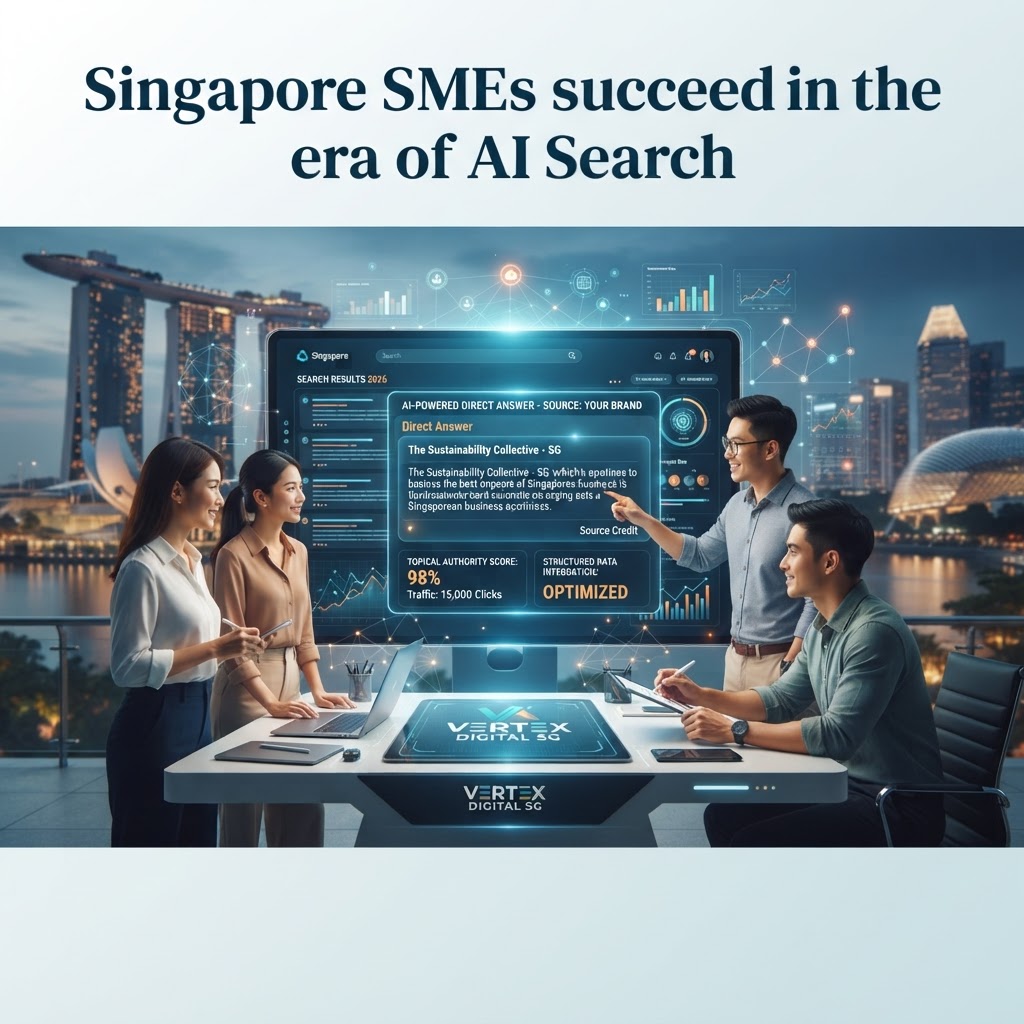
Why AI SEO matters for a digital marketing agency Singapore in 2026
AI is no longer an experimental add-on — it’s the operating system for modern search. For a digital marketing agency Singapore-based or targeting Singaporean audiences, AI-driven SEO changes how you research keywords, craft content, optimise technical signals, and measure outcomes. Search engines now combine large language models, user signals, and on-page intent to surface results that favour relevance, authoritativeness, and user satisfaction.
This article lays out a pragmatic playbook to use AI for scaling client acquisition, improving search visibility, and converting organic traffic into measurable revenue.
What’s different in 2026: trends shaping SEO Singapore
- AI-first ranking signals: Models evaluate semantic relevance and user intent more deeply than simple keyword matches.
- Zero-click and SERP dominance: Rich results, knowledge panels, and instant answers capture more real estate — requiring a strategy for visibility beyond traditional ranking.
- E-E-A-T and trust signals: Experience and demonstrated expertise now directly influence topical authority.
- Local and voice search growth: Singapore’s mobile-first population and smart assistant adoption make local optimisation and conversational queries essential.
- Automation & scale: Content generation, on-page A/B testing, and technical audits are increasingly automated, letting agencies focus on strategy and creativity.
These shifts mean a digital marketing agency Singapore-focused must combine technical rigour with AI-enabled content workflows.
How AI changes keyword research for SEO Singapore
AI tools let you discover intent clusters instead of isolated keywords. Instead of chasing high-volume head terms, you map content to clusters (informational, navigational, transactional) and identify intent gaps competitors miss.
Practical steps:
- Build topic clusters using semantic models to group related queries and long-tail conversational variants.
- Prioritise keywords by business value (estimated conversions) not just volume.
- Monitor SERP feature opportunities (featured snippets, People Also Ask, maps) and plan content to occupy them.
Link keyword anchors like “Dominate SEO Singapore” to internal agency resources to guide clients on strategic keyword prioritisation.
Content strategy: AI-assisted, human-led
AI can accelerate ideation, outlines, and first drafts. But full automation risks generic output and weak expertise signals — especially in a nuanced market like Singapore.
A balanced workflow:
- Use AI to analyze top-performing pages and generate data-backed outlines.
- Inject local signals: Singapore-specific regulations, case studies, currency, and locale-aware phrasing.
- Apply E-E-A-T: include author bios, case studies, screenshots, client testimonials, and citations.
- Create pillar pages and supporting cluster content; link them to build topical depth.
For agencies that want to move to an AI-native model for SME clients, consider frameworks like AI-native digital marketing to scale content safely and ethically.
Technical SEO + AI: speed, structure, and schema
Technical health matters more as AI models ingest structured signals. Focus areas:
- Core Web Vitals: prioritise CLS, LCP and FID improvements for mobile-first users.
- Semantic markup: implement structured data (schema.org) for products, services, FAQs, and local business details.
- Crawl efficiency: use server logs and AI anomaly detection to find wasted crawl budget and orphan pages.
- Internationalisation: if serving multi-lingual Singaporean audiences (English, Mandarin, Malay, Tamil), use hreflang and clear URL structures.
Schema increases your chance of appearing in rich results and voice answers — essential for modern zero-click search.
Local SEO: dominate neighbourhood searches in Singapore
Local search remains high-intent. For agencies, local optimisation is a fast path to measurable ROI:
- Fully optimise Google Business Profile with high-quality photos, accurate categories, and frequent posts.
- Harvest and manage reviews; respond promptly and professionally.
- Ensure NAP (name, address, phone) consistency across directories and the website.
- Create neighbourhood pages or service-area pages that reflect micro-intent (e.g., Bukit Timah vs. Jurong East) and add local case studies.
Local schema, review markup, and conversational content help with voice queries and map pack rankings.
Measuring impact: KPIs beyond rankings
Rankings are a vanity metric. Focus on indicators that tie to business outcomes:
- Organic sessions and conversion rate by landing page.
- Assisted conversions where organic traffic influenced multi-touch paths.
- SERP feature impressions and CTR (to capture zero-click impacts).
- Revenue per visitor and customer acquisition cost from organic channels.
Use AI to automate attribution modeling and anomaly detection, flagging when a client’s traffic diverges from expected patterns.
Tools and tech stack for AI SEO Singapore
A pragmatic stack for an agency includes:
- Semantic research and content platforms that integrate LLMs for intent mapping.
- Site crawlers for technical audits with automated prioritisation.
- Rank trackers that monitor SERP features and local pack positions for Singapore.
- Analytics platforms with custom attribution models and cohort analysis.
- CMS integrations for streamlined publishing and schema injection.
When building or recommending tools, document compliance and data privacy measures to reassure Singaporean clients.
Creative approaches to stand out in a crowded market
- Interactive content: calculators, quizzes and localised tools that increase dwell time and direct lead capture.
- Micro-case studies: publish short, precise proof points demonstrating how you moved a Singapore SME up the funnel.
- Video snippets and transcript optimisation: videos are favoured in many result types and support multilingual audiences.
- Partnerships with local organisations: collaborations with trade associations or schools boost local E-E-A-T.
For web and UX priorities that influence SEO outcomes, reference research on web design trends 2026 to ensure technical and visual alignment.
Client onboarding and processes for scalable AI SEO
A repeatable onboarding flow helps agencies scale without losing quality:
- Discovery and intent mapping: understand the client’s business model, KPIs, and customer journeys.
- Technical baseline audit: prioritise fixes that unblock growth (page speed, indexability, schema).
- Content programme: define pillar topics, publication cadence, and governance for AI-assisted drafts.
- Local and reputation playbook: review generation, citations, and GBP optimisation.
- Measurement plan: agreed KPIs, reporting cadence and an optimisation loop.
Documentation and playbooks accelerate onboarding and reduce time-to-impact, especially for SMEs undergoing digital transformation for SMEs.
Pricing models and value communication
Agencies should move away from hourly SEO retainers toward outcome-driven models:
- Tiered retainers based on business outcomes (traffic, leads, revenue).
- Project-based pricing for migrations, site builds or schema rollouts.
- Performance bonuses tied to agreed benchmarks.
Clearly communicate how AI reduces costs (automation, faster research) while increasing strategic value (faster insights, personalised content).
Risk management and ethical considerations
AI introduces risks: hallucinations in content, copyright issues, and over-automation that harms user experience. Mitigate them by:
- Human-in-the-loop editorial reviews and fact-checking.
- Transparent content policies and citation requirements.
- Privacy-first data practices and opt-outs for tracking where required under Singapore law.
Address these aspects proactively in proposals and contracts.
Roadmap: 90-day plan for agencies to implement AI SEO
- Day 0–30: Audit and quick wins — fix technical barriers, implement schema, and stabilise Core Web Vitals.
- Day 31–60: Content and localisation — launch pillar pages, local landing pages, and a review generation system.
- Day 61–90: Automation and measurement — deploy AI-assisted workflows for content briefs, set up attribution models, and run A/B tests on high-value pages.
For agencies committed to a fully AI-integrated model, resources on AI-native digital marketing provide frameworks tailored for Singapore SMEs.
Final takeaways: positioning your agency for growth in 2026
SEO in 2026 is holistic: it’s a mix of technical excellence, AI-augmented content, local relevance, and measurable business outcomes. A digital marketing agency Singapore-focused that masters AI SEO will not just chase rankings — it will deliver revenue, build trust, and create defensible topical authority.
For agencies seeking to accelerate results, tactical investments in structured data, local optimisation, AI-supported content workflows, and outcome-based pricing deliver the strongest returns. Consider building case studies around zero-click and SERP-feature capture to show immediate client value and long-term brand authority.
Explore deeper guidance on dominating the landscape with targeted frameworks like Dominate SEO Singapore and tactical explorations of zero-click search to expand your service offerings and win more competitive pitches.