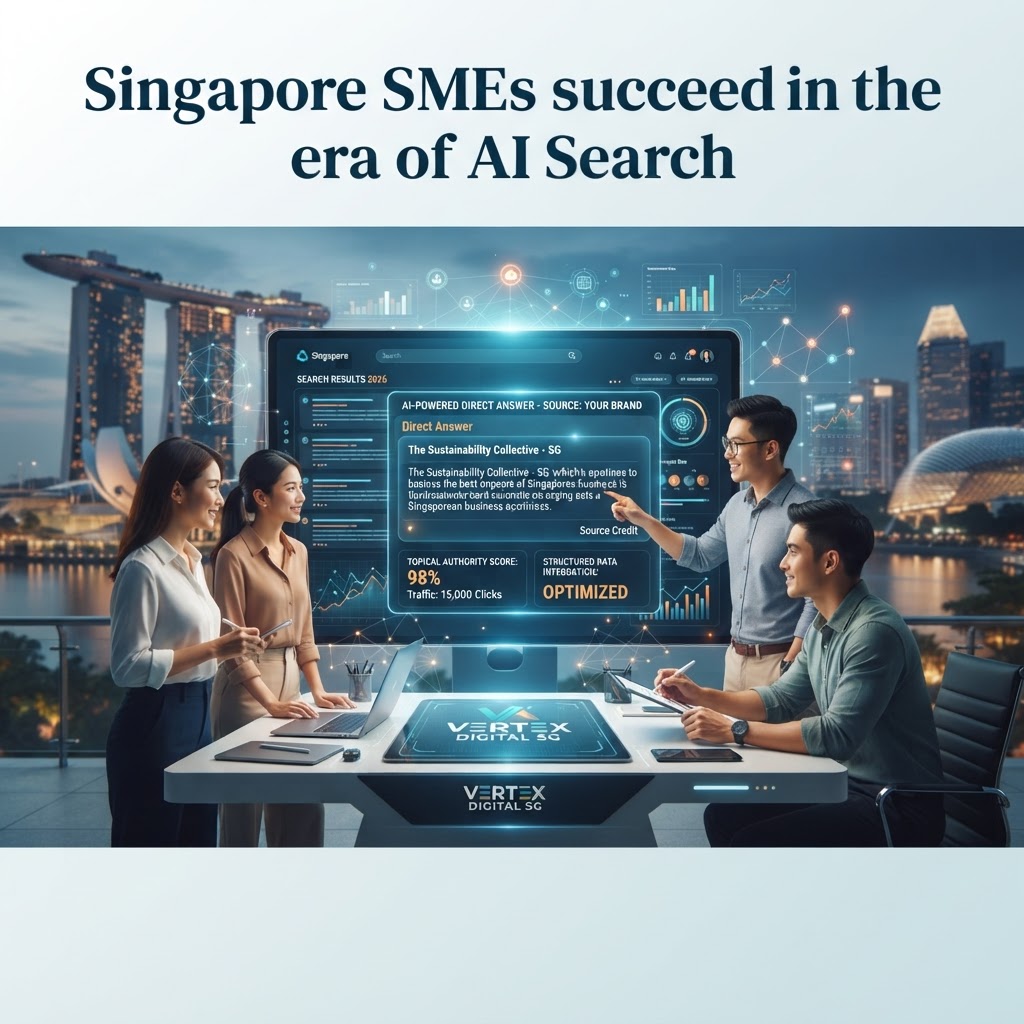
A fast-moving landscape: why AI matters for agencies in 2025
Singapore’s digital economy is maturing rapidly. Brands expect websites that load fast, personalize in real time, and convert across devices. For a modern digital marketing agency Singapore teams must offer more than design — they must deliver measurable growth. AI is no longer experimental; it’s a core capability that can transform how agencies approach strategy, creative, development and measurement.
Artificial intelligence accelerates ideation, automates rote development tasks, and produces content variations at scale. That means faster launch cycles, lower production costs, and better-performing sites. Agencies that combine human strategy with AI tooling will win more briefs and capture higher client lifetime value.
What AI changes about web design in Singapore
- Speed to market: AI-assisted prototyping and code generation reduce build time from weeks to days.
- Personalization at scale: AI can adapt content, CTAs and visuals per user segment in real time.
- SEO and content automation: Generative models create optimized copy and meta tags with local search intent.
- Consistency and governance: Design systems enriched with AI-driven components keep brand experiences uniform across channels.
- Cost efficiency: Fewer hours on repetitive tasks mean teams can focus on strategy and growth.
Every Singapore agency selling web experience should be thinking about these advantages. Local businesses, from fintech to F&B, demand a mix of high conversion rates and compliance with Singaporean data rules — and AI helps balance both when implemented responsibly.
Practical AI toolset for web designers and agencies
Not every tool is right for every workflow, but some categories consistently deliver ROI:
- Generative design and layouts: tools that suggest wireframes, color palettes and grid systems based on brief inputs.
- Content generation and localization: models that create short-form and long-form copy, headlines, and microcopy tailored for local audiences.
- Visual generation and asset production: image synthesis and editing that accelerate hero images, social assets and A/B visual variants.
- Code generation and integration: platforms that translate designs into production-ready HTML/CSS/JS or component code.
- Analytics-driven optimization: AI models that recommend UX lifts and personalization rules based on behavior data.
Top agencies pair these capabilities with human oversight — designers still guide aesthetics and accessibility, while strategists control audience targeting and message hierarchy.
How digital marketing agencies can reorganize delivery
Agencies in Singapore should re-map delivery workflows to incorporate AI in four phases:
- Discovery & Strategy — Use AI-assisted research to surface competitive insights, keyword gaps and UX benchmarks for Singapore audiences. Kickoff faster with AI-generated briefs.
- Rapid Prototyping — Employ layout generators and smart templates to create multiple variations and converge on an optimal direction quickly. This is where web design Singapore accelerators shine.
- Content & Build — Automate copy drafts, image variants and front-end scaffolding. Integrate with CMS and analytics for continuous learning and iteration.
- Measure & Iterate — Use AI to analyze visitor segments, predict churn, and deploy personalization rules. Continuous A/B tests refine creative and messaging.
This model helps a digital marketing agency Singapore operate like a product team: rapid hypotheses, fast experiments, and measurable outcomes.
Local considerations for Singapore clients
- Mobile-first expectation: Singapore has extremely high mobile penetration; mobile UX must be prioritized.
- Multilingual audiences: English is dominant, but Chinese, Malay and Tamil translations and cultural adaptations matter in many verticals.
- Privacy and compliance: PDPA and industry-specific guidelines require care when using customer data for personalization — maintain transparent consent flows.
- Performance sensitivity: Page speed drives conversions and organic rankings in a small, competitive market.
Agencies that weave these factors into AI workflows will offer more relevant, compliant and high-performing sites.
SEO, conversion and AI: a practical approach
AI can improve SEO and conversion simultaneously when used correctly:
- Keyword-informed content briefs: Generate outlines and meta tags that match commercial intent and local search trends.
- Semantic content generation: Produce helpful content that answers user questions and supports featured snippets.
- Automated schema and technical SEO: AI tools can suggest and apply structured data for products, FAQs and events.
- Personalized landing pages: Deliver dynamic headlines and CTAs that match paid-channel intent to reduce bounce and increase conversion.
Combine automated generation with manual quality checks: a human editor should verify tone, accuracy, and brand alignment before publishing.
Implementation checklist for agencies
- Audit current toolstack and identify repetitive tasks to automate.
- Pilot 2–3 AI tools on a single project to measure time and conversion lifts.
- Build or extend a design system with AI-ready components for consistency.
- Establish PDPA-aligned consent and data governance policies for personalization.
- Track KPIs: time-to-launch, conversion rate, average order value, bounce rate, and client ROI.
These steps help agencies realize cost-savings and demonstrate measurable impact to clients.
Case patterns: what wins in 2025
High-performing implementations share common patterns:
- Template + Personalization: A robust template library combined with AI-driven personalization for micro-segmentation.
- Data-informed creative: Using analytics to train models that recommend layouts and content for highest conversions.
- Continuous iteration: Automated experiments that feed model improvements and creative variants into the next sprint.
Examples range from localized e-commerce rollouts that personalize hero imagery, to B2B sites that tailor case studies by industry and role.
Ethics, accessibility and governance
AI brings responsibility. Ensure:
- Accessibility is non-negotiable: Automated design must pass WCAG checks and human testing.
- Bias mitigation: Confirm models don’t produce discriminatory or misleading content.
- Transparent personalization: Users should be aware of and able to control personalization driven by their data.
Agencies that foreground ethics and compliance will earn trust and long-term client relationships in Singapore’s regulated environment.
Final framework for agency leaders
To lead in 2025, agencies should adopt a pragmatic roadmap: standardize AI-enabled processes for research, prototyping, and build; invest in designer and developer upskilling; and align AI outputs with strict QA and privacy checks. A lean pilot approach—measure, refine, scale—reduces risk while unlocking advantages fast.
For teams focused on conversion and growth, pairing human strategy with AI tooling creates a repeatable way to deliver high-quality, locally relevant websites. This is how modern web design and marketing practices will win in Singapore’s competitive landscape. Agencies that move decisively will differentiate both by speed and by measurable client outcomes and will establish a scalable advantage in the years ahead.
For more resources and implementation guides, an experienced partner can help embed AI into your workflows and ensure you meet Singapore’s technical, creative and regulatory needs. digital marketing agency