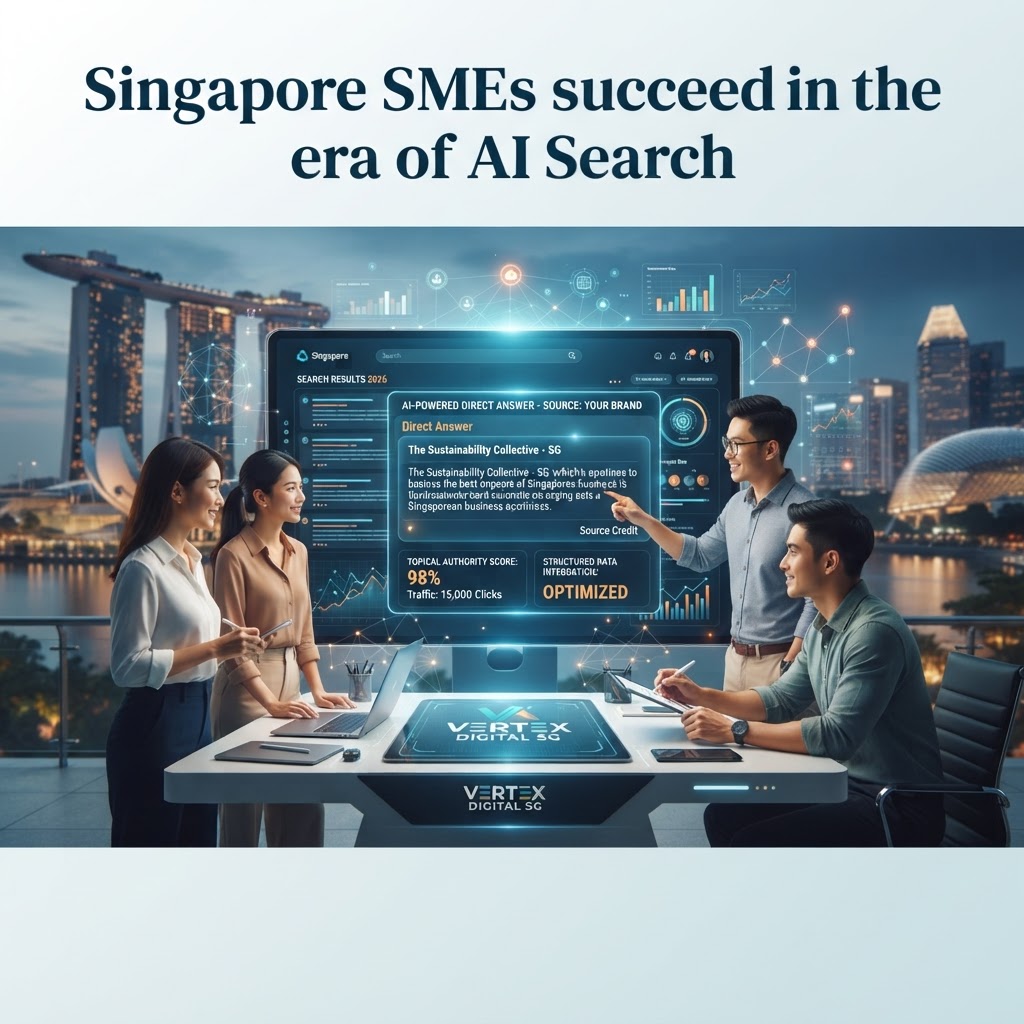
AEO and GEO: How Singapore SMEs Can Stay Visible in the Age of AI Search
The landscape of online discovery is undergoing a seismic shift. For years, Singapore business owners have focused their energy on traditional search engine optimization to capture traffic via the famous blue links. However, the rise of AI-driven tools like ChatGPT and Google AI Overviews has transformed how customers find information. Today, users often receive direct, synthesized answers instead of a list of websites, making Answer Engine Optimization (AEO) more critical than ever for maintaining your digital presence. In this new era, simply appearing on the first page of search results is no longer the sole benchmark for success. Instead, your objective must be to position your brand as a trusted, authoritative source that AI models cite when providing information to potential clients. By combining AEO with Generative Engine Optimization (GEO), our team at iPro Dezign helps local SMEs adapt their digital strategy to remain relevant. Whether you are managing an eCommerce store or a professional services firm, understanding these technical shifts is essential for long-term growth. We help businesses navigate this transition while leveraging government support like the Productivity Solutions Grant (PSG) to modernise their digital foundations for the AI-driven future.
Table of Contents
Understanding Answer Engine Optimization
Answer Engine Optimization, or AEO, represents the practice of structuring your website content to be easily parsed and retrieved by AI-powered search engines. Unlike traditional search techniques that rely heavily on keyword density and backlink volume, AEO focuses on providing concise, authoritative, and direct answers to specific user queries. AI platforms analyse vast datasets to synthesise a single response, and they favour sources that offer clear definitions, process explanations, and structured data. For Singapore SMEs, this means your content strategy must shift toward anticipating the specific questions your customers ask before they make a purchase. When a potential client asks an AI model about the best accounting practices for Singapore startups or how to maintain a specific type of office equipment, your business should be the reference point provided by the system. Achieving this requires moving beyond generic blog posts into creating high-quality, long-form content that addresses pain points with precision. Our approach involves auditing your current content to identify ‘information gaps’ where you can provide superior clarity compared to your competitors. By utilising schema markup—a form of code that helps search engines understand the context of your data—we make it easier for AI algorithms to index your insights. This technical diligence ensures that when an AI model processes your site, it views your brand as a reliable subject matter expert. It is not merely about writing more content, but about writing the right content that directly solves user problems. By focusing on intent-based language and structured, logical flow, we improve your chances of becoming the cited authority, even as search interfaces become increasingly conversational and less reliant on clicks to external websites.
The Role of Generative Engine Optimization
Generative Engine Optimization, or GEO, is the logical evolution of SEO in a world where AI generators provide summaries rather than just lists. While AEO focuses on getting your answer chosen, GEO encompasses the broader strategy of ensuring your brand is consistently present and positively represented within the generative responses provided by tools like Perplexity or Google’s Gemini. The mechanics of GEO involve three primary pillars: visibility in the generated response, influence over the sentiment of the output, and direct attribution to your site. AI models are trained on specific sets of information, and they are increasingly weighting sources based on their trustworthiness and relevance to the regional context. For a local SME, this means demonstrating expertise that is highly specific to the Singapore market. If your content is vague, the AI may bypass it in favour of more granular data from larger or global competitors. To compete, your business must demonstrate a depth of local insight—such as understanding local regulations, common Singaporean consumer preferences, or specific industry challenges faced by regional businesses—that global models cannot easily replicate. We focus on enhancing your digital footprint through high-authority mentions and content formats that AI systems prefer, such as comparison tables, pros-and-cons lists, and step-by-step guides. The goal is to make your content ‘AI-readable’ by removing clutter and ensuring that key takeaways are prominently featured. Furthermore, as these AI tools refine their ability to cross-reference multiple sources, having a cohesive narrative across your social media, web pages, and business directories becomes vital. When the AI synthesises information from several points of truth about your brand, it builds higher confidence in recommending your business. This is where consistent, accurate information management acts as a force multiplier for your overall digital strategy, ensuring your brand stays top-of-mind even when human interaction is mediated by machine intelligence.
Localising Your Content for Singapore AI Search
For SMEs operating within the unique Singapore business environment, localising your digital presence is not optional. AI models are becoming increasingly adept at distinguishing between global content and content that provides genuine local value. If your content ignores the Singapore context—such as referencing international tax laws instead of local IRAS guidelines or failing to acknowledge local cultural nuances—AI platforms are less likely to cite your brand for local searches. To stay visible, your content must incorporate ‘hyper-local’ signals. This includes details about your physical service areas, compliance with local PDPA regulations, and insights tailored to Singaporean consumer behaviour. We advise our clients to publish content that tackles local pain points, such as navigating the PSG application process, understanding local labour trends, or selecting the right tech stack for regional operations. By aligning your expertise with these local identifiers, you signal to AI algorithms that you are the most relevant source for users searching from within or about Singapore. Additionally, we use structured data to mark up your business location and service capabilities, which provides the AI with immediate, verifiable information about your company. A great way to visualize how we structure this for maximum impact is through comparative data layouts, which AI models prefer to parse when users look for service providers. Consider the following comparison of how we approach standard content versus AI-ready content for our clients.
| Metric | Traditional SEO Approach | AEO & GEO Approach |
|---|---|---|
| Primary Goal | Increase page clicks | Position as cited authority |
| Content Focus | Keyword volume | Direct answer accuracy |
| Data Structure | Standard HTML | Rich schema markup |
| Success Indicator | Search rank positions | AI source citation |
By shifting to the latter, your business moves from fighting for a link to becoming the actual source of truth for the AI, which increases trust and professional credibility with prospective leads.
Building a Performance-First Infrastructure
Technical performance is the bedrock upon which all AEO and GEO strategies must be built. Even if your content is perfectly optimised for AI, if your website suffers from slow load times or lacks a mobile-first design, the AI system will downgrade your authority. In the context of Singapore, where mobile usage is among the highest in the world, your site must provide an impeccable mobile experience. We focus heavily on Core Web Vitals, which are metrics Google uses to measure user experience, such as how fast your page loads and how stable the layout remains as it loads. A faster site does not just please search engines; it lifts conversion rates by reducing bounce rates and ensuring that mobile users—your primary audience—remain engaged. We often recommend a headless CMS approach for our clients, which decouples the back-end content management from the front-end user display. This allows for significantly faster performance and greater flexibility in how data is presented to both humans and AI crawlers. Additionally, we integrate security features that protect your site and your users’ data, ensuring full compliance with Singapore’s strict digital safety standards. Many SMEs are eligible for the Productivity Solutions Grant, which can cover up to 50% of the cost for such technical upgrades. Investing in this infrastructure is not just about maintenance; it is about building a scalable engine that can support your growth for years to come. By ensuring your site is fast, secure, and semantically structured, you create a reliable foundation that AI models find easy to crawl and trust. Our team specialises in helping you navigate the PSG eligibility process to ensure that your investment in digital transformation is as cost-effective as it is performance-focused. We don’t just build websites; we build assets that generate measurable ROI by keeping you ahead of the rapid technological shifts currently redefining how businesses are found.
Conclusion
Adapting to the rise of AI search is not a future concern—it is a present necessity. By integrating Answer Engine Optimization and Generative Engine Optimization into your digital strategy, you ensure your business remains a visible, authoritative leader in a changing landscape. At iPro Dezign, we provide the technical expertise and strategic guidance to help you navigate these shifts, from rebuilding your site for speed to crafting content that AI models trust. With support from the PSG grant, modernising your digital presence is more accessible than ever. Don’t wait for your competitors to corner the market in AI visibility. We invite you to book a consultation with our team to discuss how we can position your SME for long-term success. Let us help you take the next step toward a future-proofed digital brand today.
Frequently Asked Questions
What is the difference between SEO and AEO? SEO aims to drive traffic to your website via link clicks, whereas AEO focuses on providing concise answers that AI systems can use as direct sources within their responses.
How can I use the PSG grant for this? The Productivity Solutions Grant provides funding for IT solutions and digital marketing transformations; our team helps you identify which of our services qualify for this support.
Is content still important for AI? Yes, content remains the primary source for AI training; however, it must now be high-quality, structured, and authoritative to be cited by generative models.
Do I need a new website to be AI-ready? Not necessarily, but your site must meet modern performance standards like Core Web Vitals, which may require technical optimisation of your existing structure.
How long does it take to see results? While every market varies, moving to an AEO-focused strategy typically begins to show improvements in brand visibility and authority within several months of consistent implementation.