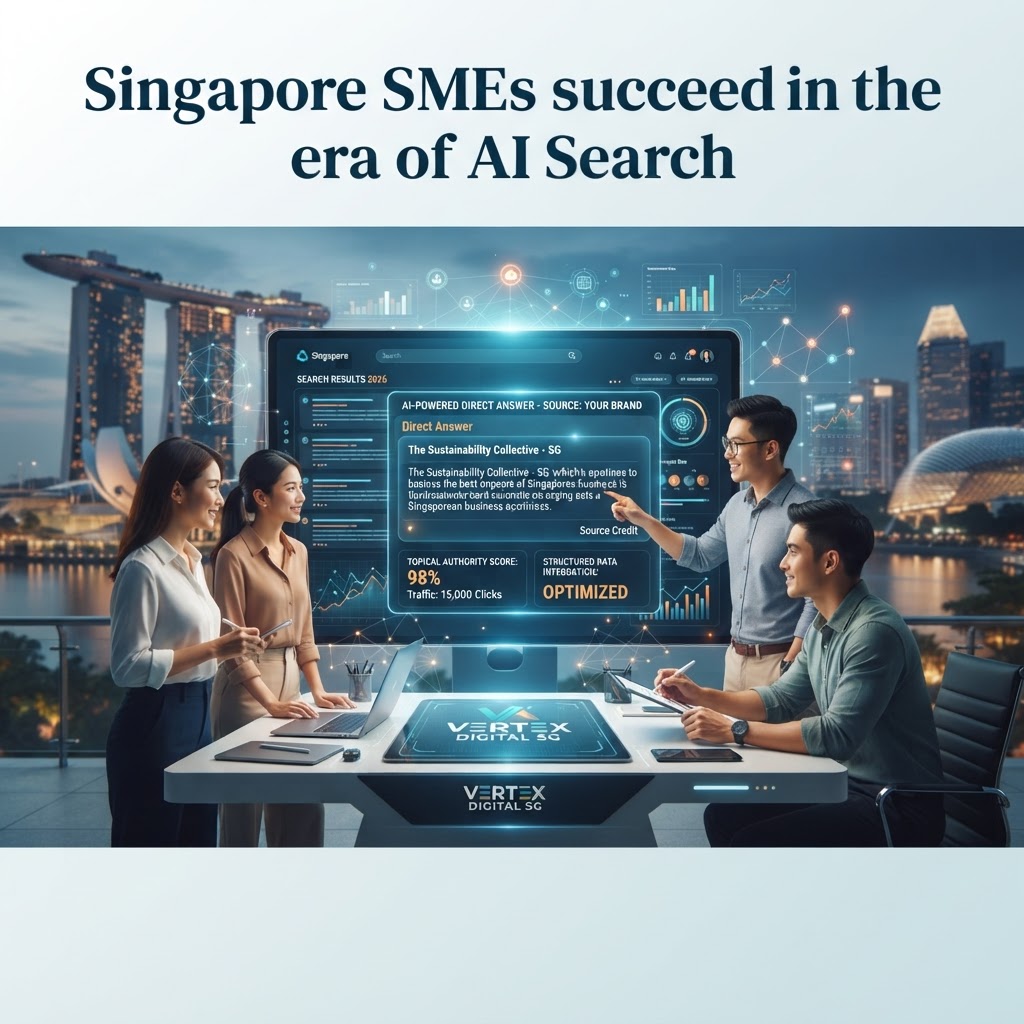
The 2025 local search landscape in Singapore
Search in 2025 is smarter, faster and more context-aware. Advances in large language models (LLMs), semantic search and multimodal ranking mean Google and other engines increasingly reward relevance, intent alignment and demonstrable local authority. For Singapore businesses, that elevates the role of a specialist digital marketing agency that understands both AI-driven techniques and local nuances.
This article explains how to build an AI-first SEO playbook—covering technical setup, content systems, local signals and measurement—that will help brands dominate local SERPs in Singapore.
Why AI changes the rules for SEO in Singapore
Traditional SEO focused on keywords and links. AI-driven SEO prioritises intent, entities and user satisfaction. Models now interpret context (searcher location, device, prior queries), surface rich SERP features (knowledge panels, local packs, video snippets) and evaluate content for helpfulness.
For local businesses, this means:
- Rankings are more about matching a user’s immediate need than matching exact keywords.
- Structured signals (schema, business metadata) are essential for visibility in local packs and knowledge graphs.
- Rich, experience-led content that proves local expertise wins over thin keyword-stuffed pages.
A specialist digital marketing agency singapore can help bridge AI best practices with local SEO realities.
Core AI-driven tactics for 2025
- Intent-first content design
Map search intents to content clusters: informational, transactional, navigational, and local. Use AI to analyze query patterns and create content that directly resolves each intent. Instead of single pages targeting a keyword, build micro-journeys: pillar pages, local landing pages and FAQ modules that answer follow-up queries.
- Entity and knowledge graph optimisation
Focus on entities (business, people, places) rather than isolated keywords. Ensure consistent NAP (name, address, phone), add detailed business descriptions, and use JSON-LD to mark relationships. This helps AI models link your brand to local queries and improves performance for ‘near me’ and branded searches.
- Semantic internal linking
Use semantic anchor text and hub-and-spoke structures to signal topic authority to search engines. Internal linking should help both users and bots navigate the cluster of related local content.
- Leverage AI for content creation and augmentation
Use LLMs for research, outlines, schema generation, and localisation—but rely on human editors for factual accuracy, brand voice and compliance. For multilingual Singapore audiences, AI-assisted translation followed by native review speeds production while preserving quality.
Learn how a dedicated AI-driven SEO approach can scale content without sacrificing local relevance.
Technical and on-page priorities
- Core Web Vitals and mobile-first: Page experience remains a ranking factor. Optimize LCP, FID/INP and CLS, especially for mobile users in high-density urban areas.
- Structured data: Implement LocalBusiness, Service, FAQ, and Event schema via JSON-LD. This increases the chance of appearing in SERP features and voice assistant answers.
- Crawlability & index control: Use AI to prioritise crawl budget—identify high-potential pages, and consolidate low-value URLs to prevent dilution.
- Image & video optimisation: Use descriptive filenames, alt text and schema; consider WebP/AVIF and streaming for faster load times.
Technical excellence is non-negotiable for enterprises and SMBs alike; a pragmatic seo singapore program should include an initial technical audit and ongoing improvements.
Content strategy: E-E-A-T, helpfulness, and localisation
Google’s E-E-A-T (Experience, Expertise, Authoritativeness, Trustworthiness) is amplified by AI. Create content that demonstrates real-world experience: case studies, local testimonials, staff bios, and process walkthroughs. For local relevance:
- Produce neighbourhood-level pages and micro-guides (e.g., service availability in Tanjong Pagar vs. Woodlands).
- Use local data, references, and events to connect with community intent.
- Local multimedia (short videos, floorplan images, virtual tours) increases engagement and signals authenticity.
A thoughtful content marketing strategy ties together those elements into a replicable system for growth.
Local-first citation, review and Google Business Profile tactics
Google Business Profile (GBP) remains central to local visibility. Optimise GBP with complete categories, service menus, photos, and booking integrations. Encourage verified, timely reviews and respond professionally; review velocity and sentiment are strong local ranking signals.
Citations still matter: ensure consistency across directories, government listings and industry associations. For multi-location businesses, create canonicalised local landing pages and use localized schema to avoid duplicate content issues.
For hyperlocal dominance, create offer-driven micro-campaigns (seasonal promotions, neighbourhood events) that tie into GBP posts and local landing pages.
Measurement, automation and tooling
KPIs should reflect business outcomes: organic leads, footfall, bookings, and revenue—not just rankings. Use a blend of analytics:
- Conversion-tracked events in GA4 or equivalent to capture call clicks, direction requests and booking actions.
- Rank tracking for core keywords and SERP features, including local pack performance.
- Cohort analysis to measure retention and lifetime value tied to organic acquisition channels.
Automate repetitive tasks with smart tools:
- Use LLMs for meta tags, schema templates, and content briefs.
- Deploy RAG (Retrieval-Augmented Generation) systems to feed local data into AI content workflows.
- Implement monitoring for reviews, brand mentions and citation drift.
Combining automation with manual quality control yields scale without quality loss.
Link strategy and reputation building
High-quality local backlinks are still valuable. Focus on:
- Local partnerships (suppliers, chambers of commerce, community events).
- PR and data-driven studies that local media will cite.
- Resource pages and tools that naturally attract backlinks from industry sites.
Avoid low-quality link schemes; AI-powered link analysis tools can help identify risky patterns.
Choosing the right digital partner in Singapore
Selecting an agency means assessing technical chops, local experience and AI maturity. Look for a partner that demonstrates:
- Proven results in local search and SERP feature capture.
- A methodology that blends human expertise with AI efficiency.
- Transparent reporting and measurable outcomes.
A reputable digital marketing agency singapore will offer a clear roadmap: audit, prioritisation, execution, and continuous optimisation. For businesses prioritising local growth, evaluate case studies, client references and technical audits before committing.
Putting it all together: a 90-day pragmatic plan
Month 1: Audit & prioritise
- Technical audit, GBP cleanup, citation sweep, and keyword-intent mapping.
- Quick wins: fix Core Web Vitals issues, add essential schema, and optimise GBP.
Month 2: Content & local activation
- Launch local landing pages, FAQ modules, and review-generation campaigns.
- Deploy AI-assisted content briefs, followed by human editing and localisation.
Month 3: Scale & measure
- Implement internal linking clusters, outreach for local partnerships, and automated reporting.
- Review KPI progress and iteratively refine the approach.
Continuous optimisation focuses on fresh content, review management and technical upkeep.
Final takeaway
In 2025, dominating local SERPs in Singapore requires an AI-aware approach that blends technical rigour, local relevance and measurable business outcomes. Prioritise intent-led content, structured data, GBP excellence and pragmatic automation. Engaging a specialist seo singapore partner can accelerate results and ensure your strategy aligns with evolving search algorithms and user expectations.