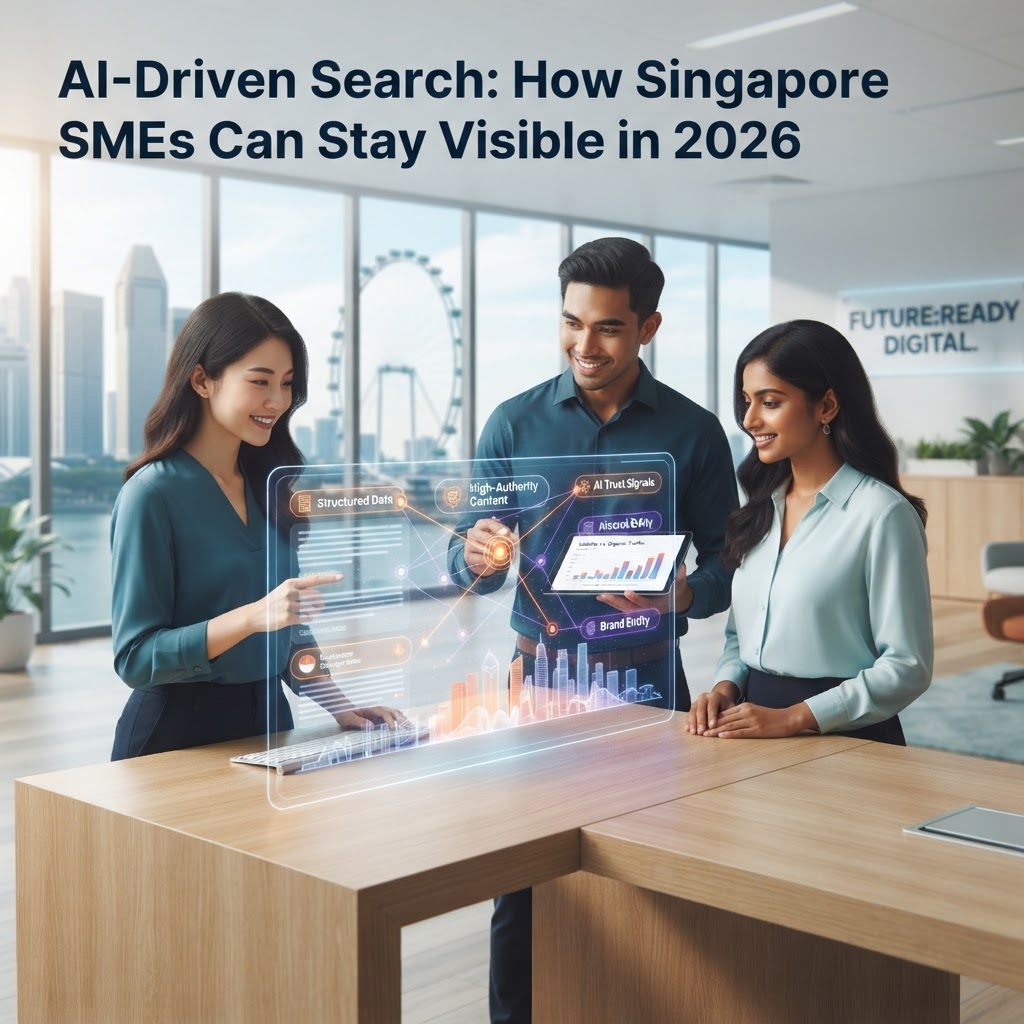
Generative Engine Optimization: A 2026 Guide for Singapore SMEs to Stay Visible
The landscape of online discovery is undergoing a profound transformation. For years, Singaporean business owners have focused their digital strategy on traditional search engine optimization, aiming to secure blue links on results pages. However, the rise of AI-powered search interfaces, which synthesize information directly for the user, has shifted the goalposts. This new paradigm is called Generative Engine Optimization. For SMEs in Singapore, this is not just a passing trend; it is the fundamental change in how your potential customers find products and services in 2026. As AI models prioritize direct, conversational, and highly relevant answers, your business needs to adapt its content strategy to remain visible. In this guide, we explore why this shift matters for your growth and how you can position your brand to thrive in an era where the search engine does the talking for you. By aligning your digital presence with these new technical expectations, you ensure your SME remains a primary source of truth for your customers, whether they search on mobile or desktop.
Table of Contents
- Understanding the Shift in Search Behaviour
- The Technical Pillars of Generative Engine Optimization
- Content Strategies for AI-Ready Businesses
- Measuring Success in the Age of AI
- Conclusion
- Frequently Asked Questions
Understanding the Shift in Search Behaviour
In the past, a typical user journey involved searching for a keyword and then clicking through several websites to compare information. Today, AI engines like Google AI Overviews and various chatbot-integrated search interfaces consolidate this data, providing a concise summary at the top of the results page. This change is critical for Singaporean SMEs because the volume of direct website traffic from traditional searches may decrease, while the quality of leads might increase if your business is featured as a credible source within these AI-generated responses. The core of Generative Engine Optimization involves ensuring that your content provides the specific facts, local context, and expertise that AI models require to build accurate, trustworthy summaries. If your website lacks structured data or relies on thin, generic content, these algorithms will simply ignore your site in favour of more authoritative sources. For a local business, this means your digital footprint must be more precise than ever. You must explain your services clearly, provide local context relevant to Singapore, and maintain a reputation that these models can verify through citations and third-party references. It is a shift from playing the keyword game to becoming an expert entity that the AI trusts. By focusing on entity-based SEO, where you map out your service offerings, location, and unique value propositions, you signal to the machines that you are the go-to authority in your sector. This consultative approach allows our team to help you pivot from traditional tactics toward a more durable, AI-resilient digital strategy that protects your visibility during this massive industry transition.
The Technical Pillars of Generative Engine Optimization
The foundation of being visible in AI summaries relies on technical performance and structured data. If your website is slow, hard to navigate on mobile, or lacks proper backend coding, AI models will struggle to crawl and interpret your business value. We often focus on Core Web Vitals, which measure user experience factors like loading speed, visual stability, and interactivity. For instance, a site that takes more than three seconds to load often experiences higher bounce rates, which negatively impacts how AI perceives your site’s quality. To excel in Generative Engine Optimization, your site architecture must be clean, secure, and semantically tagged. Schema markup is one of the most powerful tools in this process; it essentially provides a roadmap for the AI to understand that your SME is a specific entity—such as a registered Singapore business—offering distinct products or services with transparent pricing. Furthermore, we must address the importance of mobile-first experiences. Given that most Singaporeans access search via smartphones, an unresponsive site is an instant disqualifier for high-ranking AI placement. Investing in a robust, fast, and secure digital architecture is a prerequisite for long-term growth. When our team works on rebuilding a client’s platform, we integrate these technical standards from the ground up, often leveraging PSG funding to make these improvements more accessible for local SMEs. Consider the table below for a quick summary of how these technical elements impact your visibility:
| Technical Factor | Why It Matters for AI | Impact on Visibility |
|---|---|---|
| Core Web Vitals | Ensures accessibility and speed | High |
| Schema Markup | Provides context for AI interpretation | Critical |
| Mobile-First Design | Prioritizes the primary search device | High |
| SSL/Security | Builds trust for citation sources | Moderate |
By optimizing these areas, you ensure that your business meets the rigorous standards of modern search engines while also improving the user experience for your human customers. It is about balancing technical precision with the needs of the actual people you are serving.
Content Strategies for AI-Ready Businesses
Creating content for the AI era requires a move away from keyword stuffing toward comprehensive, answer-driven information. Your potential customers in Singapore are looking for solutions to specific problems, and Generative Engine Optimization requires that your website acts as the primary knowledge base for those queries. Instead of writing broad, generic articles that touch on many topics, you should focus on developing depth around your core competencies. If you are an interior design firm, for example, do not just post photos; create detailed, educational guides that explain the process, costs, and benefits of your specific design methodologies. Use professional tone and clear, plain English that is easy for both humans and AI models to parse. You want to structure your content so that it answers the ‘what,’ ‘why,’ and ‘how’ of your services clearly within the first few paragraphs. This makes it easier for search engines to pluck your expert insights for their AI-generated summaries. Additionally, consider how you can build authority through local signals. Mentioning your connection to Singapore, your experience with local regulations like the PDPA, and your track record with local clients helps the AI differentiate your business from international competitors. Another vital tactic is creating ‘entity-consistent’ content, meaning your business name, address, and service categories are listed exactly the same way across your website, Google Business Profile, and local directories. This consistency acts as a trust signal that reassures AI models that your information is accurate and reliable. As your digital partner, we help you audit your current content, identify gaps in your authority, and craft a roadmap that establishes your brand as a trusted expert in your chosen niche.
Measuring Success in the Age of AI
Defining success when the search engine displays the answer directly can be challenging because traditional metrics like ‘organic sessions’ are no longer the only indicator of performance. In this new era of Generative Engine Optimization, you need to look at a broader set of data points, including brand mentions, conversion rates, and the quality of enquiries coming through your contact forms. If your site is frequently cited as a source in AI summaries, you might notice that traffic becomes more intent-driven; the people landing on your site already have a strong interest because the AI has pre-vetted your expertise. We advise our clients to track how often their brand appears in AI snippets and whether this correlates with a higher volume of qualified leads. It is important to remember that performance-first builds are not just about vanity metrics; they are about measurable ROI. Whether it is a reduction in your cost-per-acquisition or an increase in the conversion rate on your landing pages, the goal is to see tangible business growth. Monitoring these metrics allows you to adjust your content strategy in real-time, focusing your energy on the topics and services that generate the most business value. Because results depend heavily on your industry and the level of local competition, we emphasize a consultative approach. We help you set realistic benchmarks based on your current starting point, rather than chasing hollow rankings. By focusing on data-backed, sustainable growth and utilizing Singapore’s various SME support schemes like the PSG grant, we ensure that your digital investment remains focused on bottom-line results, ensuring you stay visible, credible, and profitable even as the digital landscape continues its constant evolution.
As we have explored, the transition to Generative Engine Optimization represents a significant leap forward in how businesses must approach their digital presence. While the shift from traditional search methods may seem daunting, it is ultimately an opportunity to solidify your brand as a leading voice in your industry. By focusing on the technical pillars of speed and structure, creating high-value content that truly informs your customers, and tracking the right performance metrics, your Singapore SME can remain ahead of the curve. Do not let this change overwhelm your operations. Instead, view it as a chance to refine your strategy and better serve your target audience. Our team is here to guide you through this process, from technical site audits to content strategy development, ensuring you maximize your ROI with the help of available funding. Reach out today to book a consultation, discuss your current challenges, and start building a future-proof presence that will keep your business growing for years to come.
Frequently Asked Questions
What is the main difference between traditional SEO and Generative Engine Optimization? Traditional SEO focuses on earning clicks through search listings, whereas Generative Engine Optimization focuses on providing accurate, entity-based information that AI models use to construct direct answers.
Do I need to stop traditional SEO to focus on AI? No, they work together. Strong, traditional SEO foundations, such as good site architecture and clear content, are necessary for AI models to understand and trust your website.
How can my Singapore SME benefit from PSG funding for this? Many digital marketing and web development projects, including those focused on upgrading your site for modern performance standards, may qualify for up to 50% funding through the Productivity Solutions Grant.
How long does it take to see improvements in visibility? Results vary based on your market and starting point, but most technical and content improvements require three to six months to show meaningful shifts in performance metrics.
Can you help me assess my current site’s readiness for AI? Yes, we provide comprehensive audits to identify technical and content gaps, offering a clear roadmap to improve your visibility in an AI-driven search environment.