Generative Engine Optimization: A 2026 Guide for Singapore SMEs to Stay Visible
The digital landscape in Singapore is shifting beneath our feet. For years, SME owners have focused on traditional Search Engine Optimization (SEO) to ensure their brand appears at the top of Google results. However, the rise of AI-powered interfaces, such as Google’s AI Overviews and ChatGPT search, has fundamentally changed the game. Today, users often receive direct answers without ever clicking through to a website. This transition necessitates a strategic pivot toward Generative Engine Optimization. As an agency partner, our team observes that the traditional click-centric model is declining, and visibility now depends on being cited as a reliable source within AI-generated responses. For Singaporean businesses, this means your digital presence must become more authoritative, concise, and structured. By focusing on Generative Engine Optimization, your company can maintain its digital footprint, build trust with potential customers, and ensure your brand remains relevant in an era where AI synthesizes information on behalf of the consumer. This guide explores how to adapt your strategy to ensure your business remains the go-to answer for your customers while leveraging professional support and available funding to keep your operations competitive in our increasingly digital local market.
Table of Contents
Why Generative Engine Optimization is Essential for Singapore SMEs
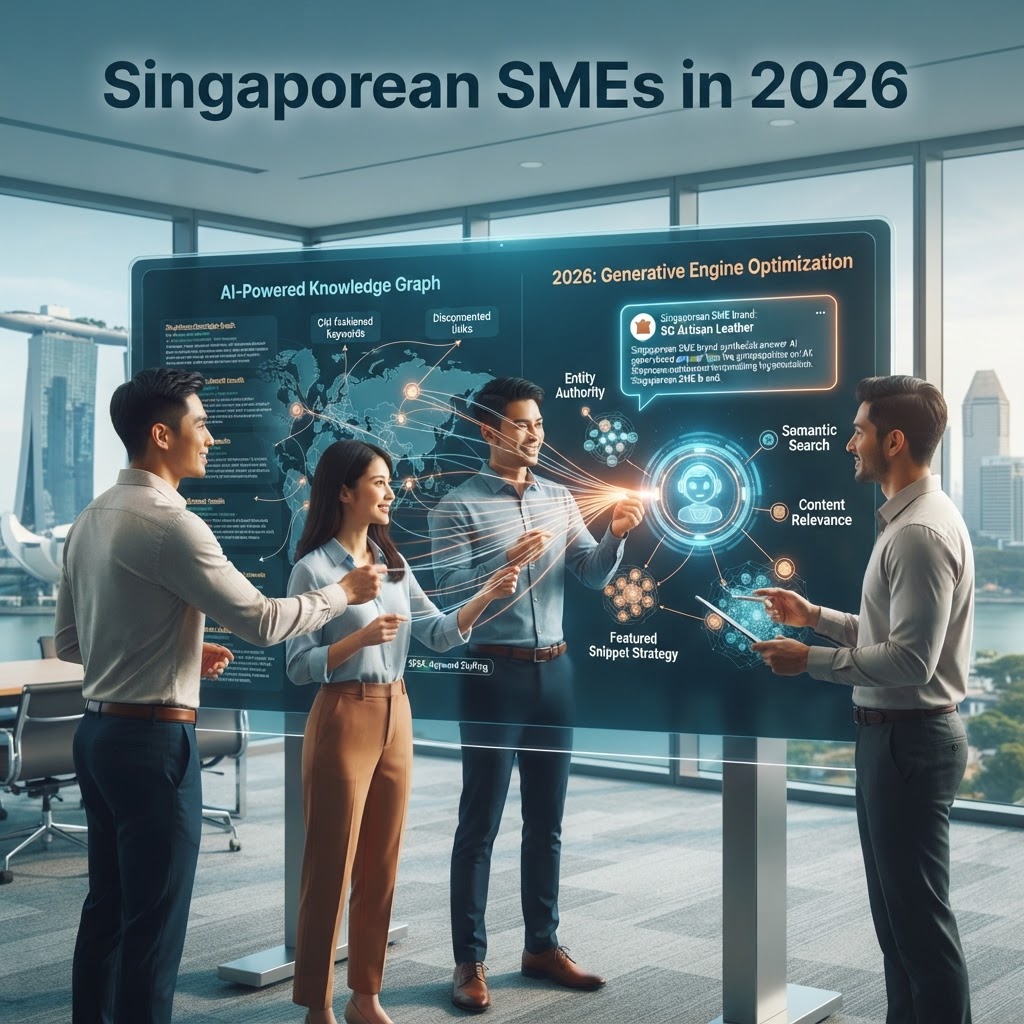
In the Singapore SME landscape, visibility is the primary driver of growth. Historically, businesses invested heavily in SEO to capture search traffic, aiming for the top spots in search results pages. However, the nature of information retrieval has moved toward conversational AI interfaces. These systems aggregate data from various sources to provide a synthesis of information directly in the chat or search window. When a potential customer asks about the best services in Singapore, the AI might answer directly, potentially reducing traffic to individual websites. Generative Engine Optimization is the practice of structuring your digital content so that AI models can easily parse, trust, and cite your brand as an expert authority. This is no longer just about meeting technical criteria; it is about proving your relevance to an algorithmic entity. By adopting this approach, you are positioning your business to be the primary citation in AI-led search results. Many local businesses are currently vulnerable because their content is designed for old-school spiders rather than for the semantic understanding of large language models. The risk here is substantial; if your competitors adapt to AI indexing while you remain tethered to outdated keyword stuffing, you will lose your prime digital real estate. Our team emphasizes that this is not a trend that will fade; it is a permanent upgrade to the global infrastructure of information discovery. Singapore SMEs, particularly those in competitive retail, professional services, or consultancy sectors, must treat their website not just as a brochure, but as a structured knowledge base. By prioritizing clarity, authority, and accurate data architecture, you ensure that AI tools can retrieve your information reliably and present your services to a target audience that is ready to engage with the right solutions at the right time.
Optimising for AI Answers: Shifting from Keywords to Concepts
The core philosophy of Generative Engine Optimization lies in moving away from disjointed keyword lists and toward coherent conceptual content. In the past, agencies might have suggested creating dozens of pages targeting individual, low-volume keywords. Today, AI engines look for depth, entity recognition, and high-quality topical coverage. If you are a plumbing firm, for instance, you should create comprehensive guides that answer the “how,” “why,” and “what” of your services rather than repeating phrases unnaturally. Our team suggests mapping out the common pain points your Singaporean customers face and addressing them with high-quality, long-form content that provides clear, actionable answers. Structure your information using schema markup, which is a standardized data vocabulary that helps search engines understand the context of your content. This allows an AI to identify your prices, operating hours, and service capabilities with precision. When an AI summarizes a topic, it looks for sources that act as definitive hubs of information. If your website provides structured, high-value data, you are far more likely to be cited as a reference. Furthermore, avoid the temptation to create superficial content; instead, invest in original research, case studies that show results, and expert opinions that provide a unique perspective. You should also ensure that your website architecture reflects logical hierarchy, grouping related topics together so the AI can easily traverse your knowledge base. This conceptual approach forces you to think about the user’s intent rather than just the words they type into a box. For an SME, this means focusing on the unique value proposition that defines your local business, ensuring that whenever an AI compiles an answer for your industry, it highlights your firm as a recommended partner. It is about providing the depth that a simple search result cannot convey, thereby establishing authority that machines find difficult to ignore when generating responses for your prospective clients.
Building a Technical Foundation for AI Search Success
Technical performance is the bedrock of visibility in an AI-dominated search environment. If your website is slow, cumbersome, or incompatible with modern mobile devices, your content simply will not be surfaced, no matter how high its quality. Core Web Vitals, a set of metrics used by search engines to measure user experience, including loading speed and visual stability, have become critical. An AI engine needs to crawl your site efficiently, and this requires clean, well-optimized code and a robust hosting environment. For SMEs, this often means upgrading from basic shared hosting to more performant solutions that can handle traffic spikes and provide fast server response times. Furthermore, your site must be fully mobile-responsive. In the Singapore market, where mobile penetration is exceptionally high, a poor mobile experience is a non-negotiable failure point. We recommend conducting a full technical audit of your site to ensure there are no broken links, crawl errors, or bloated scripts slowing down performance. Consider implementing a headless CMS or a modern framework if your current platform is limiting your performance capabilities. The following table illustrates how we assess current infrastructure gaps:
| Metric | Standard Requirement | Performance Goal |
|---|---|---|
| Page Load Speed | Under 3 Seconds | Under 1.5 Seconds |
| Mobile Responsiveness | Functional | Optimized UI/UX |
| Schema Markup | Basic/Missing | Full Implementation |
| Security/SSL | Standard | Robust Encryption |
Beyond speed, you must ensure that your site adheres to PDPA compliance and is secure. Security is a ranking signal that AI models take into account, as they prioritize safe, reliable information sources. When your technical foundation is sound, the AI can crawl, parse, and verify your business details without friction. This gives you a significant competitive advantage over local peers who have neglected their technical debt. As part of our one-stop agency approach, we help SMEs leverage the PSG grant to fund these infrastructure upgrades, covering up to 50% of the cost. This makes the leap to a performance-first build both affordable and strategic. By investing in a resilient technical platform, you are building a house that AI can easily visit and learn from, ensuring that your digital footprint remains resilient and visible as these generative tools continue to iterate and grow in complexity.
Maintaining the Human Edge in an Automated World
While Generative Engine Optimization is about playing well with machines, you must never lose sight of your human audience. The ultimate goal is to convert an AI citation into a real-world consultation or sale. To achieve this, your brand voice must remain authentic, relatable, and trustworthy. AI can generate text, but it cannot replicate the nuance, empathy, and professional experience that your team brings to the table. In your digital communications, emphasize the personal touch of your business—the years of local experience, your commitment to the Singapore business community, and your specific approach to solving client problems. Include testimonials, case studies, and clear bios that humanize your team and build credibility. When a potential customer follows an AI citation to your website, they should be met with a professional, inviting, and easy-to-navigate interface that reflects your real-world service. Ensure that your call-to-action is clear and low-pressure, inviting them to start a conversation rather than pushing a hard sell. It is important to remember that AI is a tool, not a replacement for relationships. Your content should act as a bridge that leads the user from an AI-generated answer to a human-led consultation. We encourage our clients to maintain an active blog or resource centre that discusses the challenges faced by local businesses, providing fresh insights that prove your ongoing expertise. This consistency keeps your site relevant and provides the steady stream of high-quality information that AI models rely on for current updates. By being transparent, responsive, and easy to reach, you convert that momentary digital visibility into a long-term professional relationship. Being an AI-forward SME does not mean becoming a digital robot; it means using the efficiency of AI to highlight your unique human capabilities to a wider, more informed local audience, ensuring your brand stands out for its quality rather than just its presence.
In summary, adapting to the age of generative search is a necessity for all Singapore SMEs looking to protect their long-term visibility. By shifting your focus toward structured data, topical authority, and technical excellence, you position your brand as a trusted resource that AI engines can rely on. Remember that this process is an investment in your brand’s digital resilience. While the technology changes, the core need for reliable, high-quality, and locally relevant information remains constant. Our team is ready to guide you through these technical and strategic shifts, helping you access available grants like the PSG to ensure your digital presence is modern, secure, and ready for the future of search. Book a consultation with us today to discuss your site’s readiness for Generative Engine Optimization and start building a stronger, more visible digital future.
Frequently Asked Questions
What is the primary difference between traditional SEO and Generative Engine Optimization? Traditional SEO focuses on achieving high rankings on a list of blue links, while Generative Engine Optimization focuses on becoming an authoritative source that AI models cite in conversational answers.
How can I use the PSG grant for these upgrades? Our team can assist in verifying your eligibility for the PSG grant, which can cover up to 50% of the cost for professional website development and infrastructure upgrades designed for better visibility.
Does this mean I should stop blogging? Absolutely not. High-quality content is more important than ever, provided it is structured, topical, and directly addresses the specific queries of your target audience.
Will my website lose traffic to AI answers? While some informational traffic may decrease, the traffic you do receive is likely to be more qualified, as users have already received an AI summary and are now looking for a deeper connection with a provider.
How long does it take to see improvements? Significant results depend on your existing digital footprint and market competition, but businesses typically see improvements in site health and authority within a few months of implementing a structured content and technical upgrade plan.