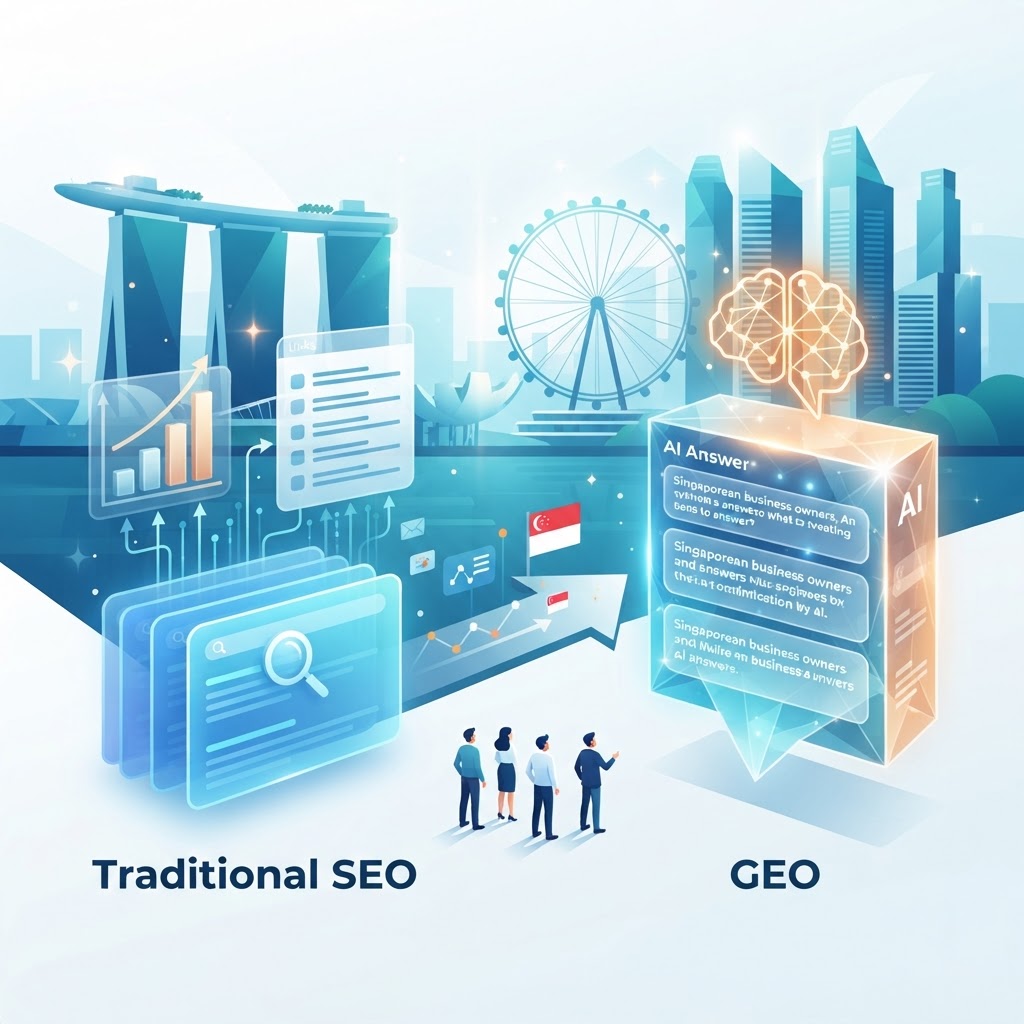
Why futureproofing SEO matters for Singapore in 2026
Search is no longer a race to the top of a single results page. Between generative search, stricter privacy rules, and a surge in local intent, Singapore businesses need strategies that last. For any digital marketing team or digital marketing agency singapore, futureproof SEO is about resilient systems: content that signals expertise, technical foundations that survive algorithm shifts, and processes that leverage automation responsibly.
Macro trends shaping SEO in Singapore
- AI-driven SERP features: Search engines increasingly synthesize results (search generative experiences). That means visibility can come from concise answers, knowledge panels, or featured snippets rather than just traditional rankings.
- E‑E‑A‑T as a ranking baseline: Experience, Expertise, Authoritativeness, Trustworthiness remain central—especially for finance, health, legal and other sensitive verticals.
- Local and hyperlocal queries: With Singapore’s compact urban footprint and high mobile usage, local intent (map packs, near-me queries) drives high-converting traffic.
- Privacy-first measurement: Cookieless tracking, first-party data and server-side tagging are essential as Google phases out third-party cookies.
- Page experience and Core Web Vitals: Mobile-first performance and accessibility increasingly affect rankings and conversion.
These trends require a combined emphasis on technical SEO, content strategy, local optimisation and AI tooling for scale. Agencies that adapt will deliver better ROI for clients.
Core pillars of a futureproof SEO strategy
Below are the practical pillars every digital marketing agency singapore should adopt in 2026.
1. Signals of authority: E‑E‑A‑T and topical depth
Build content clusters that demonstrate clear expertise and first-hand experience. For Singapore businesses, local signals—case studies with local customers, Singapore-specific data, named authors with credentials—boost credibility.
Tactics:
- Publish local case studies and Singapore-specific insights often.
- Use author bios that emphasize credentials and first-hand experience.
- Build internal linking to cluster pages that show topical depth.
For guidance on structuring local SEO initiatives for agencies, check this resource on seo singapore local tips for digital marketing agency 2026.
2. Answer Engine Optimization (AEO) — owning answers, not just links
Users increasingly get answers directly on the results page. Optimize content to be machine-readable and succinct so it can be used in synthesized responses. Use structured data, concise lead paragraphs, and clear Q&A sections.
Tactics:
- Add FAQ schema and clear, single-sentence answers at the top of pages.
- Create short, authoritative explainers for common queries in your niche.
- Monitor zero-click trends and adapt content to capture attention and downstream engagement.
For a deeper playbook on answer-focused search, see this guide on answer engine optimization.
3. Technical resilience: Core Web Vitals, mobile, and indexing
Technical SEO remains the foundation. In 2026, speed, accessibility, and robust indexing strategies are non-negotiable.
Checklist:
- Ensure mobile-first design and fast Largest Contentful Paint (LCP).
- Prioritize Cumulative Layout Shift (CLS) fixes for interactive experiences.
- Implement server-side rendering or edge caching for content-heavy pages.
- Maintain clean crawl budgets, canonicalization, hreflang (if multi-language) and structured data.
Automating monitoring with synthetic and real-user metrics lets agencies catch regressions before they affect rankings.
4. Local-first approach for high-intent conversions
Singapore’s market awards businesses that appear in local packs and own Map visibility. Local SEO should be part of every campaign for bricks-and-mortar or service-area clients.
Tactics:
- Optimize Google Business Profile with categories, photos, and regular posts.
- Use local schema, consistent NAP (name, address, phone) and localised landing pages.
- Generate and manage local reviews ethically, and respond promptly.
A practical resource on local tactics for agencies is available here: seo singapore local tips for digital marketing agency 2026.
5. AI and automation — scale with human oversight
AI tools accelerate research, draft generation and personalization. But human oversight ensures accuracy and preserves E‑E‑A‑T. Use AI for ideation, schema creation, and content templates; pair with editorial review.
Implementation tips:
- Use AI to generate outlines and topic clusters, then have subject experts add experience and nuance.
- Automate technical checks and reporting but validate significant changes manually.
- Deploy personalization with first-party data for relevant CTAs.
Explore how agencies can leverage AI safely in Singapore with this AI-driven digital marketing guide.
6. Structured data and semantic SEO
Structured data helps search engines understand content contextually. In 2026, schema types for products, events, how-tos, FAQ, and local businesses are table stakes.
Best practices:
- Implement JSON‑LD for key pages and test with schema validators.
- Use schema to mark reviews, authorship, and step-by-step guides to increase eligibility for rich results.
- Create entity-driven content that connects brand, people, places and topics—this builds topical authority.
7. Measurement that matches modern SERPs
Traditional ranking reports are insufficient. Track a blended set of KPIs:
- Visibility in answer features, knowledge panels and voice results.
- Organic clicks and impressions by SERP feature.
- Conversion lift from improved topical authority and local packs.
- Engagement metrics tied to page experience (bounce, time on page, scroll depth).
Use server-side analytics, consented first-party data and conversion modeling to keep measurement robust in a privacy-first world.
8. Content ecosystems and distribution
Instead of isolated pages, build ecosystems: pillar pages, supporting posts, video assets, and downloadable tools. Promote via owned channels and partnerships to earn links and local mentions.
Distribution tips:
- Repurpose long-form guides into micro-content for social and chat platforms.
- Host webinars or walkthroughs with Singapore industry partners to generate local backlinks.
- Use content hubs to funnel topical authority to conversion pages.
Practical 12-month roadmap for agencies
Month 1–3: Audit & baseline
- Full technical audit (Core Web Vitals, indexing, crawl budget).
- Content audit for E‑E‑A‑T gaps, duplicate content, and local coverage.
- Measurement plan: set KPIs for clicks, conversions, and SERP features.
Month 4–6: Fix & fortify
- Implement technical fixes and performance optimizations.
- Launch local pages and set up Google Business Profile consolidation.
- Add structured data to high-priority pages.
Month 7–9: Content & authority
- Publish pillar content and cluster pages; add case studies and author bios.
- Execute a localized link-building campaign and PR outreach.
- Test AI-assisted ideation workflows and editorial QA.
Month 10–12: Scale and iterate
- Automate reporting and deploy personalization experiments.
- Conduct seasonal content pushes and measure impact on conversions.
- Continuous monitoring: Core Web Vitals, index changes, and SERP feature shifts.
KPIs to monitor quarterly
- Organic sessions and conversion rate (by device and location).
- Impressions and clicks from SERP features (snippets, knowledge panels, maps).
- Local pack visibility and GBP engagement metrics.
- Core Web Vitals performance and page speed metrics.
- Backlink quality and topical authority signals.
Practical tools and integrations for Singapore agencies
- Crawlers: Screaming Frog, Sitebulb, or similar for large-site analysis.
- RUM & LAB: Google PageSpeed Insights, Lighthouse, and real-user monitoring.
- Analytics: Server-side analytics with consented first-party data capture.
- AI: Controlled prompting frameworks and fact-checking layers.
For implementation examples that align with Singapore SME needs, review this guide on AI for Singapore SMEs.
Getting clients ready for change
Educate clients on why zero-click and answer-driven visibility can still produce value: increase brand recognition, drive assisted conversions, and improve conversion efficiency. Show the link between authority signals and lower acquisition costs over time.
Agencies should package services into modular offerings (technical baseline, local boost, content hub, AI ops), so clients can adopt change incrementally.
Final checklist for a futureproof SEO launch
- Establish E‑E‑A‑T content standards and author verification.
- Deploy core technical fixes and monitor Core Web Vitals.
- Implement local SEO basics: GBP, local pages, schema.
- Optimize for answers: concise top-of-page answers, FAQ schema, structured data.
- Adopt AI tools with human-in-the-loop editorial control.
- Move to first-party measurement and consented analytics.
If you’re responsible for SEO Singapore initiatives, map these steps into your 12-month plan and prioritize quick wins that improve both visibility and conversion. For a practical roadmap tailored to agency workflows and local best practices, see this specialised seo singapore 2026 for digital marketing agency resource.
Conclusion
Futureproof SEO in Singapore is about combining technical resilience, local relevance, and trustworthy content. Digital marketing agency singapore teams that embrace AI responsibly, prioritize E‑E‑A‑T, and measure beyond rankings will be best positioned to capture evolving search demand in 2026 and beyond. For step-by-step implementation models and real-world templates, explore additional practical guides such as the AI-driven digital marketing and answer engine optimization resources linked above.