Generative Engine Optimization: A 2026 Guide for Singapore SMEs
As the digital landscape shifts from traditional blue-link search results to AI-powered answers, local business owners must adapt. If your website was built for the search era of 2020, it likely struggles to surface in modern AI snapshots. Generative Engine Optimization Singapore is no longer just a technical trend; it is a fundamental shift in how your customers discover your services. Whether you operate a retail store, a professional services firm, or a tech startup, the way AI models like Google’s Gemini or Perplexity synthesize information means you must pivot your strategy now. This guide explores how your Singapore SME can remain visible, authoritative, and trusted in an AI-driven ecosystem. We focus on evidence-based strategies to help you navigate this transition, ensuring your digital footprint aligns with how users actually interact with the web today. By prioritising intent-driven content and technical performance, you can capture the attention of high-value prospects before your competitors do. Let us walk you through the essential steps to secure your brand’s digital future in the age of generative search.
Table of Contents
Understanding the Shift to Generative Engine Optimization Singapore
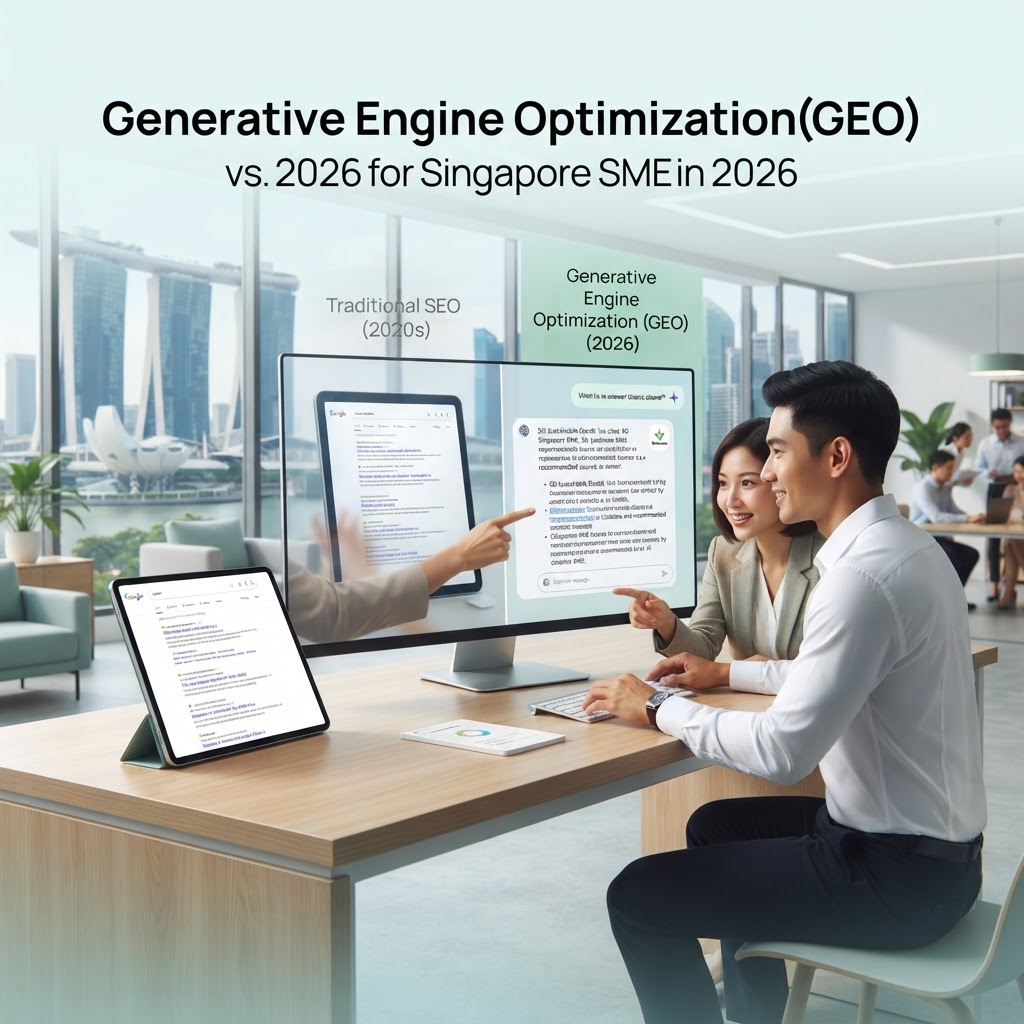
Generative Engine Optimization, or GEO, represents the next phase of search marketing. Unlike traditional SEO, which focuses on satisfying algorithms to achieve specific link positions, GEO aims to make your content the primary source for AI-generated summaries. When a user asks an AI model about solutions for business challenges in Singapore, the model synthesizes vast amounts of data to provide a concise, factual answer. If your website is not structured to be easily parsed and cited by these models, your business will effectively be invisible in the new answer-based interface. This shift requires a change in mindset from keyword density to entity-based authority. Our team observes that AI models prioritise sources that provide clear, multi-faceted answers to complex questions rather than just repetitive keyword strings. For Singapore SMEs, this means you need to create content that provides deep, contextual value. A robust GEO strategy involves understanding the semantic intent behind user queries. For instance, instead of merely targeting ‘web design Singapore’, your content should aim to answer queries like ‘how does responsive web design improve conversion rates for Singaporean retail businesses?’ This approach positions your brand as a helpful expert rather than just another service provider competing for clicks. As these models evolve, they are becoming increasingly sensitive to accuracy and citation. We advise focusing on transparent, high-quality information that adheres to professional standards, ensuring your site remains a reliable node in the web’s knowledge graph. By aligning your business information with the way AI models process data, you are essentially future-proofing your online presence. This is not about tricks; it is about clear communication and technical accessibility, allowing AI tools to verify your expertise and deliver your content to the users who need it most.
Building Authority for AI Discovery
Authority is the currency of the AI age. When a large language model generates a response, it leans on sources it perceives as highly credible. For an SME in Singapore, building this authority starts with deep, original research and unique brand insights. If your content merely regurgitates information available elsewhere, AI systems will likely ignore it in favour of more authoritative sources like established news outlets or large educational databases. To stand out, you must inject your specific industry experience into every page. For example, if you are a marketing agency, share data on current local campaign trends, local customer behavior shifts, or unique insights regarding Singapore’s digital market. This ‘proprietary knowledge’ is what makes your content indexable and citable. Furthermore, structure your content to facilitate quick consumption by AI scrapers. Use clear headings, bulleted lists for key takeaways, and concise summaries at the beginning of each article. This enables AI models to extract your core arguments efficiently. You should also ensure that your website maintains a consistent brand voice across all pages, which builds a recognizable identity that AI models can associate with specific categories of expertise. We recommend conducting regular content audits to identify thin or outdated pages that might confuse AI crawlers. Replace these with comprehensive, long-form content that answers the specific questions your customers are actually asking. It is vital to remember that AI models value factual clarity. Avoid jargon-heavy language unless you define it immediately. By simplifying complex concepts, you make your content more accessible to both human readers and AI systems, which in turn increases the likelihood of your site being selected as a primary answer source. This strategy turns your website into a library of verified knowledge rather than a static brochure, which is a powerful way to win in the current digital climate.
Technical Performance and Structured Data
Behind every authoritative piece of content, there must be a solid technical foundation. AI engines depend on clean, well-structured data to interpret the meaning of your website content. Schema markup, a type of structured data, is crucial here because it explicitly tells search engines what your page is about—whether it is a service, a product, a testimonial, or a company location. Without this, you are relying on the engine to guess, which often leads to poor placement in results. In addition to schema, site speed and mobile-friendliness remain non-negotiable. Google’s Core Web Vitals, which measure user experience factors like loading speed and visual stability, act as a baseline for how AI engines assess the quality of a site. A slow-loading site signals to an AI that the user experience will be poor, potentially disqualifying it from being cited in a summary. We focus on building sites that are lightweight, mobile-optimised, and secure. Many SMEs in Singapore struggle with legacy sites that have too many plugins or unoptimized media files, which severely hampers performance. Rebuilding these on a modern, headless CMS—a system where the backend is separated from the frontend—can significantly improve speed and flexibility. Consider the following table regarding technical optimization priorities:
| Metric | Goal | Impact |
|---|---|---|
| Core Web Vitals | Passing on all metrics | Improves trust and visibility |
| Schema Markup | High entity coverage | Helps AI interpret intent |
| Mobile Response | Sub-2 second load | Crucial for local traffic |
| Security | HTTPS and SSL | Ensures credibility |
Implementing these technical standards is not optional; it is essential for surviving in an AI-dominated ecosystem. When your site is technically sound, it speaks the language of modern search engines fluently, allowing them to index and promote your business with confidence. Furthermore, accessibility is a key component of modern technical SEO. Ensuring your site can be read by screen readers and that your images have descriptive alt-text also happens to make your content much more ‘legible’ for AI models. By focusing on these technical details, you are building an infrastructure that supports your growth rather than holding it back.
Leveraging Local Context for Singapore SMEs
For Singapore-based businesses, local context is a massive competitive advantage. While global AI models can answer general questions, they rely on localized data to provide accurate results for users in Singapore. You can capitalize on this by ensuring your website is optimized for local search intent. This involves explicitly mentioning your service areas, integrating local news or industry-specific Singaporean case studies, and maintaining accurate business listings across platforms. When a user searches for ‘digital transformation services in Singapore’, the AI engine looks for signals of local relevance. Your physical address, local contact details, and mentions of your involvement in the Singaporean business community are all powerful signals. Furthermore, Singapore SMEs should look into government grants like the PSG (Productivity Solutions Grant), which can cover up to 50% of the cost for digital transformation projects. Our team assists clients in leveraging these grants to fund website rebuilds, security upgrades, and digital infrastructure improvements that are essential for long-term SEO success. By aligning your business goals with local support, you can afford high-quality technical updates that were previously out of reach. Do not underestimate the power of local testimonials and reviews, either. AI models process these to gauge the quality of your services. Encouraging satisfied clients to leave detailed feedback creates a corpus of text that confirms your reputation to the AI. When these signals—local relevance, government-backed infrastructure, and verified customer feedback—combine, they create a ‘local authority’ that is very difficult for competitors to displace. Use this to your advantage by creating region-specific content hubs. Write about local challenges, participate in industry events, and be a visible participant in the Singaporean digital ecosystem. This not only builds human trust but also signals to AI models that you are a definitive authority in your specific local market.
As we move deeper into 2026, the shift toward generative search is inevitable. The businesses that thrive will be those that view their website not as a static advertisement, but as an evolving source of truth. By combining technical excellence—such as optimized site performance and structured data—with content that provides genuine local expertise, you place your SME in the best position to be discovered by AI systems. Remember, these systems are designed to help users find the best answers. If your business consistently provides those answers, you will be rewarded with qualified traffic and sustained growth. At our agency, we specialise in helping Singapore SMEs navigate these technical and strategic complexities. Whether you are looking to modernise your web architecture or refine your content approach to align with generative search standards, we are here to guide you through the process. Reach out today for a consultation or to check your eligibility for PSG funding. Your path to digital resilience starts with a clear plan and a commitment to quality. Let’s build your future together, ensuring your business stays visible and authoritative in the modern digital landscape.
FAQ
What is the main difference between SEO and Generative Engine Optimization? Traditional SEO targets ranking on a list of blue links, whereas GEO aims to be the cited source in an AI-generated answer snapshot.
How does structured data help with AI discovery? Structured data provides explicit, machine-readable information about your content, helping AI models accurately categorize your business and services.
Can Singapore SMEs use PSG for website improvements? Yes, many digital solutions and website rebuilds that improve technical performance and security qualify for the PSG grant, covering up to 50% of costs.
Why is local content important for GEO? AI models prioritise localized data when users make location-based queries; having specific, relevant local content helps you appear in these targeted responses.
Does a faster website really matter for AI search? Yes, speed is a key metric for user experience, and AI engines prioritise high-quality, fast, and accessible sites as reliable sources for users.